Video “Three Wishes: Palestinian and Israeli Children Speak Out”

Three Wishes in the Media

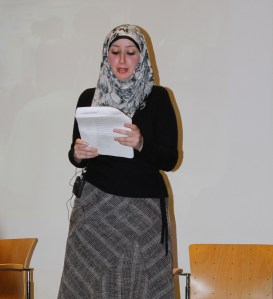
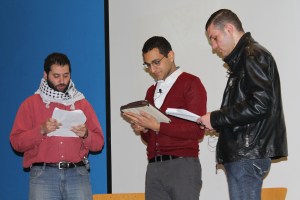
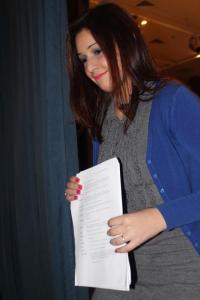
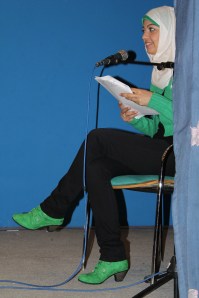
Three Wishes:  Ottawa Gladstone Theatre December 2008 

War from the eyes of a child – Education – New play focuses on Israeli-Palestinian conflict

Orléans Star 12-07-31 11:56 PM Published on December 5th, 2008

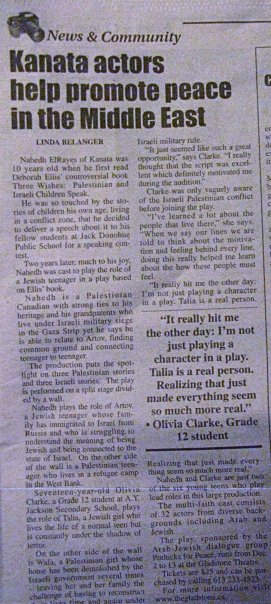
Divided by conflict and witnesses to violence, Israeli and Palestinian children speak out about their fears, hopes and dreams in a new Ottawa play that features two east-end teens in leading roles.

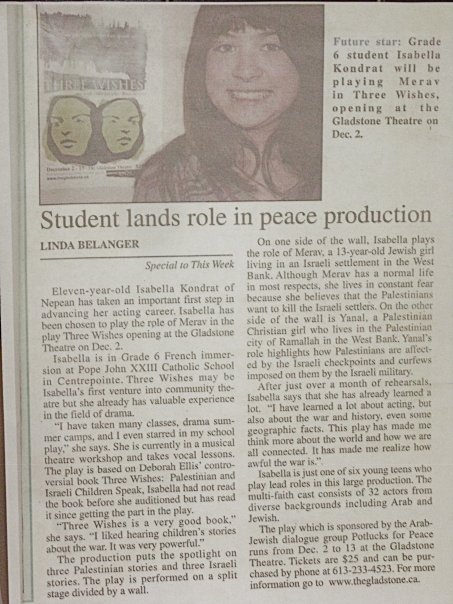
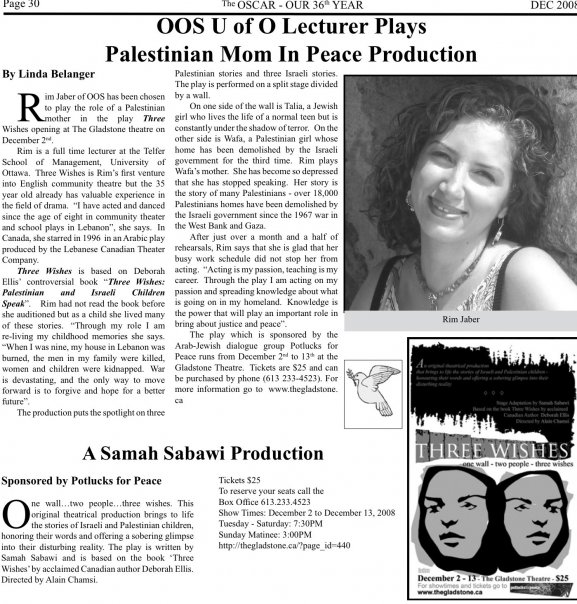
The stage adaptation of Deborah Ellis’ controversial book, Three Wishes: Palestinian and Israeli Children Speak, captures the honesty and straightforwardness only a child can share when the world around them is in turmoil. The production, written and produced by Ottawa’s Samah Sabawi and sponsored by the Arab-Jewish dialogue group Potlucks for Peace, puts the spotlight on three Palestinian stories and three Israeli stories. The play is performed on a split stage at the Gladstone Theatre, divided by a concrete wall topped with barbed-wire. It is on either side of this wall the lives of these children and their families unfold.

While every word in the play is lifted from the book, Sabawi has broken the dialogue up so a number of characters speak. For example, 18- year-old Hassan’s narrative has been cut so his family also shares in the storytelling. “It’s more like a conversation,” Sabawi explains.

Colonel By’s Kiera Polak, 15, plays the role of Yanal, a 14-year-old Palestinian girl. “I’ve learned a lot through the play,” she says, noting children in the Middle East have gone through hard times and want things to be fixed.

Meanwhile Orléans resident Dergham Shahrouii plays Hassan, who lives in a refugee camp in the West Bank. Injured by Israeli shelling, Hassan is confined to a wheelchair. On the other side of the wall is Artov, a Jewish teen whose family immigrated to Israel from Russia and is struggling to understand the meaning of being Jewish and being connected to the state of Israel. “These kids talk about the simple, human need to live a normal life,” Sabawi says of the interviews from the book. “(They talk about) how conflict affects their life at a personal level.”

The book, she continues, is “very compelling. These are real stories and real experiences.”

Sabawi read the book about three years ago after her then-nine-year-old son read it and put together a speech for class. The kids in the book, she explains, are so honest – there’s no politics. “I just loved reading their words.”

The children’s book gained infamy in 2006 when the Canadian Jewish Congress questioned the inclusion of the book in the Silver Birch reading program. At least four school boards in Ontario, including the Toronto District School Board, pulled the book from their shelves. While some said the request to remove the book was about age-appropriateness, others indicated it was a political move.

Sabawi, who says parents are the best judge of what their children can take, doesn’t recommend the play for those under the age of eight. “The play is about kids in a conflict zone,” she explains. “This is serious stuff.”

Hoping to raise awareness with her production, Sabawi notes that people tend to discuss the conflict in “grown-up” terms with maps, statistics and borders. The conversation is distant and sometimes the human cost is forgotten, she continues. “The Middle East is not about angry men or Paris or fights between extremists,” Sabawi says. “People live there and their stories need to be told.” “Three Wishes” runs until Dec. 13 at the Gladstone Theatre, 910 Gladstone Ave. Tickets are $25 and can be purchased by phone at 613-233-4523 or online at http://www.thegladstone.ca


The Real News on repression and cultural resistance in Gaza with footage of Tales of a City by the Sea’s public reading

What hope sounds like: a performance by Gaza’s children at the Gaza Music School

The children of the Gaza Music School performing to a French and Egyptian delegation early January 2013. The boys in this clip are around 9 years of age. According to Qattan Foundation’s website, the Gaza Music School (GMS) was established “in response to growing demand for music education voiced by children and parents who attend the Qattan Center for the Child (QCC) in Gaza City, one of the A. M. Qattan Foundation’s main projects.” The Gaza Music School was completely destroyed by Israel during its attack on Gaza in 2008 and was rebuilt since then. A testimony to the resilience of the Palestinian people. To find out more information about the school and Qattan Foundation visit the following linkhttp://www.qattanfoundation.org/subpage/en/gms.asp?sectionID=654


“So, while I am happy to have experienced and to write about all the vibrancy in Gaza, I can’t gloss over how all-pervasive the siege is, how it impacts almost every aspect of people’s lives. ”

ZazaFL's avatarzazafl

(These are thoughts, some fully formed – many rambling, most disjointed. It is a bit all over the place, but it is what I have for now.)

Gaza has been on my mind, in my heart and in my plans for years- like all of Palestine. But I never could quite get there. My first time in Palestine coincided with the pull out of the settlers from Gaza so I couldn’t go. Since then I’ve tried to march there (Gaza Freedom March) and sail there, along the way meeting detention, sabotage, kidnapping and imprisonment. So this time was to be straightforward – permission secured from the Egyptian authorities….  After some wonderful days in Cairo wandering around, seeing the changes from being there during the Mubarak regime, when thousands of police and soldiers were deployed to stop a solidarity action with our Palestinian sisters and brothers in Gaza, chatting to, and…

View original post 1,984 more words

Gaza audience feedback following the public reading of Tales of a City by the Sea

Photo Gallery: Gaza public reading of Tales of a City by the Sea

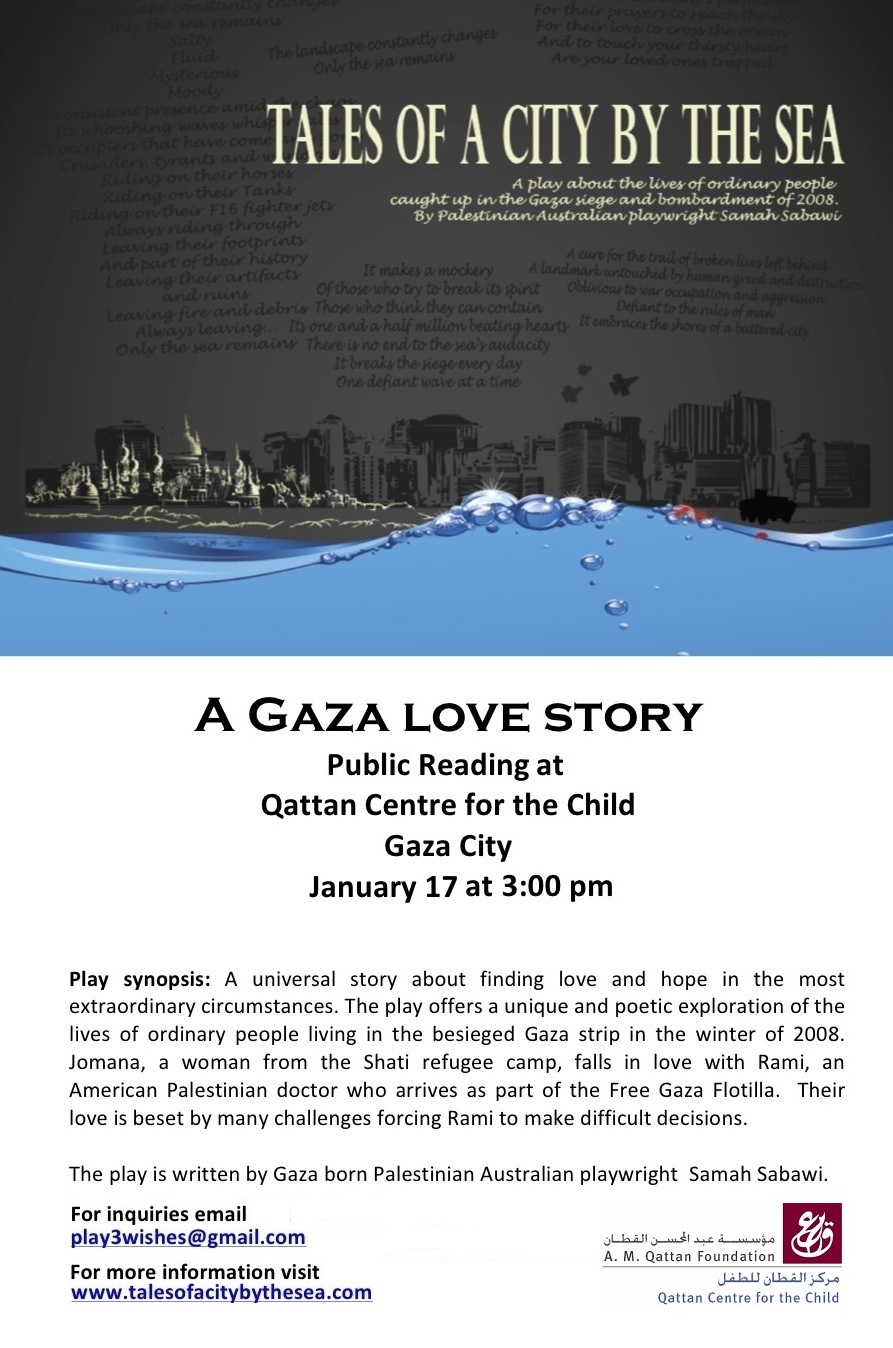
A reading of the play Tales of a City by the Sea took place in Gaza city at the Qattan Centre for the Child followed by a discussion on January 17th  2013.   The reading was part of ongoing efforts by international artists to break the cultural siege of Gaza and to work collaboratively with local talent.  What resulted from this event was a profound experience for both the writer, the cast and the audience.  The audience feedback (video will be uploaded next week) highlighted the need for creating more space for cultural and artistic events in the besieged Gaza strip.

The Gaza team from left: Khaled Harara, Eman Hilles, Sameeha Olwan, Ayman Qwaider, Mohammed Ghalayini, Manar Zimmo, Alaa Shoublaq, Samah Sabawi, Mahmoud Hammad, Najwan Anbar, Alia Abu Oriban and Ayah Abubasheer.

Sameeha Olwan

Sameeha Olwan reading the part of Jomana.

From left: Mohammed Ghalayini, Ayman Qwaider and Mahmoud Hammad

From left Mohammed Ghalayini reading the part of Rami, Ayman Qwaider reading the part of Ali and Mahmoud Hammad as Mohanad.

554355_10152424530600562_1359321734_n

Manar Zimmo reading the part of Lama.

From left:  Mahmoud Hammad, Alaa Shoublaq, Mohammed Ghalayini and Ayman Qwaider

From left:  Mahmoud Hammad as Mohanad Alaa Shoublaq as Abu Ahmed, Mohammed Ghalayini as Rami and Ayman Qwaider as Ali.

Eman Hilles

Eman Hilles was the narrator of our Tales.

Mohamad Akilah

Gaza esteemed musician Mohamad Akilah.

Najwan F. Anbar

Najwan Anbar reading the part of Um Ahmed

In Gaza Tales of a City by the Sea at Qattan Centre for the Child

FinalPoster

Israel’s Gaza Bantustan

First published on AlJazeera

Israel’s one state reality greeted us at the gates of the Gaza-Rafah crossing when we were asked by the Egyptian officer to present our Haweyah (Palestinian IDs) in order to be allowed through. It is not like we weren’t expecting this request, we knew that it would come down to this even though our Australian passports clearly showed Gaza as our place of birth we were still not considered Palestinian nationals in our own home city. Rather, we were treated like foreigners who needed an almost impossible amount of bureaucratic red tape designed to discourage the likes of us of ever thinking of visiting loved ones back home.

Allow me to explain: Since Israel’s establishment it has used the system of ID cards to differentiate between its Jewish and non-Jewish residents and citizens, a distinction needed in order to apply its apartheid discriminatory policies of separate and unequal treatment. When Israel occupied Gaza and the West Bank in 1967, its Interior Ministry began to also issue ID cards to the Palestinians in the Occupied Territories. By 1982, Israel passed the Identity Card Carrying and Displaying Act requiring all residents of Israel both inside its 1948 borders and inside the green line in the Occupied Territories, who are over 16 years of age, to carry at all times these ID cards and to present them upon request to the authorities.

Israeli citizens’ ID cards come in blue plastic casing with the Israeli Coat of Arms on the outer cover. Palestinians prior to the establishment of the Palestinian Authority had orange casings in the West Bank and red casings in the Gaza Strip both with the IDF insignia embossed on the outer cover highlighting Israel’s military control. Palestinians in the Occupied Territories who were forbidden entry into Israel’s 1948 borders had green casings.


After the establishment of the Palestinian National Authority and as part of the creation of the illusion of progress, the Palestinian National Authority was handed some limited inconsequential powers. These included issuing Palestinian residents with ID cards. A pointless exercise given that the power to issue these cards hinged on Israel’s approval, which was selectively given. Not only that, Israel continues to this day to control the Palestinian population registry and to assign the actual ID numbers provided for the Palestinian ID cards; the all-important cards required to enter Gaza and the West Bank.

Much has been written about how the system of ID cards is used as a weapon to further cement the fragmentation of the Palestinian population as it confines the Palestinians to their geographic Israeli-controlled Bantustans, forbidding Palestinians with Gaza IDs entry into the West Bank and Jerusalem and vice versa. But perhaps the worst and most insidious effect this system has is in the way it is designed to control and monitor the movement of all Palestinians and to curb the Palestinian population by denying their diaspora the right to come home even if for a short visit.

As we stood at the Rafah crossing, we were confronted with this reality. The Egyptian officer insisted that only Palestinians with the Israeli-controlled Palestinian ID cards are allowed to use this crossing. These orders are a result of an unforgivable move, one of many, that were made by the Palestinian National Authority when in 2005, Palestinian negotiators led by Mohammed Dahlan (a Fatah leader with strong links to Israel and the US) signed an agreement with Israel on movement and access from and to Gaza. One of the conditions they agreed to was restricting the use of the Rafah crossing to Palestinian ID card holders. It is hard to fathom why the Palestinian Authority would have agreed to such an inhumane condition which in reality means that Gazan residents would be cut off from loved ones in exile.

After seven hours of waiting at the Rafah border and after exhausting every connection, every phone number, every thread of hope and every possibility, we managed to make it through. Once inside Gaza, it became abundantly clear that despite Hamas’ visible presence inside the city and the endless waves of green flags, we had arrived into an Israeli controlled Bantustan. The currency used here is the new Israeli Shekel, the IDs all the residents carry are issued by the Israeli interior ministry, all births go through the Israeli national registry, the essential products are all Israeli in this captive market. As I type this to the sound of the Israeli F16 hovering in the sky above, and as I look at the sea patrolled by Israeli cruisers, I am convinced that I am now inside Israel’s one state reality in a Bantustan they call Gaza.

Samah Sabawi is a Palestinian writer and Policy Adviser to Al-Shabaka, the Palestinian policy network.  

Follow her on Twitter: @gazaheart

The Palestinian Circus: creative acts between reality and hope

Posted: December 21st, 2012 ˑ Filled under: .culture.theatre ˑ  No Comments

This post is also available in: Dutch

al.arte.magazine 

Over the last weeks, The Palestinian Circus School has been performing in Belgium in various locations, offering a show around the theme ‘Kol Saber!’ The travelling company of performers from Ramallah, Palestine differs from the traditional circus setting with the large tent and animal acts. However, classic circus acts such as acrobatics and tightrope walking do form a part of their show, albeit choreographed in a special way and embedded in a story. The young Palestinian people actually use the circus to tell their story to the world.

The Palestinian Circus School was established in 2006 by the Belgian Jessika Devlieghere and her Palestinian husband Shadi Zmorrod. The school teaches around 170 children and young people 9-27 years of age in different parts of the occupied Palestinian territories. Shadi Zmorrod is the former artistic director of the Jewish Jerusalem Circus and started the circus school when the circus refused to take in Palestinian children. The project is a form of cultural resistance against the occupation and the daily threats. The school aims to offer children a solid and safe haven where they can escape the depressing daily reality, just like a real circus family would do. A place that allows them to explore their creativity and develop social and psychological skills. An artistic world in which they can discover fun, embrace hope, create a positive self-image and learn to work in a team.

Kol Saber - © Veronique Vercheval

Kol Saber – © Veronique Vercheval

More than a school

Some of the early students became local trainers themselves in the basic techniques of acrobatics, juggling, trapeze, flower sticks, pois and clowning. They went on to tour refugee camps in the occupied territories with surprising performances. They also performed abroad, in France and Belgium. One of these trainers is Fadi Zmorrod. “I’ve never done anything like circus acts before I started. After three weeks of intensive training I was amazed at the physical capabilities I turned out to have. It’s therapy. I use it to release tension. ” Young students learning more about their culture, and how to trust others, makes the circus school more than just a school. “We went to other cities. The hardest thing I encountered were the many checkpoints, because they made me nervous. But I also learned more about my culture. We had to get rid of some old ideas like ‘men are stronger’ and ‘girls have more fun.’ For example , touching eachother is prohibited. We have to be physical but without touching eachother. The trust factor is also at play. Girls have less confidence. We learn about gender roles and empowerment. “

The youngsters needed something to look forward to in order to take life into their own hands. The circus school enables them to do just that, without having to live in constant fear. According to Noor Abu Rob, one of the young artists, growing up was difficult. “We only had the streets to live in and sometimes we couldn’t go to school because of a curfew. For me, circus is an open world. I can express myself better through the circus than through words. “

Kol Saber - © Lucia Ahmad

Kol Saber – © Lucia Ahmad

Kol Saber - © Veronique Vercheval

Kol Saber – © Veronique Vercheval

When they first performed in Belgium the shows theme was ‘Circus behind the wall’. The performance was based on the Palestinians’ daily lives, in which the notion of separation is central. The title refers to the wall that separates the Palestinian territories from Israel. The Palestinian Circus wants to teach the public about communication through juggling and clowning acts. This time around they performed their new contemporary circus production ‘Kol Saber!’. The production centers on the various realities of streetlife, a story of the ongoing challenge to escape the external power holding sway over their lives.

‘Kol Saber!’ literally means ‘Eat (the sweet fruit of) the cactus!’, but figuratively speaking ‘Eat patience!’, and tells the story of young people waiting for a change in their society. They try everything and keep believing in hope but finally have to accept the fact their lives will remain the same.

The 14 december show in the De Roma concert hall in Borgerhout was overshadowed by the death of the 17-year-old Mohammad Ziad Al-Salaymeh, one of the students of the Palestinian Circus School. He was shot and killed near a checkpoint by an IDF soldier on his birthday. Mohammad went out to buy a birthday cake and came under fire because the soldiers suspected him to be carrying a gun. Later the Israeli newspaper Haaretz reported he had been carrying a toy gun. That news devastated both performers and founders of the travelling company. Jessika Devlieghere held an emotional speech and the young artists dedicated the show to Mohammad al-Salaymeh and the many other innocent victims. It was not the first time that candles were lit. In 2008 they did the same, observing a minute’s silence. The young artists hope this is the last time.

Ahmad Abu Taleb - © Vince Buyssens

Ahmad Abu Taleb – © Vince Buyssens

Ahmad Abu Taleb (21) from Jenin has been performing in the Palestinian Circus for 4,5 years now. “For me, the circus is a way to tell my story and that of the Palestinian people in a creative way and to show it to the world. We recently lost our colleague Mohammad al-Salaymeh. No matter how many atrocities we experience, we will find the power to perform over and over again. Because for every Mohammad who dies by Israeli violence, we are performing even more passionately on stage.”

As has been said, the performance was far from a traditional circus show, but rather a profound story poetically told by means of dance and circus techniques like juggling, aerial acrobatics, balancing acts and jumps. With coats dancing for life, diverging and converging, fighting and living, in a tense context, until a mysterious coat falls from the sky and change the rules of the game. ‘Kol Saber!’ portrays the conflicting life between the bitter realities imposed by the occupation and the sweet and colorful dream of the bereaved sea.

Kol Saber - © Lucia Ahmad

Kol Saber – © Lucia Ahmad

The project gives the students a sense of dignity and is a way to prevent becoming a victim in a dehumanizing conflict, allowing them, on the contrary, to be proud to be Palestinian.

Artists: Ahmed Abu Taleb, Fadi Zmorrod, Mohammed Abu Taleb, Mohammed Abu Sakha and Noor Abu Rob
Directed by Shadi Zmorrod
Costume design: Fadila Aalouchi

More information: http://www.palcircus.ps/
Written by Malikka Bouaissa – Asma Ould Aissa

This article first appeared in al.arte.magazine 

Join Gaza Marathon: a 42-kilometre run along the coastline of the Gaza Strip.

Join us in April 2013 for the Gaza Marathon: a 42-kilometre run along the coastline of the Gaza Strip.

Organised by the UN Relief and Works Agency for Palestine Refugees (UNRWA), the marathon will host runners from the US, Europe and elsewhere, as well as the young people of Gaza.

Funds will go towards a special programme of fun summer activities for the children of Gaza, many of whom have been traumatised by the recent conflict.

Sign up today at unrwa.org/gazamarathon.

Gaza prepares for Christmas: “the people of Gaza cling to life…the smiles of the children attest to it … the happy mothers … the open shops, the noisy traffic…Gaza vibrates with life”

Posted on Dec 18, 2012 in DioceseSlide

GAZA – Traditionally, the Latin Patriarch of Jerusalem, His Beatitude Fouad Twal, visits the parish of the Holy Family in Gaza before Christmas.  He did this year on the third Sunday of Advent and celebrated Christmas Mass for the faithful in Gaza.  The communications team of the Latin Patriarchate was in Gaza three days early and met with the parishioners in anticipation of this visit.

This year, Christmas has a special dimension for Catholics of the Holy Family Parish in Gaza. In the three weeks since the end of the Israeli operation “Column of Defense,” the parish has seen the ceasefire as “a miracle.”  Patriarch Fouad Twal who went for the first time to Gaza since the ceasefire,  explained in his Sunday homily that “Christmas is a gift from Heaven, but the good will of men so that there may be peace is also needed.”  He also invited Christians “to live a strong faith”  in order to continue living in this Holy Land where the Holy Family passed during the flight to Egypt and to remember that “even Jesus suffered injustice.”  According to the parish priest, Father Jorge Hernandez, IVE: “the parishioners are very appreciative of this visit and it is also a little of Jerusalem that came here to them, and this touches them very much in their faith life.”  To thank all those who supported them with their prayers and their gifts during the war, the parish celebrated an official Mass of Thanksgiving. The pastor said “that they all know we have prayed for them.”

After yesterday’s Mass, the Patriarch, together with  Bishop Marcuzzo, Vicar inIsrael, as customary, met with the families for the exchange of Christmas greetings. The General Administrator of the Patriarchate, Fr. Humam Khzouz, who coordinated the entrance of the delegation to the Gaza Strip and the Chancellor, Fr. George Ayoub, were also part of the Patriarchal delegation.

The small Catholic parish of the Holy Family has exactly 185 faithful. Among the 1.6 million Gaza inhabitants, a crowded area of 360 sq. kilometers, there are 1,550 Christians (Greek Orthodox for the most part) now only half of the 3,000 in 2008.


Christmas, however, will be celebrated after the bombs.  So life goes on in Gaza. Eight days of mass destruction left  traces on houses, public buildings and schools. Along the roads are found several ruins as those of the football stadium where the stands collapsed after the stadium was struck by bombs. In the midst of the rubble, violence still resonates and on their faces “exhaustion is seen by the dark circles around the eyes” as Bishop Marcuzzo noted yesterday.

By this, we must recognize, the people of Gaza cling to life. The smiles of the children attest to it in front of our photo cameras, the happy mothers and the daring of their sons, the open shops, the noisy traffic. In fact, Gaza vibrates with life. Men, women, children confronted with violence, scarcity, the conservatism that strongly rules daily life, they suffer from a high unemployment rate (60% of the population) and from the weight of the days without some distraction. But the inhabitants here also live the joyful feasts and marriages. In the Catholic parish, for example, there are on average 1- 2 marriages and 3 – 4 baptisms a year.

Immediately after the ceasefire, the three Catholic schools of the Gaza Strip, which accommodate 1500 students of which the overwhelming majority are Muslims, organized the resumption of classes. The two Catholic schools of the Holy Family reopened their doors. The School of the Rosary Sisters instead had to wait until the following Monday in order to repair broken windows because of the explosions. “The winter cold was arriving and they needed to act quickly” says Sister Davida, Principal of the School. In this school where four Rosary Sisters serve, the principal tells of the resuming of classes: “many children made great effort to concentrate after thirty minutes of class. Some psychologists from Caritas came to help them restart by playing and singing. Restoring to a child the sense of security is a long process.”

The relentless drama continues in the interior of each person. Father Jorge Hernandez noted, together with the School Principal, different problems in children of school age. “When the bell announces the end of classes, when an airplane flies above their heads, some students are afraid” they explain. “Other children stay in small groups near the walls. They always have the behavior of war. They are afraid of the silence, of the grand silence.” The Pastor then says “In Gaza now, when a child begins school, he has already seen two wars. And he is not yet 4 or 5 years old.”


To these children born in war and who live in war, the parish proposes a pastoral life of prayer  and playful activity to help them grow “normally” in this little strip of overpopulated land that suffers the embargo by its neighbors. More than ever the religious communities that live in Gaza strain themselves to do everything to help the faithful of the parish, but also the Orthodox and the Muslims so that they catch again their breath after the recent events. The parish is supported by three sisters of the Incarnate Word Institute, to which the pastor also belongs as well as the new parochial vicar, Father Mario, who arrived just three weeks ago.

At their side work the Rosary Sisters and the Missionary Sisters of Charity of Mother Teresa, who are dedicated to disable children. Through “the festive oratorio”, children, parents and families can lead an almost normal life. There are some beautiful moments, the people come to develop themselves, to pray, to see each other and to play. So as in the streets of Gaza, also in the parish life resumes its rights, forgetting the daily problems of security, the health services but also the constant problems with electricity.

The parish is an island of life, where calm seems reestablished again, away from the images of a Gaza “ghost city”. Of course, they have rediscovered their life, but with an embargo. As the Patriarch has said on several occasions “the people of Gaza do not have a normal life. They live in an open-air prison.” On Saturday afternoon, before the arrival of the Patriarch, in the parish courtyard some youth were playing ball, the scout band had its rehearsals, the crib was ready, the Christmas tree decorated, the divan straightened up and the Sunday lunch prepared.  It is here that the Patriarch greeted the parishioners the following day, extending to them personally his Christmas wishes.

A mother of a family who welcomed us for Friday evening dinner said: “We will resume our daily life. It was really a very hard period, it was not easy, but with the children we are ready to celebrate Christmas. We need it to live well.” The Christmas tree, the crib, the imminent birth of a fifth child shows that there is life here. Right here! And in our parish we are preparing for Christmas with forgetting the sick and elderly persons. In the ten days that precede the Christmas feast, the pastor visits 4 elderly or sick (that is, 40 persons in all) each evening in the company of a small delegation of youth and the Sisters of the Incarnate Word. We shared in four of these meetings. The visitors, about fifteen, this evening, in the blue night of the Holy Land joined together in prayers and songs, distributing holy water and small gifts. Sometimes the priest administers the anointing of the sick. Father Jorge explains: “For three years, since I am here, I saw that this little round of visits interests many. In the beginning we started with five, now the movement has expanded. All the youth today want to participate. We are obliged to organize turns. During the year, we also distribute communion to the sick. At times it also happens that   2-3 scouts come along to offer their service.

On Tuesday, December 18, the Latin Church in Gaza expects 450 persons for the traditional “Christmas Concert” organized every years at this time of years in the context of the Baroque Music Festival, supported by the service of Cultural Cooperation of the French General Consulate in Jerusalem. On the evening of December 24, maybe some parishioners will have obtained permission from the Israeli authorities to go for Christmas Eve in Bethlehem. But all cannot have it. Those who remain in Gaza will welcome near the living crib His Excellency, Bishop Shomali, Auxiliary Bishop for Jerusalem who will spend Christmas Night in the company of the Parish faithful. And not only that… as many non-Catholics will come to rejoice at the coming on earth of the Prince of Peace and to pray with the pastor who has a message of Christmas:  “that the Savior may give His peace to the people of Gaza and especially to the leaders of the region. That He may also give us the strength to continue advancing.”

Christophe Lafontaine

Click here for more Christmas in Gaza images or go this link https://picasaweb.google.com/medialpj/LePatriarcheAGazaPourNoel2012#slideshow/5822930124911516418


Palestine Youth Orchestra: the sound of resistance

A comprehensive analysis of the arguments surrounding the call for a cultural boycott of Israel

By Samah Sabawi

This paper was prepared for the 7arakat Conference: Theatre, Cultural Diversity and Inclusion November  2012 and was first published in the 7arakat conference E:Proceedings. 

Introduction

International artists find themselves standing at a crossroad between their desire to support all forms of artistic expression, Israeli or otherwise, and the Palestinian civil society’s call to support a cultural boycott of all Israeli state sponsored forms of art. Some argue art and culture are apolitical and boycotting them is an infringement on freedom of expression.  They insist that art is a language of peace and building bridges. Others argue that culture and art are in fact political and can serve as tools of political propaganda and repression.  They highlight the responsibility of artists to affect change by raising awareness about political and social issues. In this paper, I will set out to explore the relationship between the culture and politics within the Palestinian Israeli conflict, while examining the arguments for and against the Palestinian Civil Society’s call for a cultural boycott of Israel.

Boycott Divestment and Sanctions – BDS

Confronting a failed peace process and a disappearing Palestinian state, and inspired by the South African movement to end apartheid, Palestinian civil society in 2005 set out to build a rights based grassroots movement that adopts a non-violent form of resistance based on international law and the universal declarations of human rights. They called on people of good conscience around the world to apply boycotts divestments and sanctions on Israel until Israel ends its occupation of Palestinian land, including East Jerusalem, and fulfills its obligations under international law toward the Palestinian refugees, granting full equality to the Palestinian citizens of the state of Israel. Endorsed by 170 Palestinian political parties, organizations, trade unions and movements representing Palestinians in the Occupied Territory, inside Israel’s 1948 boundaries, as well as in Diaspora, the 2005 BDS call represents the voice of the majority of Palestinian civil society and its three demands articulate a unified Palestinian vision that cannot be dismissed. The BDS call is now endorsed by hundreds of leading international human rights activists, including prominent figures such as Stephane Hessel (2010), co-author of the Universal Declaration of Human Rights and Holocaust survivor.

The Palestinian Campaign for Cultural and Academic Boycott of Israel (PCABI)

In 2006 the majority of Palestinian cultural workers, including most filmmakers and artists along with hundreds of international cultural workers and artists issued a unified statement in support of BDS. Today the list of artists who have publically joined the cultural boycott and have cancelled performances in Israel includes celebrities from around the world like Pink Floyd’s Roger Waters, Annie Lennox, Brian Eno, Devendra Banhart, Tommy Sands, Carlos Santana, Elvis Costello, Gil Scott-Heron amongst many others. The list also includes some incredible writers like Eduardo Galeano, Arundhati Roy and Alice Walker, as well as accomplished filmmakers such as Ken Loach and Jean-Luc Godard.

However, not all artists respond favorably to the boycott call. Some still choose to perform in Israel like pop icons Elton John, Madonna and Lady Gaga to name a few. These artists insist that performing in Israel is about promoting peaceful co-existence by bringing people together. They maintain that cultural events such as concerts are apolitical and should remain so. They complain that the boycotts single out Israel unfairly and that artists – according to Elton John – should not “cherry-pick” their conscious (“Elton John performs in Israel”). They also argue that boycotts are a blunt instrument that amounts to collective punishment of the Israeli people.

Is culture apolitical?

In order to understand the relationship between culture and politics within the Palestinian Israeli context it is important to review the history of Palestinian culture and the political challenges it has faced throughout the years of the Palestinian struggle for freedom.

In an article that appeared in Haaretz (15 May 2012) commemorating Nakba, Dr. Hanan Ashrawi described Palestinian society prior to Israel’s establishment in1948 as highly developed commercially, artistically and culturally. Its economic development was one of the highest in the Arab World and its high school enrolment was second highest with 379 private schools as early as 1914, and dozens of bookstores. In fact, Ashrawi wrote that between the years 1911 and 1948 Palestine had at least 161 newspapers, magazines and other publications and a vibrant cultural scene with cinemas, live theatres and musical concerts both by local artists as well as visiting giants like Egyptian icon Om Kalthoum and the Lebanese singer Farid Alatrash.

All of this was disrupted in 1948 when Israel was established on the ruins of Palestinian villages. Since then Palestinian culture became the target of a systematic and deliberate attempt at erasure by the Israeli authorities. For example, a story which broke out only this year on Al Jazeera titled “The Great Book Robbery” uncovered how during the process of establishing the state of Israel, librarians from Israel’s National Library accompanied the Israeli army into Palestinian homes after their residents were driven out and systematically took all the books that were left in these houses. The books included priceless volumes of Palestinian Arab and Muslim literature, including poetry, works of history, art and fiction. Thousands of these books were destroyed but some were added to the library’s collection and remain till this day in the Israeli National Library, designated, abandoned property – of course totally disregarding the fact that this property does belong to a people who were forced to leave and never permitted to return to their homes or to be reunited with any of their assets, including their books.

Another example of the politicization of culture in the Palestinian Israeli context is how British and then Israeli authorities often targeted not only Palestinian political leaders, but also artists and intellectuals, imprisoning them, banishing them into exile, and even assassinating them. Amongst the artists and intellectuals assassinated by Israel were writer Ghassan Kanafani (Abukhalil 2012) and poet and intellectual Wael Zuaiter (Jacir 2007). Also of great significance to this discussion is how during Israel’s invasion of Lebanon in 1982, Israeli forces looted and confiscated the accumulated national archives of the Palestine Liberation Organization, which included valuable and rare collections of films and other Palestinian cultural artifacts (IMEU 2012).

Israel’s attack on Palestinian culture continues today and takes many different shapes and forms. Palestinian artists in the occupied and besieged West Bank and Gaza suffer the same fate as all other Palestinians living under occupation. They are discriminated against, their movement is restricted, and their most basic human rights are denied. Israel does not distinguish between culture and politics. In 2005, when Former deputy director general of the Israeli foreign ministry, Nissim Ben-Sheetrit, launched the ‘Brand Israel’ campaign he admitted  “We are seeing culture as a hasbara toolof the first rank,and I do not differentiate between hasbara and culture” (Ben-Ami 2005). This was abundantly clear in the aftermath of Israel’s three-week bombardment of Gaza during the winter of 2008-2009. As the world witnessed in shock the incredible devastation and human suffering of an imprisoned 1.5 million people mostly refugees and half under the age of 18, Israel brushed off all criticism, blaming the outrage over its actions on bad public relations. Its solution to improve its image as revealed in a New York Times article (Bronner 2009) was not to address its record of violations, but to grant an extra $2 million from the Israeli Foreign Ministry’s budget to improve its image through “cultural and information diplomacy”. Arye Mekel, the ministry’s deputy director general for cultural affairs, was quoted in the article saying, “We will send well-known novelists and writers overseas, theater
companies, exhibits…This way you show Israel’s prettier
face, so we are not thought of purely in the context of war” (Bronner 2009).

Mekel’s quote is a perfect illustration of how, if you dig beneath the surface, you’ll find that many Israeli state sponsored events that may seem to be simply cultural and for pure entertainment purposes are in fact driving political agendas and whitewashing crimes similar to those committed in Gaza.  In fact, Israel goes so far in its manipulation of cultural events that it has made it a condition for artists who receive state funding to sign a contract stipulating they commit to “ promote the policy interests of the State of Israel via culture and art, including contributing to creating a positive image for Israel” (Laor 2008).  In other words, Israeli artists who are sponsored by the Israeli state are required to support the policies of the state in public and to remain silent on Israel’s discrimination and atrocities against the Palestinians. This was confirmed when Israeli pop music artist Idan Raichel admitted in an interview published on Australia-il.com (2008) the nature of the relationship between the state and its sponsored artists: “We certainly see ourselves as ambassadors of Israel in the world, cultural ambassadors, hasbara ambassadors, also in regards to the political conflict”.

Can cultural events bring people together?

Having established that culture in the Israeli Palestinian context is not apolitical and cannot be seen in isolation of the political environment, I’d like to move on to address the second argument made by opponents of the cultural boycotts who favor performing in Israel as a way to ‘bring people together’ and to promote ‘co-existence’ through joint Palestinian Israeli cultural projects.

First of all, let’s look at the benefit of the joint cultural projects. Will these joint projects pursue an agenda for justice and equality or will they bring two unequal sides together – an occupied and an occupier – and promote an illusion of symmetry? Projects that don’t aim to end Israel’s occupation and oppression of the Palestinian people only promote the normalization of the status quo. That is why increasingly more and more Palestinian artists are turning away from these joint ventures, often refusing to accept badly needed funds and the promise of fame and success, because they recognize that the price for participation – normalizing oppression – is too high to accept.

Secondly, the idea that a concert in Israel can bring Palestinians and Israelis together is absurd when one considers that millions of Palestinians who live under Israel’s military control are prevented by Israel’s apartheid policies from attending. To clarify, when concerts are held in Israel, Palestinians in the West Bank do not enjoy the same access to them as Jewish settlers living on land confiscated from Palestinians in the West Bank. In fact, even when cultural events take place inside the Occupied Territories, for example in Ramallah, Palestinians in other enclaves and Bantustans within the occupied territories or those who live in Gaza, or Palestinians who hold Israeli citizenships – are often not allowed to attend due to the hundreds of Israeli checkpoints in the Occupied Territories and tricky permit systems, all designed to fragment and control Palestinian society.

Israel’s system of apartheid and segregation touches every aspect of Palestinian life and excludes Palestinians from many opportunities that are afforded the Jewish people. This issue of exclusion was at the center of the controversy at the Shakespeare’s Globe Theatre, as international and local artists expressed dismay at The Globe for inviting Israel’s national theatre Habima to participate in the ‘Globe to Globe’ festival. A protest letter which appeared in The Guardian (29 March 2012) and was signed by an impressive number of celebrities, including first artistic director of Shakespeare’s Globe, Mark Rylance, Trevor Griffiths, Sonja Linden, and Emma Thompson, pointed to the fact that “…by inviting Habima, the Globe is associating itself with policies of exclusion practiced by the Israeli state and endorsed by its national theatre company”.

International artists have an ethical responsibility to address this issue of exclusion and discrimination, which is central to the reality of the conflict. The real questions artists need to ask themselves are: Do we want to promote a culture where we feel comfortable performing before an audience that is selected by way of racial privilege? Do we want to engage with Israeli artists who have committed by way of signing a legal contract to whitewash Israel’s system of discrimination and oppression? How can we accept the claim that concerts or cultural events can ‘bring people together’ when these events often work to promote and to support an existing system of discrimination designed to keep the people apart?

Protecting artistic freedom of expression

Israel has argued that the cultural boycott infringes on artistic freedom. While it is true that Israeli artists are free to express and share their art with the world, Palestinian artists face tremendous challenges with stifling travel restrictions, arbitrary detention, political repression and various roadblocks that get in the way of them holding rehearsals, exhibiting their work or even performing the simplest tasks, which becomes quite impossible under occupation.

Today, Palestinian artists and theatre makers are caught in an intricate and multi layered system of oppression. Take for example the Freedom Theatre in Jenin and the tremendous challenges they face. A Human Rights Watch report this year (27 July 2012) accused Israel and its perceived security arm the Palestinian Authority of  “trampling on the rights of Freedom Theater’s staff,” adding that  “[a] theater should be able to offer critical and provocative work without fearing that its staff will be arrested and abused.”

The HRW statement referred to Israel’s ongoing system of arbitrary arrests and detention and called for an investigation into allegations of mistreatment, raising the concern that since the murder of its director and co-founder, Juliano Mer-Khamis, in April 2011, the Israeli occupation forces have “repeatedly raided the theater and beaten and arbitrarily arrested employees”.

Israel’s occupation and system of discrimination infringes daily on the Palestinian artists’ freedom of expression.  So the question here is should Israeli state sponsored artists’ freedom of expression override that of the Palestinians? There is Hypocrisy to the Israeli claim that it does. In 1984Enuga S. Reddy, then director of the United Nations Centre Against Apartheid, responded to similar criticism about the cultural boycott of South Africa; the following is an excerpt of his press briefing published on the PACBI website:

“It is rather strange, to say the least, that the South African regime which denies all freedoms … to the African majority … should become a defender of the freedom of artists and sportsmen of the world. We have a list of people who have performed in South Africa because of ignorance of the situation or the lure of money or unconcern over racism. They need to be persuaded to stop entertaining apartheid, to stop profiting from apartheid money and to stop serving the propaganda purposes of the apartheid regime.”

Profiting from the occupation

But profiting from apartheid and serving its propaganda purposes is precisely what artists do when they cross what the Palestinian solidarity movement now calls the world’s largest picket line’ (Billet 2012).  Take for example Madonna’s Israel Peace Concert during which Madonna told her fans in Tel Aviv’s Ramat Gan stadium, “It’s easy to say I want peace in the world, but it’s another thing to do it”. Her recipe for peace was simple; she told her fans that “[i]f we rise above our egos and our titles and the names of our countries and names of our religions, if we can rise above all that, and treat everyone around us, every human being with dignity and respect, we will have peace” (Steinberg and Bronstein, 2012). But the reality is that Madonna’s peace speech was lost on the Palestinians, who were denied access to her ‘peace concert’ and who remain locked up behind Israel’s high walls and barbed wires.

More significant is the fact that Madonna’s so called ‘peace concert’, which gave lip service to peace, in fact was successful in promoting tourism in Israel, bringing in 4,000 tourists with some fans paying up to NIS 5,000 for VIP tickets and accommodation packages (Domke and Halutz 2012).  So in reality, the concert was great for Israel, its economy, its image and its institutions but did not do much for the cause of working toward creating a real environment for a peace with justice.

Singling out Israel

Some argue that boycotts single out Israel unfairly and that artists – as Elton John said  – should not “cherry pick” their conscious (Daily Mail 19 June 2010). Some Israeli artists feel that there is a sense of prejudice, as was expressed by Habima’s artistic Director Ilan Ronen:

We come to the Globe along with 37 countries and languages. And this is the only theatre, and the only language, that should be boycotted? Everything is OK in those other countries – no problem at all? Artists should not boycott other artists… I think, as an artist, that this is wrong. We should have a dialogue with everybody. We should discuss and disagree. (Tonkin 2012)

But Palestinians have every right to single Israel out for occupying and oppressing them, and to call for the help and the solidarity of the international community in a non-violent, peaceful form of resistance that is anchored in human rights and progressive liberal values. Ronen’s assertion that Israeli artists are unfairly singled out is also misleading. Unlike South African academic and cultural boycott, which was actually a “blanket” boycott, BDS does not target individualIsraeli academics, writers or artists. Israeli artists are welcome to cooperate with Palestinian artists as long as the projects they are working on together do not whitewash Israel’s occupation, ignore the inequality and discrimination against Palestinians or work to promote Israel’s softer side, while the state continues its gross violations of the human rights of the Palestinians. Israeli artists who receive Israeli state funding are in fact under contractual duties, as illustrated earlier, to do just that.   

Boycotts raise awareness

As this debate continues, it is important to note that even when artists choose not to abide by the boycott call, the controversy that surrounds their performances or their participation in Israeli sponsored events at times within itself serves to educate and raise awareness around the issues and creates opportunities for discussions and for constructive dialogue about what is going on in Israel/Palestine.

This was apparent here in Melbourne when the Boycott fever caught on with the Melbourne International Film Festival in 2010.  At the time, the makers of the film Son of Babylon, having realized that the Melbourne Film Festival was sponsored by Israel, tried to boycott the event. The film’s director Mohamed Al-Daradji and producers Isabelle Stead and Atia Al-Daradji demanded the film, a Palestinian co-production, not to be shown in protest against Israel’s “illegal crimes against humanity” (Quinn 2010).  The festival director Richard Moore declined the request and the film was shown as scheduled. However, this incident created waves of media coverage as most major news outlets and tens of bloggers around the world weighed in their opinion.  The controversy opened the gates to debate and discussions around Israeli actions and the ethics of the boycott movement. This was a refreshing change given that before the Boycott calls, Israel was only in the spotlight when a major event took place; often a suicide bombing, rocket attacks wars or massive bombardments.

Conclusion

Palestinian Civil Society’s call for a cultural boycott of Israel is a legitimate non-violent form of resistance that aims to put international pressure on the state of Israel in order to end its occupation and discrimination policies against the Palestinian people.  Neither Palestinians nor Israelis believe that culture is apolitical. Israel’s assault on Palestinian culture is well documented and its targeting of Palestinian cultural figures has been denounced by various human rights groups. Israel uses culture as a branding tool to promote its softer side and to whitewash its violations of the Palestinian people’s basic human rights. Palestinians also view their art and their culture through the prism of their struggle for freedom justice and equality. From erasure to resistance, Palestinian culture today is an expression of the Palestinian people’s story with all its dimensions, including the political. For Palestinians art is a form of resistance; theatre is political mutiny, dance is rebellion, and singing is liberation.

Works Cited

Abukhalil, As’ad. “Ghassan Kanafani: In Our Memory.” Alakhbar English. Web. 12 July 2012.

“An interview with Idan Raichel.” Australia.il.com. Web. Hebrew. 2008.

Ashrawi, Hanan. “Recognizing Nakba, reaching peace.” Haaretz. Web. 15 May 2012.

Ben-Ami, Yuval. “About Face.” Haaretz. Web. 20 Sept. 2005.

Billet, Alexander . “Madonna sings for apartheid; yet campaign to boycott Israel grows stronger.” Electronic Intifada ChicagoWeb. 12 June 2012.

Bronner, Ethan. “After Gaza, Israel Grapples with Crisis of Isolation.” New York Times. Web. 18 March 2009.

“Call for Academic and Cultural Boycott of Israel.”  Palestinian Campaign for Academic and Cultural Boycott of Israel [PCACBI].  Statements. Web. 6 July 2004.

“Cultural Boycott: Statement by Enuga S. Reddy, Director of U.N. Centre Against Apartheid at a Press Briefing (1984).” Palestinian Campaign for the Academic & Cultural Boycott of Israel [PACBI]. Web. 11 January 1984.

Domke, Ronit and Avshalom Halutz. “Madonna draws 4,000 tourists to Israel for MDNA concert premier.”  Haaretz. Web. 29 May 2012.

“Elton John performs in Israel after string of other artists cancel appearances.” Daily Mail Online. Web. 19 June 2010.

“Fact Sheet:  Palestinian Culture: 64 Years Under Israeli Assault.” The Institute for Middle East Understanding [IMEU]. Web. 2 August 2012.

Hessel, Stephane. “Gaza Flotilla: Global Citizens Must Respond Where Governments Failed”. Huffington Post. The Blog. Web. 15 June 2010.

“Israel/Palestinian Authority: Theatre Group Hit From Both Sides”. Human Rights Watch. News. Web. 27 July 2012.

Jacir, Emily. “Material for a Film: Retracing Wael Zuatier.” Electronic Intifada. Web. 16 Jul. 2007.

Laor, Yitzhak . “Putting out a contract on art.” Haaretz. Web. 25 July 2008.

“Palestinian Civil Society Call for BDS.”  BDS Movement.  Statements. Web. 9 Jul. 2005.

Quinn, Karl. “Festival threatened over Israel link.” The Age. Web. 4 August 2010.

Steinberg, Jessica and Dani Bronstein.  “Madonna kept Tel Aviv crowd waiting ‘until she got her Gummi Bears’.” The Times of Israel. Web. 4 June 2012.

“The Great Book Robbery.” AlJazeera. Web. 24 May 2012.

Tonkin, Boyd. “Artists should not boycott other artists.” The Independent. Web. 28 May 2012.


Biography

Samah Sabawi is a writer, political analyst, commentator, author and playwright. She is co-author of the book Journey to Peace in Palestine and writer and producer of the plays Cries from the Land and Three Wishes. Sabawi is currently in the process of working on her third play Tales of a City by the Sea – a love story set against the backdrop of Israel’s bombardment of Gaza in 2008-2009.
Sabawi is a policy advisor to the Palestinian policy network AlShabaka and former public advocate for Australians for Palestine. Her past work experience include holding the position of Executive Director and Media Spokesperson for the National Council on Canada Arab Relations (NCCAR) and working as Subject Matter Expert (SME) on various countries in the Middle East’s cultural and political landscape for the Canadian Foreign Service Institute’s Center for Intercultural Learning.
Palestinian Art Organization based in Jerusalem announces initiation of work on Otherwise Occupied for the 55th Venice Biennial 2013

  palestinianpavilion_2013

Aissa Deebi & Bashir Makhoul
Otherwise Occupied
29 May–30 June 2013

Venice Biennale 2013
55th International Art Exhibition

Palestine has been occupied for so long it is no longer a spatio-temporal entity but a construction of the imaginary: a national designation that includes a far-flung diaspora, a huge population of refugees, as well as members of an indeterminate territorial authority under occupation and even a large number of Israeli citizens. There exist simultaneously no Palestinian state and many Palestinian states. It is the quintessence of Benedict Anderson’s classic formulation of nationhood as ‘imagined communities.’

Both artists, Makhoul and Deebi, were originally born inside the 1948 borders, in the margins of another state in their homeland and outside the occupied West Bank and the centres of contemporary Palestinian culture, and have immigrated to live elsewhere. In order to get closer to Palestine, to engage in new ways of thinking or imagining the nation, it is perhaps necessary to live at a distance from it.

Al Hoash is a Jerusalem based nonprofit Palestinian organization that seeks the development and elevation of the status of visual arts as a substantial and critical tool for communication, innovation, pleasure, free expression and national pride. Its work is based on the belief that the visual arts play a vital role in promoting the welfare, development and independent creative spirit of all people.

Al Hoash’s mission is to provide and sustain a knowledge-based platform for Palestinians to express, explore, realize and strengthen their national and cultural identity through visual practice. Visual culture can be utilized to analyze, research and explore the formation and transformation of our collective and individual memory in the process of producing identity.

wwww.thepalestinianpavilion.com

info@alhoashgallery.org

Australia VS Palestine Football Match 1939 مباراة فلسطين و استراليا

Amelia Smith's avatarAmelia Smith

3Originally published in Middle East Monitor

Four days before the ‘Refraction: Moving images of Palestine’ exhibition is set to open in London, curator Shaheen Merali is describing a video from the show by artist Khaled Jarrar. “He’s walking through where he lives, in the occupied territory, wearing a wet suit, flippers and a snorkel, hailing a taxi,” he explains. “For Jarrar, that is maybe an act of trying to escape a landlocked society. The surrealism of living under occupation.”

The exhibition is made up of pieces of work which are the artists’ individual reflections on Palestine, how they view and challenge chaos, war and massacre in the region. “This notion of refraction is that, for me, when light goes through something, it kind of changes direction, it takes on another set of values. Those values are to do with the artists, and how they see their world,” says Merali.

The…

View original post 877 more words

The war in Gaza: photographing the conflict

The Guardian

Associated Press photographer Bernat Armangué tells the story behind some of his images that have featured on front pages around the world in the last week

Palestinians flee their homes after an Israeli forces strike on nearby a sports field

Palestinians flee their homes after an Israeli forces strike on a nearby sports field

During this last Israeli offensive inside the Gaza Strip we were working 18 hours every day, non stop. We usually started at 5am taking pictures of the Israeli air strikes and rockets launched by Palestinian militants. At first light we would cover the direct consequences of these air strikes: destroyed buildings, bodies in the hospital morgues and funerals. In situations like this, there is no fixed agenda; reality changes every minute. It is the experience you have as a photographer and a certain level of improvisation that leads you to tell the story as well as you can and as fast as possible. Our working day finished late at night and then we would attempt to do normal things: eat, take a shower and try to sleep in between the air strikes.

You don’t decide what to photograph, you decide where not to photograph, which is always based on a hypothetical average of risk. There were certain areas that were constantly affected by bombs, which I avoided. My main priority was to show the life of the people in Gaza; I followed them in their houses, on the streets, to the morgues.

The way the people of Gaza face their reality is very different to my life. I guess I tried to transmit some of this through the pictures. In my job, I work with a team of journalists, photojournalists and TV crews. Everyone tells the same story in a different format. But specifically on the street I work with my colleague Majeed Hadman, known as a “fixer”. He helps me in everything; he’s half of my vision and my hearing and most importantly: he’s my friend.

Smoke rises after an Israeli forces strike in Gaza City by Bernat Armangue

Smoke rises after an Israeli forces strike in Gaza CityThis air strike (pictured above) was at around 6 in the morning. It’s just in front of our office building, which is why I had this close view. But due to the proximity of the explosion, it was complicated to shoot: we strongly felt the air-expansion caused by the blast, the extremely loud sound and obviously your heart accelerates a little.

A Palestinian man kisses the hand of a dead relative in the morgue of Shifa Hospital in Gaza City

A Palestinian man kisses the hand of a dead relative in the morgue of Shifa hospitalThis was the last picture I took that day. I spent most of the day taking photographs of Palestinian rescue workers recovering people under the rubble of homes – some of them alive, some of them dead. That day 11 members of the al-Dallu family were killed when an Israeli missile struck the two-storey home of the family in a residential area of Gaza City. Some bodies were recovered and brought to the morgue, so I went there to take some pictures. While I was there, another family came to check if it was true that one of their relatives had been killed. They cried, held his body and one of them kissed his hand while saying goodbye. It was a rare tender moment there.

A Palestinian woman is helped after being injured during an Israeli forces strike

A Palestinian woman is helped after being injured during an Israeli forces strike next to her houseIt was early in the morning and we heard an explosion nearby. We arrived at the scene (pictured above) and saw a woman injured by shrapnel. She was being helped to safety.

Palestinian mourners cry during the funeral of Salem Paul Sweliem during his funeral in Gaza City

Palestinian mourners cry during the funeral of Salem Paul SweliemMost of the population in Gaza are Muslim, but there is also a Christian community. A member of the family pictured above died of shrapnel wounds after an air strike. The photograph shows the family members leaving their house to attend the funeral mass.

A Palestinian man rides past a destroyed area after an Israeli airstrike

A Palestinian man rides past a destroyed area after an Israeli airstrikeThis building (pictured above) was destroyed during the night. It was aHamas government complex known as Abu Khadra. It is less than 100m from our office, so we literally jumped from our beds during the air strike due to the loud noise and the shaking of our building. I arrived at the scene at first light and started to take pictures. Donkeys are used a lot as transport in Gaza, and I guess this man was probably on his way to work.

Osama Abdel Aal is rescued after his family house collapsed during an Israeli strike in Tufah, Gaza

Osama Abdel Aal is rescued after his family house collapsed during an Israeli forces strike in the Tufah neighbourhoodThis picture shows Osama Abdel Aal moments after being rescued. His family house collapsed during an Israeli forces strike in the Tufah neighbourhood. The first thing he did was point and tell the rescue team that there were other family members buried beneath the rubble.

This article appeared in The Guardian Photography Blog

Palestine gallery to open in London

OneWorld Events

Londoners will soon be able to get off the tube at King’s Cross and walk into a Palestinian refugee camp.

They will be able to meet some of the 12,000 descendants of the 750,000 Palestinians forced to flee their homeland in the wake of the creation of the state of Israel in 1948.

The people of Shatila camp are squeezed into one square kilometre. The labyrinthine alleyways are plastered with posters and inscribed with graffiti and street art.

You enter the home of Mariam, a 90-year-old woman who is propped up in bed. She tells her family’s story, part of the story of the Nakba (The Catastrophe – the Palestinian displacement).

You can call in on Hassan, sitting in his shrine contemplating the history that has brought him here, fingering a string of blue prayer beads as he explains his eclectic collection of objects – Muslim and Christian, secular and religious, prayer beads, crucifixes, icons, clay pots and seashells, all illuminated by fairy lights.

Or you can meet three generations of the Al-Awwal family: Rasheed, 42, his mother, sitting regally in her armchair, and his son, Abdul.

All this is possible through an interactive touch-screen tour of Shatila soon to be unveiled at Europe’s first Palestinian gallery, which opens in October.
“Palestinian artists are not widely recognised,” says the gallery’s communications and events officer, Sami Metwasi. “They are isolated. This gallery will give them a chance to be presented to the world.”

He says the Palestinian image “has been polluted during the years of struggle and conflict”, and the exhibitions and activities will help highlight its people’s rich, diverse culture.

“It is always after others see the high quality of our art and culture that their respect for Palestine grows. We Palestinians are not just victims of injustice but a living culture worthy of admiration and respect.

“What is wonderful about it and about our people is that even under the most terrible circumstances of occupation, exile and war we have not only kept our cultural heritage alive but created new cultural output of such high quality to earn its place among world class modern art and culture.”

Another aim, he says, is to communicate with British culture, to build bridges and to give an opportunity to British people to explore Palestinian culture.

“We are not a traditional gallery with traditional divides and barriers between installations and users,” notes Metwasi. “Rather, we aim to use this modern space to bring people together and to bridge gaps between Palestinians and locals.”

It will also be a centre for Britain’s Palestinian community, estimated at 75,000.
The gallery’s original sponsor was the Prince of Sharjah, Sheikh Sultan al-Qassimi, who funded it through the London-based Palestine Return Centre. It is now an independent entity.

The gallery has already started work, with activities that include creative workshops for teenagers and, on 26-27 June, performances by a group of youngsters from a camp in Bethlehem who tell their stories through photographs, images and dance, “proving that talent can bloom in the most difficult conditions of life in exile and under occupation”.

* The Palestine Gallery, 21-27 Chalton Street, NW1. Tel: 0207 121 6190

Original article appeared here

Gaza 2012: Palestine’s Long Walk to Freedom

By: Haidar Eid

Published Wednesday, December 12, 2012

AlAkhabar English


The long walk to South Africa’s freedom is marked by two immensely tragic events: the Sharpeville massacre in 1960 and the Soweto Uprising in 1976, both of which led to the galvanizing of internal and international resistance against the apartheid regime. Ultimately, these events would lead to the long-called for release of Nelson Mandela and to the end of one of the most inhumane systems the world has ever seen.

Without Sharpeville and Soweto, among other landmarks towards victory over settler colonialism, South Africa would still be ruled by a minority of fanatic, white settlers claiming to fulfill the word of (their) God.

Palestine’s long walk to freedom has gone through similar harrowing events, beginning with the 1948 Nakba to the latest eight-day onslaught on Gaza.

In order to understand Gaza in 2012, one ought to trace its origin back to 1948. Two thirds of the Palestinians of Gaza are refugees who were kicked out of their cities, towns, and villages in 1948. In After the Last Sky, the late Palestinian thinker Edward Said argues that every Palestinian knows perfectly well that what has happened to us over the last six decades is “a direct consequence of Israel’s destruction of our society in 1948…”

The problem, he argues, is that a clear, direct line from our misfortunes in 1948 to our misfortunes in the present cannot be drawn, thanks to “the complexity of our experience.”

At 139 square miles, Gaza is the largest refugee camp on earth, a reminder of the ongoing Nakba. The inhabitants of Gaza have become the most unwanted Palestinians, the black heart that no one wants to see, the “Negroes” of the American south, the black natives of South Africa, the surplus population that the powerful, macho, white Ashkenazi cannot coexist with.

Hence the calls to “flatten” Gaza and “send Gaza back to the Middle Ages.”

In 2008-9, Gaza was bombed by Apache helicopters and F-16 jets for 22 days, killing more than 1400 civilians. As if that was not enough, Israel decided to return to Gaza in 2012 and repeat the same crimes in eight days, this time killing more than 175 civilians and injuring 1399. These are massive losses for a population of just over 1.5 million people.

Israel’s airstrikes, which damage essential infrastructure and terrify the civilian population, are a form of collective punishment against the Palestinian people. Even more, they are war crimes forbidden under international humanitarian law, specifically the Geneva Conventions.

Yet Israel consistently gets away with war crimes. The official, government-based “international community” does not seem interested in the suffering of the native Palestinians. The much-admired, “better than Bush” American president, Obama, thinks that “Israel has the right to defend itself.” The same right does not apparently apply to Palestinians.

Likewise, the British Foreign Secretary William Hague believes that Hamas is “principally responsible” for the current crisis, as well as the ability to bring it most swiftly to an end. This is in spite of the deadly siege imposed on Gaza for more than five years, so much so that Israel even used calorie counting to limit the amount of food that entered Gaza during the blockade.

The fact that Palestinians in Gaza are not born to Jewish mothers is enough reason to deprive them of their right to live equally with the citizens of the state of Israel. Hence, like the black natives of South Africa, they should be isolated in a Bantustan, in accordance with the Oslo terms. If they show any resistance to this plan, they must be punished by turning the entire Strip into an open-air prison.

Both the US and the UK display deliberate and unconscionable ignorance in the face of the brutal reality caused by Israel to Gaza. As a result of Israel’s blockade on most imports and exports and other policies designed to punish Palestinians, about 70 percent of Gaza’s workforce is now unemployed or without pay, according to the UN, and about 80 percent of its residents live in grinding poverty.

But don’t Obama and Hague know this?!

As Hamid Dabashi put it:

Obama is fond of saying Israelis are entitled to defend themselves. But are they entitled to steal even more of Palestine, terrorise its inhabitants and continue to consolidate a racist apartheid state…? Was South Africa also entitled to be a racist apartheid state, was the American south entitled to slavery, India to Hindu fundamentalism?

The only option for Palestinians is to follow the same route as the South African struggle. The South African internal campaign aimed to mobilize the masses on the ground rather than indifferent governments around the world. What hope could they have gotten from the likes of Margaret Thatcher, Ronald Reagan, and Helmut Kohl? It was left to ordinary South Africans and global citizens to show their moral rejection of crimes committed by the ugly apartheid system.

In South Africa’s long walk to freedom, there was no compromise on respect for basic human rights. Apartheid’s attempts to point fingers at “black violence” and “intrinsic hatred” toward Western civilization and democracy, did not hold water.

Similarly, international civil society, and some governments, have seen through Israel’s propaganda campaign where the aggressor is turned into the victim. Across the years, Palestinians have been completely dehumanized. Instead of Reagan and Thatcher, we have Obama and Hague, blaming the victim and condemning resistance to occupation, colonization, and apartheid.

But South Africans did not wait for the American administration to “change its mind.” The global BDS campaign, steered by South African anti-apartheid activists, coupled with internal mass mobilization on the ground, was the prescription for liberation, away from the façade of “independence” based on ethnic identities. Similarly, the Palestinian call for boycott, divestment, and sanctions has been gathering momentum since 2005. Gaza 2012, like Soweto 1976, cannot be ignored: it demands a response from all who believe in a common humanity.

Gaza 2012 has, undeniably, given a huge impetus to this process by making all Palestinians inside and outside of historic Palestine realize that “Yes, We Can!” We are no longer the weaker party, the passive victim who does not dare bang on the walls of Ghassan Kanafani’s trunk in Men in the Sun, but rather Hamid in All That is Left To You, the Palestinian hero who decides to act.

Haidar Eid is Associate Professor of Postcolonial and Postmodern Literature at Gaza’s al-Aqsa University and a policy advisor withAl-Shabaka, the Palestinian Policy Network.

Original article appeared here https://talesofacitybytheseadotcom.wordpress.com/wp-admin/post-new.php