Gaza’s Ark: A bid to break Israel’s blockade… from within

GAZA CITY: Palestinian labourers and foreign activists are working tirelessly to transform a large fishing boat into “Gaza’s Ark” with the aim of exporting local produce in the latest bid to break Israel’s blockade on the coastal strip.

The Ark, which is being fitted out to carry goods and more than 100 passengers, is near completion and is expected to set sail for Europe in the latest high-profile attempt to challenge Israel’s maritime lockdown on the tiny Hamas-run territory.

If they are successful, this will be the first time goods from Gaza have been exported by sea since the signing of the 1994 Oslo Peace Accords.

Significantly, this attempt to alleviate the effects of the seven-year blockade comes from within Gaza, where locals refurbishing the 24-metre-long (78 feet) vessel want to take matters into their own hands, rather than waiting for help from the outside world.

“This will help fishermen, farmers and factory workers in Gaza to market their products,” said Abu Ammar Bakr, who was a fisherman for 40 years before turning his hand to repairing boats.

Mohammed Abu Salmi, who owns a furniture shop, was equally buoyed by the prospect of shipping products overseas.

“Export by sea will resuscitate farming and light industry in Gaza and will ease unemployment… and help to lift this oppressive blockade,” he told AFP.

“We have great experience and produce great furniture,” Abu Salmi boasted.

“We exported to Israel and from there to Europe before the blockade, and people abroad are asking for our products,” he said, pointing proudly at the dining tables and chairs fashioned in his workshop.

Among the items which are to be carried on board for export are fruit and farm produce, furniture, embroidery and other crafts, organisers say.

“The aim is not aid or humanitarian like the boats that were coming to Gaza, it’s a commercial venture to support the Palestinian economy and pave the way to exporting Palestinian products,” project manager Mahfouz Kabariti said.

But a sense of apprehension marks the preparations.

A plaque at the entrance to the quay on which the Ark is being built remembers the nine Turkish activists who were killed in May 2010 during an Israeli raid on a six-ship flotilla trying to reach Gaza in defiance of the blockade.

Although the international outcry which followed the deadly raid forced Israel to significantly ease the terms of its blockade on Gaza, which was first imposed in 2006, tight curbs remain in place on exports and travel.

Breaking the siege ‘from within’

Under the terms of the current restrictions, Gaza fishermen are not allowed to enter waters more than six nautical miles (11 kilometres) from the shore, with naval patrol boats known to fire on those who step out of line.

It is the prospect of a confrontation with Israeli forces that is worrying some of those planning to join the boat on its blockade-breaking mission, with Abu Salmi afraid the navy might “open fire and sink the Ark, or arrest those on board like they did in 2010 and seize the goods”.

Organisers of the project are unsure what action Israel might take.

“I hope Israel won’t stop the boat from sailing to European countries,” said Kabariti.

“It is natural that the Israeli authorities might not allow a boat to set sail from Gaza. But we want to send our message to the world, whether the occupation allows it to sail or not,” he said.

“We want to draw attention to the blockade which is preventing Palestinian products from being exported, and we have an ark that we can use to do it.”

Among those planning to join the Ark on its maiden voyage are a number of foreign activists, who include Swedish national Charlie Andreasson who also took part in the ill-fated Freedom Flotilla of 2010.

The aim, said Andreasson, is “to break the siege”.

“Why would they stop it?” he asked, somewhat naively.

“We’ve been sending ships to Gaza to try to break the siege, and this time we are turning it around and sending a ship from Gaza out to Europe with goods — so we’re trying to break the siege from within,” he told AFP.

Andreasson has been working on the project since early June, when activists managed to raise enough money from European donors to buy up the old fishing boat.

From its purchase to completion, including labour, Gaza’s Ark will have cost an estimated $150,000 (114,000 euros), with its website showing that so far, $110,000 has been raised.

Dozens of people are working to restore the Ark, with local fishermen receiving a salary for their labour and foreign activists volunteering.

The project’s mission statement, according to the website, is to “challenge the illegal and inhuman Israeli blockade”.

For fisherman Bakr, it would be a huge blow if the Ark — which will sail under the Palestinian flag as well as several international ones — never left port.

Fisherman and factory workers would have to watch their goods “festering in warehouses because they’re unable to export them”, he said.

This article first appeared here

London: Whole in the Wall first UK solo exhibition by Palestinian artist Khaled Jarrar

Yareah Magazine: This exciting body of work, which includes a new site-specific participatory installation, will be shown in London from 20 June – 3 August 2013.

Khaled Jarrar. Whole in the Wall. Ayyam Gallery London

Khaled Jarrar, Still image from video ‘Concrete’, 2012

Inspired by everyday events and experiences, Jarrar’s practice incorporates performance, video, photography and sculpture to document his observations on life in an occupied Palestine. The restrictions imposed on him and his fellow citizens have become the catalyst and subject of his occasionally satirical artistic output.
One of the highlights of the exhibition is an installation which will see Jarrar construct an imposing concrete wall extending along the length of the gallery; confronting the viewer immediately upon entering the space. In order to pass through the wall visitors will have to clamber through a hole shaped like Palestine – an allegory for the process endured by people crossing the apartheid wall in the West Bank in order to reach their homes in Palestine.
Alongside this installation, Jarrar will show a series of video works and new and recent concrete sculptures based on sporting paraphernalia: footballs, volleyballs, basketballs and ping pong rackets. These are formed from materials secretly chiseled by the artist from the separation wall. By making reference to the footballs left by the wall by children who use the area as a site for their games, and by repurposing this found material, Jarrar seeks to provoke a dialogue about possession and reclamation.
Other recent projects include Live and Work in Palestine (2011 – present) – an entry stamp Jarrar created for the ‘State of Palestine’, which he then stamped into the passports of tourists entering Ramallah. Designed to encourage a collaboration with his audience, the project enabled them to formally record their visit to a ‘stateless’ place – a symbolic gesture to interrogate the gap between an aspirational state and an actualised one. Jarrar has since performed this action in other countries, including the at the Pompidou in Paris and the Norwegian Nobel Institute in Oslo, as well as the 2012 Berlin Biennale; there Jarrar pointed to ‘Checkpoint Charlie’ as a key source of inspiration for the touring project.
A former captain of the Palestinian Presidential Guard, Jarrar is familiar with bureaucracy, politics, military discipline, and affairs of the state. This previous career informs his artistic practice, and much of his work has focused on the action of breaking free from disciplinary modes of being and subverting existing codes of conduct. Whilst explicitly addressing the ownership of land and displacement of people, Jarrar treads carefully but with authority, and offers a potent alternative account of life in an occupied Palestine.
This article appeared in Yareah Magazine

Palestinian singer from Gaza qualifies for Arab Idol final

Palestinian singer from Gaza city Muhammad Assaf is one of 12 Arab singers who have made it into the final round of MBC’s popular singing competition Arab Idol performing the Palestinian song ‘Ya Teir el-Tayir’, ‘Oh Flying Bird’. Video of his performance  (below) has gone viral with over one million viewers.

Seductively swaying Carmen the Gypsy Danced to a Palestinian Orchestra in Bethlehem

“With our music we represent Palestine. We say out loud the name of the country that many decided to deny its existence. The world thinks we don’t love life, but we do. We love life, music and we serve our country with our instruments.”

By: Malak Hasan

Palestine News & Information Agency – WAFA

BETHLEHEM, April 18, 2013 (WAFA) – Seductively swaying in her red dress wrapped around her slender body and rather dark hair carelessly resting on her pale shoulders, Carmen the Spanish gypsy emerged from Georges Bizet’s 1875 Opera Carmen to dance and sing about love accompanied by the Edward Said National Conservatory of Music (ESNCM) orchestra performed in the city of Bethlehem on Saturday.

Once the music began, the audience was captivated in the melodies of the violin, cello, flute, bass and drums played by young Palestinian and international musicians, and the Swiss singers whose voices brought closer the burning story of Carmen and her jealous lover, Don Jose.

Religion, country of origin, or language, all didn’t matter as the audience who was watching Opera Carmen only came for one reason: to witness the power of music in bringing together two different worlds and cultures on one stage.

With the Palestinian red and white kuffiya, the national scarf and head cover, resting on the shoulders of the Swiss St Michel Choir and the black kuffiya on the shoulders of some Palestinian musicians, the act was not only a celebration of the western and eastern harmony, art and music, but an expression of resistance and solidarity with Palestine.

While Carmen sang with her velvety voice, director and choir conductor, Philippe Savoy, explained, his enthusiasm evident, “We chose the red and white scarf because it carries the colors of the Swiss flag.”

The story of Carmen, which was originally written in French, doesn’t relate to the Palestinian people in the sense of the word. It is the story of a young Spanish woman who works in a cigar factory and dies at the hands of her rejected lover.

 Academic director of the Edward Said National Conservatory of Music, Michele Cantoni, who looked very calm yet eager before the performance, said “the significance of the act is to mainly show the quality of playing, teaching and talents here in Palestine.”

It wasn’t only to present the unique potentials of the young Palestinian musicians who try to live a normal life in abnormal conditions but also, says Cantoni, “to show this picture to those abroad who think Palestinians are different than any other people whereas they have the same kind of humanity, sensitivity and the same kind of capability, but unfortunately a certain kind of propaganda convinced the world that this is not the case.”

It is not always that an opera is performed in Palestine and this is exactly why such an act was well received. Even though the story and the language were foreign, it didn’t stop the audience at the Solomon Pools’ Convention Center from enjoying the fine act.

Nadin Baboun, a violinist with the ESNCM orchestra, said: “Everyone understands the language of the music. You don’t have to be a musician to sense the love, suspense, romance and drama.”

She explained, “With our music we represent Palestine. We say out loud the name of the country that many decided to deny its existence. The world thinks we don’t love life, but we do. We love life, music and we serve our country with our instruments.”

With words sang in broken Arabic, the St Michel choir closed their performance singing “Hadi Ard Jdudi… Filistinu, Filistinu” (This is the land of my ancestors… Palestine, Palestine); asserting in their own artistic way the Palestinian people’s right to live in their homeland and the land of their ancestors.

M.H./M.S.

This article first appeared here 
Palestinian-American composer and conductor George Bisharat and the Oakland East Bay Symphony in “Ya Way Li”

IMEU, APR 17, 2013 

url-5__2_.jpeg

The exile, fear and frustration of Palestinians expelled from their homeland will be brought to life through John Bisharat’s composed autobiography “Ya Way Li.” The piece, which is debuting April 20 with the Oakland East Bay Symphony in California, is part of the program, “Notes from the Middle East,” which brings together viewpoints of Palestinians, Egyptians and Israelis through music.

According to Bisharat, a Palestinian-American composer and conductor, “The piece tells the story of the fear and heartbreak my father, uncles and aunt endured during their struggle of being expelled from their homeland.” Bisharat’s uncle Emile wrote the poem “Ya Way Li” in Arabic and Bisharat composed the music with singers, percussionists and instrumentalists. “The text specifically reveals the Palestinian perspective. One of the lines is ‘and here I am a stranger in exile with no hope of ever returning to my origin,'” explains Bisharat. “This speaks to the issues of the right to return and the military occupation.”

The zourna, a woodwind instrument that plays three notes, is featured in the piece and was used by Bisharat’s father and uncles to gather their children. “It was a calling together of the family. It’s a personal note, and I decided to start and end the piece with it. It’s kind of the bookends to the piece.”

In addition to the instruments used in this piece, foot-stomping is also incorporated. The entire orchestra stomps their feet in unison to symbolize the frustration of the Palestinians. “There’s so much frustration, resentment and fear in the piece. It’s kind of a dark piece because it’s not a happy situation by any means. But it speaks to the fear and insecurity faced by Palestinian families, including my own.”

Bisharat created this music specifically for the program. He has written other Arabic music and enjoys working with other composers and musicians. “I love the idea of someone else improvising in a framework I have worked out as a composer and leaving a slot open for improvisation. You’ll also end up with something that is bigger and greater than what you would be able to do as your own. These musicians are bringing their own life experiences in every note they play.”

Born in Los Angeles, Bisharat’s mother introduced him to music. He attended UCLA’s Professional Designation in Film Scoring program and graduated in 1986, and has been making music ever since.

Bisharat has conducted The London Symphony Orchestra and The National Symphony Orchestra, among other international engagements.

Bisharat derives from a musically savvy family. Several of his family members are different types of artists. His brother and sister are both professional musicians and one of his uncles, aside from being a psychiatrist, was a violin crafter and another uncle played the flute. Bisharat’s wife is world-renowned concert pianist Louise Thomas. “I was lucky, I guess, to be born into a family of such talented, educated and artistic people, very warm and loving people.”

Read this article and much more on The Institute for Middle East Understanding website which offers journalists and editors quick access to information about Palestine and the Palestinians, as well as expert sources — both in the U.S. and in the Middle East. Read the IMEU Background Briefings. Contact IMEU for story assistance. Sign up for IMEU e-briefings.

The Economist: A theatre of protest “The Island” opened to packed audiences in Palestine’s Jenin refugee camp

ADAPTED from South Africa’s Robben Island, where Nelson Mandela was jailed under apartheid, to an Israeli prison cell, Athol Fugard’s play “The Island” has opened to packed audiences in the Jenin refugee camp on the Israeli-occupied West Bank. Confined to a concrete floor set in a sea of sand, two cellmates keep up their morale by rehearsing a production of Sophocles’s Antigone, in which a woman chooses to die rather than obey the king’s decree not to bury her brother, a political dissident. “You won’t sleep peacefully,” Antigone tells the king when he condemns her to death.

Despite its transposed setting, the play retains its poignancy. Almost every Palestinian on the West Bank has a brother, father or husband whom the Israeli authorities have, at one time or another, locked away. At present, 4,500 are behind bars. Jenin may have the highest rate of any town. Imprisonment has become a male rite of passage, as well as a place of higher education: many opt for distance learning at Israeli universities.

Ahmad Rokh, one of the actors in “The Island”, who has served four prison terms, was first put inside at the age of 14. The refugee camp in Jenin was a prime source of suicide-bombers during the second intifada (uprising) that lasted from 2000 to around 2005. Nearly a decade on, it has recovered a sense of humour. The audience laughs at the prisoners dressed in drag.

The theatre has had to overcome a troubled phase. Two years ago its founder, Juliano Khemis, a half-Palestinian, half-Jewish actor, was killed in circumstances that neither the Israeli nor the Palestinian authorities have explained. The Freedom Theatre has reopened its drama school after a hiatus of more than a year.

Though the number of Palestinian political prisoners has halved since the height of the second (and most recent) intifada, it is still twice as high as it was a dozen years ago. Those behind bars include hundreds of stone-throwers, 15 members of the Palestinian parliament and 170 people held without trial under “administrative detention”. The Palestinian Authority also runs its own prisons, where scores of leading members of Hamas, the Islamist group that rejects Israel’s existence, have been locked up.

When an Israeli production of the same play was performed at the Hasimta Theatre in Jaffa three years ago, the director, Alon Tiran, observed members of the audience leaving “in a different mindset from when they arrived”. He could not ask for more than that, he said. In Jenin, reactions have been more pronounced. “We are all Antigone,” says Ahmad Jbarah, better known by his nom-de-guerre, Abu Sukar, who attended the play’s opening. “The more the oppressor condemns us as criminals, the more heroic we are,” he says. Mr Sukar was in prison for 27 years for his part in a bombing in Jerusalem in 1975 that caused 15 civilian deaths.

This article appeared here

About Tales of a City by the Sea

The play Tales of a City by the Sea is a unique and poetic journey into the lives of ordinary people in the besieged Gaza strip prior to, during and after its bombardment during the winter of 2008.  Jomana, a Palestinian woman who lives in the Shati (beach) refugee camp in Gaza falls in love with Rami, an American born Palestinian doctor and activist who arrives on the first Free Gaza boats in 2008. Their love is met with many challenges forcing Rami to make incredible decisions the least of which is to take a dangerous journey through the underground tunnels that connect Gaza to Egypt.  Although on the surface this love story appears to explore the relationship between diaspora Palestinians and Palestinians under occupation, there is a broader and more universal theme that emerges – one of human survival and tenacity.  Tales of a City by the Sea avoids political pitfalls, ideological agendas and clichés by focusing on the human story of the people in Gaza. Although the play’s characters are fictional, the script is based on real life events and is a product of a collection of real stories the author Samah Sabawi and her family have experienced during the events of the past several years. Sabawi has written most of the poetry in the play during the three-week bombardment of Gaza in 2008/2009.

The writer Samah Sabawi is a Palestinian-Canadian-Australian published writer, commentator and playwright.  She has travelled the world and lived in its far corners, yet always felt as though she was still trapped in her place of birth Gaza.  The war torn besieged and isolated strip has  shaped her understanding of her identity and her humanity.  So what else could Sabawi do but to indulge in Gaza’s overwhelming presence and to succumb to tell the stories of her loved ones back home.  Her most recent play Tales of a City by the Sea is dedicated to them and to all of those who still manage to have faith and hope even as the sky rains death and destruction.

The script is available to interested theatre makers upon request.  Please email play3wishes@gmail.com for more information.

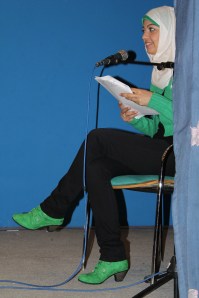
Ms. Sabawi speaking at the Launch of the The People's Charter To Create a Nonviolent World

Photo courtesy http://thepeoplesnonviolencecharter.wordpress.com/launch-events/

Follow Samah Sabawi on Twitter @gazaheart

Samah Sabawi’s professional bio can be found here

For more information on Samah Sabawi: http://en.wikipedia.org/wiki/Samah_Sabawi

Classical music moves into the camps of Palestine

Published March 23rd, 2013 – 07:00 GMT on AlBawaba
How often does one see pictures of brave Palestinian children facing up to Israeli soldiers and tanks, armed only with stones in their hands and often paying with their lives for daring to do so?

Ramzi Aburedwan was one such child, who grew up in the refugee camp of Al Amari near Ramallah. At the tender age of 8, he witnessed his best friend being killed during an Israeli military operation. He then found himself throwing stones during the first Intifada and as a street combatant Aburedwan seemed destined for an Israeli prison or a Palestinian martyr’s poster. But fate decided to intervene.

At 17, he was invited to a music workshop in Al Bireh, adjacent to Ramallah, where he fell in love with the art and started to learn to play the viola. Replacing stones with a musical instrument led to a journey of channelling his anger into creativity and of personal transformation.

After studying for a year at the Edward Said National Conservatory of Music (ESNCM) in Ramallah and thereafter attending a summer workshop in the United States — at the Apple Hill Centre for Chamber Music of New Hampshire — he enrolled at the Conservatoire National de Region d’Angers.

In 2000 Ramzi created the ensemble “Dal’Ouna”, music that symbolised the link between East and West. It flowed from an encounter between Palestine and France, from the melting of pure traditional Middle Eastern songs with mixed jazzy compositions, played on Western classical musical instruments (viola, violin, clarinet, flute, guitar, piano), and traditional Eastern instruments (bouzouk, oud, darbouka, bendir, etc).

In 2005, he was awarded the “DEM” gold medal for viola, chamber music and music theory. While in France, he also learnt to play the piano.

Yearning to share his knowledge and experience, and inspire a new generation of Palestinians, by helping their anger and frustrations find musical expression, Aburedwan established Al Kamandjâti (The Violin) in October 2002. It was to be the place where Palestinian children and youth could learn music and develop their culture.

In August 2005, Riwaq, the Palestinian architectural organisation engaged in conservation and rehabilitation, completed the renovation of the Al Kamandjâti Music Centre in the old city of Ramallah and it was here that Aburedwan launched his nonprofit musical enterprise, funded mainly by European donors.

Taking music to the people, Al Kamandjâti set up music schools for Palestinian children in various cities, villages and refugee camps. These music schools offer children the opportunity to learn to play music, to discover their cultural heritage as well as other musical cultures, but above all to explore their creative potential.

In addition, Al Kamandjâti produces numerous concerts and several music festivals throughout the year as part of its mission to bring music to all Palestinians.

Aburedwan explains the rationale: “Perhaps the least recognised effect of the violent Israeli occupation on the lives of Palestinian people is the undermining of culture, art and leisure. When a regime wants to weaken a people, it uses psychological, cultural and physical means. It attempts to erase tangible evidence of that people’s unique cultural heritage. Our struggle must be cultural and militant, artistic and political, and economic. But on no account should we forget the primary reason behind the projects and activities led by Al Kamandjâti, which is to educate children, who suffer most from the unjust politico-economic situation.

“We cannot afford to sit back and wait for favourable political decisions which would establish a Palestinian State,” he says. “We must proactively work on galvanising Palestinian cultural life. We must give our children the opportunity to think beyond soldiers and tanks. They must think creatively, not about the destruction of their country, but about rebuilding their way of life and future.”

In the West Bank, Al Kamandjâti today provides music training to around 500 students in places such as the Al Amari, Jalazon, Qalandiah and Qaddura refugee camps, the village of Deir Ghassana, the old cities of Ramallah and Jenin, and in Tulkarem.

Since 2005, Al Kamandjâti, with ten French musicians, has also organised annual music workshops in the Palestinian refugee camps of Lebanon, where, today, they have 60 students at Bourj el Barajneh and Shatilla.

In Palestine, Al Kamandjâti employs 22 musicians who teach violin, viola, cello, guitar, flute, clarinet, oboe, bassoon, trombone, trumpet, saxophone, piano, accordion, oud, nay, Arabic percussion, orchestra, singing, harmony, choir, improvisation and music theory.

“Music is a universal language,” Aburedwan says. “We encourage Palestinians to use this artistic tool to harmonise and enrich their cultural life, promoting international awareness and recognition of the Palestinian nation.

“Through music, Al Kamandjâti seeks to show that education and culture can transcend and overcome the Israeli violence from which Palestinians suffer,” he adds. “Learning music provides children with a form of expression to channel their energy creatively and constructively. Are not today’s children tomorrow’s adults? Classical music is, for the children, a discovery. We introduce each one to an instrument. Moreover, these workshops enable children to gather in a disciplined setting, whether as neighbours or friends or new acquaintances”.

Many young international musicians have been working at Al Kamandjâti, discovering music and a practical approach to mastering various instruments with Palestinian children. Jason Crompton came from New Jersey four years ago to visit his sister in occupied Jerusalem and after learning about Al Kamandjâti, he stayed on to teach piano and conduct the orchestra. He learnt Arabic to communicate with the children and eventually married a fellow teacher from Italy, Madeleine, who teaches the flute and also works with UNRWA schools in the refugee camps around Ramallah. They have a child and now live in Ramallah.

“The feeling of sharing in the musical experience with anyone who wishes to indulge is special and we believe that we belong here,” Crompton says.

Their story lends credence to the oft-held belief that music transcends both borders and barriers. At Al Kamandjâti, it has been an enriching experience for both the Palestinian children and the teachers of many nationalities.

Not only does Al Kamandjâti teach Palestinian children how to play music, it also teaches some of them how to repair, maintain and tune instruments.

Shehadeh, a young man who has been involved in setting up a local lute-making workshop, spent three months in Italy with stringed-instrument makers who had previously been to Palestine, learning to repair and make instruments. Today his workshop adjoins the Al Kamandjâti building in Ramallah.

Al Kamandjâti organises The Music Days Festival in June, in partnership with the French Cultural Centres Network. The festival lasts 12 days and takes place in more than ten Palestinian cities. A Baroque Music Festival follows in December and various churches in the cities of the West Bank and occupied Jerusalem host it.

Al Kamandjâti also engages in exchange programmes abroad with partner organisations. Some students have been given the opportunity to take part in music workshops abroad to improve their technical skills. Khalil, the coordinator, explains, “We had nine students who completed their scholarships in France last year — in violin, percussion, bass, clarinet and guitar, and two of them learnt how to fix string-section instruments.

“We have two blind brothers, Mohammad and Jihad, who today teach percussion and oud at the Helen Keller Centre in [occupied] Jerusalem,” he adds.

Today, Al Kamandjâti stands for Aburedwan’s transformation from a stone-pelter to a viola player and his dream of sharing his knowledge and experience with his people, bringing joy to the children growing up in refugee camps and under occupation.

This article appeared on http://www.albawaba.com/entertainment/palestine-camps-music-479027

Let Gaza surprise you!

By Samah Sabawi

20130122_115944

Gaza is one of the most reported on and yet least understood places on earth.  Its mere mention conjures up images of war victims, war criminals, piles of rubble, militants with guns, dead children and weeping mothers.  A simple google search will bring up disturbing images of heart break, terror and destruction.  But all of this is an infliction on a place that has neither surrendered its identity nor lost its beauty to decades of violent Israeli occupation.

Gaza is a city of many tales.  While some are about loss, grief and misery, many others are about enduring love, triumphant moments, tenacity, passion, music and hope that lives beyond the confines of the siege and the occupation.  If you dig deeper than the negative headlines and the devastating news reports you will find many pleasant surprises.  You can take a walk along Gaza’s gorgeous fields, enjoy its magical sunsets, get to know its warm people, visit its ancient sites and eat its delicious dishes.  You will find in Gaza everything that would make you love life with a passion!  So join me here to explore some of Gaza’s unknown side.

The Arts:

There is a common belief that Gaza’s art scene is all but dead.  While it may be true that art in general is not a great priority for the people in Gaza who are too concerned with bigger financial and political issues, Gazan artists continue to create and to excel in their fields.  There is also an appreciation of the need to encourage art in children starting from a young age.

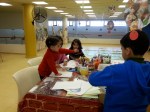
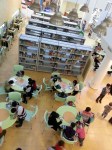
One establishment worthy of salutation for supporting the arts is the Qattan Centre for the Child in Gaza.  This cultural centre is an oasis for the hearts and the minds of children.  Equipped with a large library painted in vibrant colors and comfortable eye soothing furniture the QCC in Gaza focuses on developing the children emotionally and intellectually through visual art, music, education, cultural events and much more.

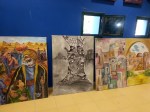
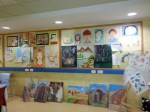
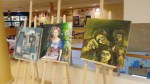
Below are some images of the QCC in Gaza.  Keep in mind all of the paintings you’ll see in some of these photos were in fact painted by children under 15 years of age at the centre.

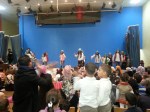
The Qattan center was built on land donated by the Gaza municipality and has succeeded in meeting its goal of creating an educational and stimulating space for children and their caregivers.  Parents are encouraged to join their children in the library, engage with them over art and craft activities, or just watch them proudly as they perform their song and dance routines.

Membership at the QCC is free of charge to all children in Gaza from all walks of life and some of the classes offered charge a small symbolic fee.  Many of the events are also free of charge such as the concerts captured in the video below that took place as part of the winter camp activities in January 2013.  In this video below you’ll see a variety of instruments, you’ll hear music of both Arab and western origins ranging from Gershwin to Darweesh.

Also worthy of special salutation is the Gaza Music School and its incredible teachers and talented children.  The children featured in the next video are nine years of age.  They are very dedicated to the art they practice in spite of all the challenges they face including Israel’s bombardment of the Gaza Music School  in 2009.


The landscape

The Gaza Strip is densely populated mostly by refugees who fled Israel’s war of ethnic cleansing in 1948 and have not been allowed to return to their homes since.  As the population continues to grow in the besieged strip the natural landscape changes to make way for more cement structures and buildings to accommodate this growth.

However, population growth is not the only challenge facing Gaza’s green spaces.  Agricultural land  is shrinking as Israel usurps more of Gaza’s water supplies and if that’s not enough, Israel’s siege, blockade, frequent bombardment and occasional land incursions have left their mark on many of Gaza’s farming land.  A recommended report that sheds great light on this is the UNISPAL report Farming without Land, Fishing without Water.

Below are two pics of bombed trees in our farm in Gaza. The first depicts a tree totally uprooted from the power of a one ton bomb blast.   The second photo  depicts a tree that was uprooted from the blast, flew in the air and actually landed straight on top of another tree.

Despite all of the challenges and the uncertainties of Israel’s incursions and bombings, some farmers have insisted on maintaining their land.  When visiting their farms you get a sense of what Gaza’s landscape looked like before Israel’s war of ethnic cleansing began.   You can imagine how before the refugees were chased into the far corners of their homeland to settle into camps under occupation, how most of Gaza’s natural landscape would have looked like.

The Sea

Perhaps the most important feature of Gaza is its sea.  It is the only landscape that remains unchanged, unaffected by the occupation and the aggression.  The sea is an open recreational space that is free of charge.  For Gazan families the sea is a cure for all of life’s problems.

The food

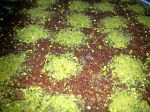
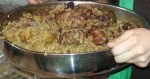
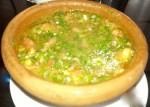
Finally, no matter where you go to in Palestine, you will always be overwhelmed with warm hospitality and great food.  Gaza is no different.  Here are some pics of some of my favourite dishes, but if you’re looking for a more comprehensive list along with recepies I highly recommend you visit The Gaza Kitchen.  Bon appétit or as they say in Gaza Saha we afya!

Video “Three Wishes: Palestinian and Israeli Children Speak Out”

Three Wishes in the Media

Three Wishes:  Ottawa Gladstone Theatre December 2008 

War from the eyes of a child – Education – New play focuses on Israeli-Palestinian conflict

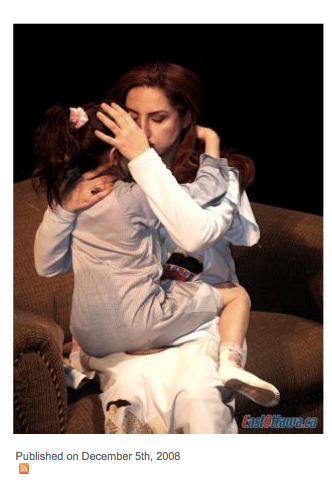
Orléans Star 12-07-31 11:56 PM Published on December 5th, 2008

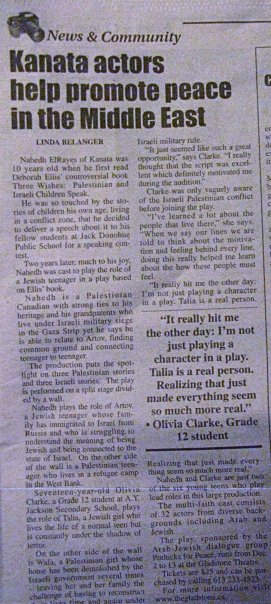
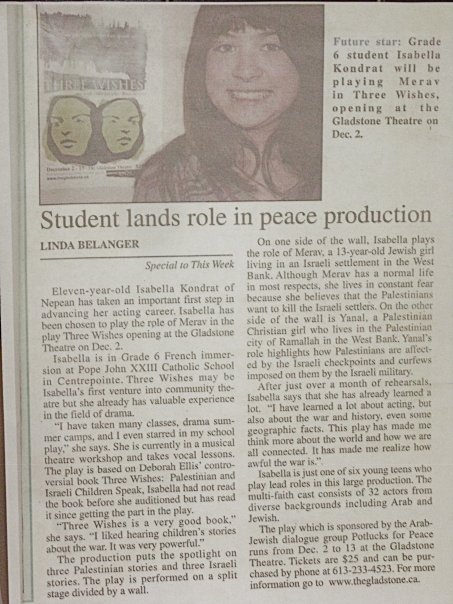
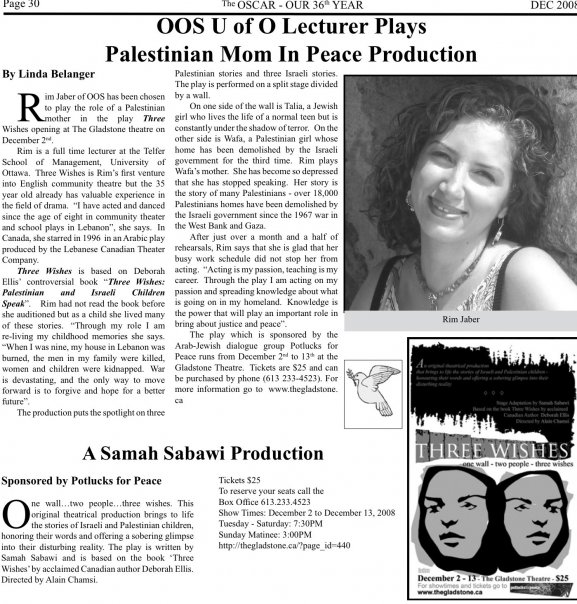
Divided by conflict and witnesses to violence, Israeli and Palestinian children speak out about their fears, hopes and dreams in a new Ottawa play that features two east-end teens in leading roles.

The stage adaptation of Deborah Ellis’ controversial book, Three Wishes: Palestinian and Israeli Children Speak, captures the honesty and straightforwardness only a child can share when the world around them is in turmoil. The production, written and produced by Ottawa’s Samah Sabawi and sponsored by the Arab-Jewish dialogue group Potlucks for Peace, puts the spotlight on three Palestinian stories and three Israeli stories. The play is performed on a split stage at the Gladstone Theatre, divided by a concrete wall topped with barbed-wire. It is on either side of this wall the lives of these children and their families unfold.

While every word in the play is lifted from the book, Sabawi has broken the dialogue up so a number of characters speak. For example, 18- year-old Hassan’s narrative has been cut so his family also shares in the storytelling. “It’s more like a conversation,” Sabawi explains.

Colonel By’s Kiera Polak, 15, plays the role of Yanal, a 14-year-old Palestinian girl. “I’ve learned a lot through the play,” she says, noting children in the Middle East have gone through hard times and want things to be fixed.

Meanwhile Orléans resident Dergham Shahrouii plays Hassan, who lives in a refugee camp in the West Bank. Injured by Israeli shelling, Hassan is confined to a wheelchair. On the other side of the wall is Artov, a Jewish teen whose family immigrated to Israel from Russia and is struggling to understand the meaning of being Jewish and being connected to the state of Israel. “These kids talk about the simple, human need to live a normal life,” Sabawi says of the interviews from the book. “(They talk about) how conflict affects their life at a personal level.”

The book, she continues, is “very compelling. These are real stories and real experiences.”

Sabawi read the book about three years ago after her then-nine-year-old son read it and put together a speech for class. The kids in the book, she explains, are so honest – there’s no politics. “I just loved reading their words.”

The children’s book gained infamy in 2006 when the Canadian Jewish Congress questioned the inclusion of the book in the Silver Birch reading program. At least four school boards in Ontario, including the Toronto District School Board, pulled the book from their shelves. While some said the request to remove the book was about age-appropriateness, others indicated it was a political move.

Sabawi, who says parents are the best judge of what their children can take, doesn’t recommend the play for those under the age of eight. “The play is about kids in a conflict zone,” she explains. “This is serious stuff.”

Hoping to raise awareness with her production, Sabawi notes that people tend to discuss the conflict in “grown-up” terms with maps, statistics and borders. The conversation is distant and sometimes the human cost is forgotten, she continues. “The Middle East is not about angry men or Paris or fights between extremists,” Sabawi says. “People live there and their stories need to be told.” “Three Wishes” runs until Dec. 13 at the Gladstone Theatre, 910 Gladstone Ave. Tickets are $25 and can be purchased by phone at 613-233-4523 or online at http://www.thegladstone.ca


The Real News on repression and cultural resistance in Gaza with footage of Tales of a City by the Sea’s public reading

https://www.youtube.com/watch?v=rQUzSHrLRBc

Gaza audience feedback following the public reading of Tales of a City by the Sea

Photo Gallery: Gaza public reading of Tales of a City by the Sea

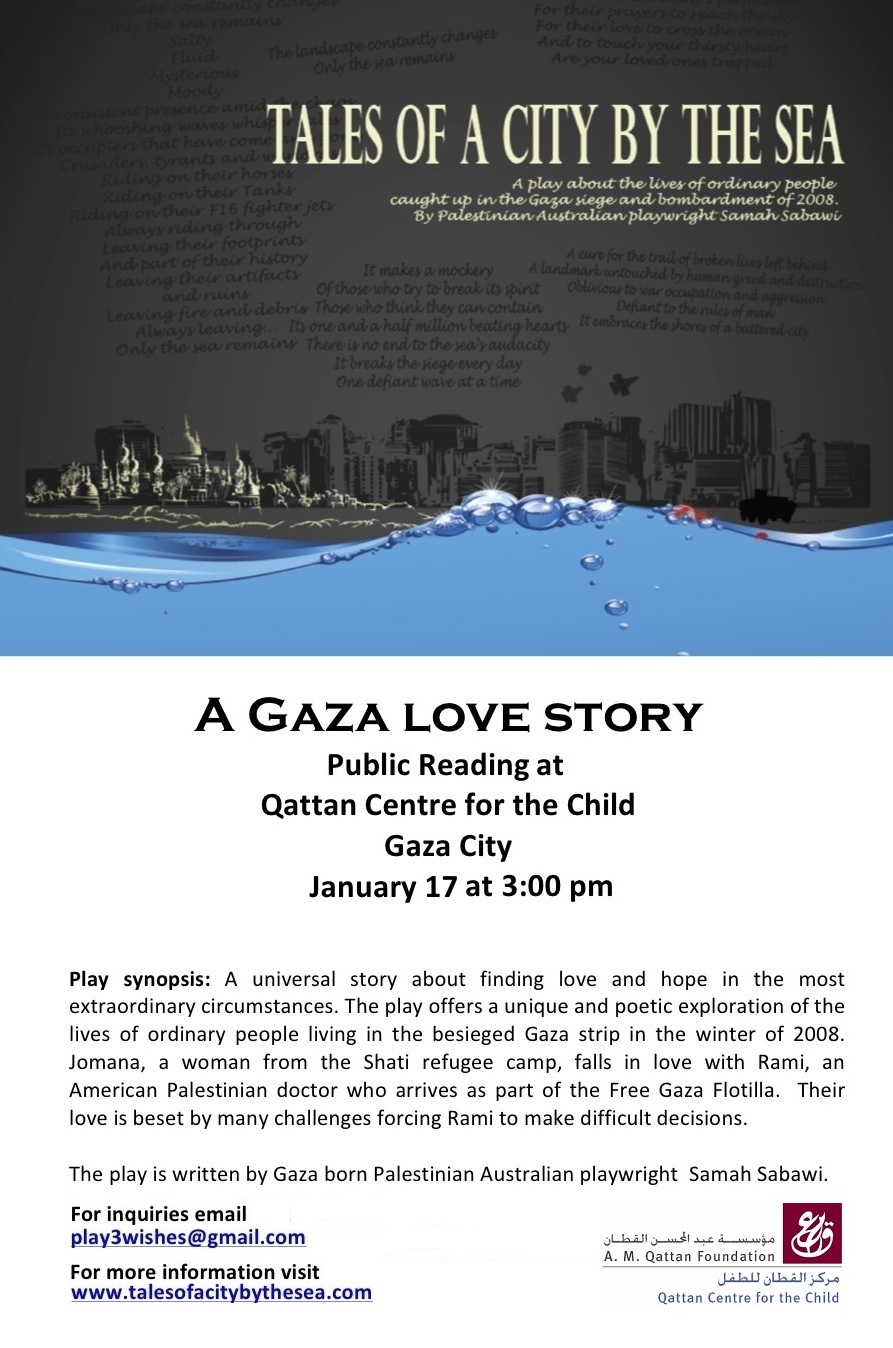
A reading of the play Tales of a City by the Sea took place in Gaza city at the Qattan Centre for the Child followed by a discussion on January 17th  2013.   The reading was part of ongoing efforts by international artists to break the cultural siege of Gaza and to work collaboratively with local talent.  What resulted from this event was a profound experience for both the writer, the cast and the audience.  The audience feedback (video will be uploaded next week) highlighted the need for creating more space for cultural and artistic events in the besieged Gaza strip.

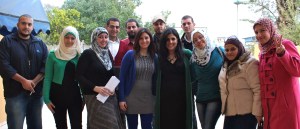
The Gaza team from left: Khaled Harara, Eman Hilles, Sameeha Olwan, Ayman Qwaider, Mohammed Ghalayini, Manar Zimmo, Alaa Shoublaq, Samah Sabawi, Mahmoud Hammad, Najwan Anbar, Alia Abu Oriban and Ayah Abubasheer.

Sameeha Olwan

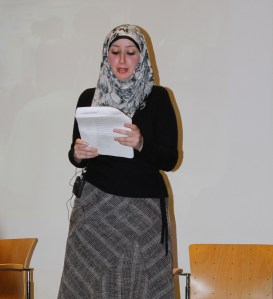
Sameeha Olwan reading the part of Jomana.

From left: Mohammed Ghalayini, Ayman Qwaider and Mahmoud Hammad

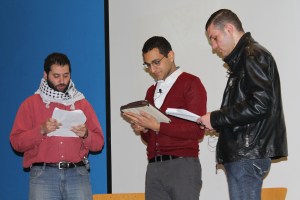
From left Mohammed Ghalayini reading the part of Rami, Ayman Qwaider reading the part of Ali and Mahmoud Hammad as Mohanad.

554355_10152424530600562_1359321734_n

Manar Zimmo reading the part of Lama.

From left:  Mahmoud Hammad, Alaa Shoublaq, Mohammed Ghalayini and Ayman Qwaider

From left:  Mahmoud Hammad as Mohanad Alaa Shoublaq as Abu Ahmed, Mohammed Ghalayini as Rami and Ayman Qwaider as Ali.

Eman Hilles

Eman Hilles was the narrator of our Tales.

Mohamad Akilah

Gaza esteemed musician Mohamad Akilah.

Najwan F. Anbar

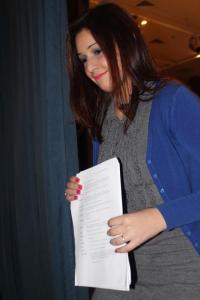
Najwan Anbar reading the part of Um Ahmed

In Gaza Tales of a City by the Sea at Qattan Centre for the Child

FinalPoster

The Palestinian Circus: creative acts between reality and hope

Posted: December 21st, 2012 ˑ Filled under: .culture.theatre ˑ  No Comments

This post is also available in: Dutch

al.arte.magazine 

Over the last weeks, The Palestinian Circus School has been performing in Belgium in various locations, offering a show around the theme ‘Kol Saber!’ The travelling company of performers from Ramallah, Palestine differs from the traditional circus setting with the large tent and animal acts. However, classic circus acts such as acrobatics and tightrope walking do form a part of their show, albeit choreographed in a special way and embedded in a story. The young Palestinian people actually use the circus to tell their story to the world.

The Palestinian Circus School was established in 2006 by the Belgian Jessika Devlieghere and her Palestinian husband Shadi Zmorrod. The school teaches around 170 children and young people 9-27 years of age in different parts of the occupied Palestinian territories. Shadi Zmorrod is the former artistic director of the Jewish Jerusalem Circus and started the circus school when the circus refused to take in Palestinian children. The project is a form of cultural resistance against the occupation and the daily threats. The school aims to offer children a solid and safe haven where they can escape the depressing daily reality, just like a real circus family would do. A place that allows them to explore their creativity and develop social and psychological skills. An artistic world in which they can discover fun, embrace hope, create a positive self-image and learn to work in a team.

Kol Saber - © Veronique Vercheval

Kol Saber – © Veronique Vercheval

More than a school

Some of the early students became local trainers themselves in the basic techniques of acrobatics, juggling, trapeze, flower sticks, pois and clowning. They went on to tour refugee camps in the occupied territories with surprising performances. They also performed abroad, in France and Belgium. One of these trainers is Fadi Zmorrod. “I’ve never done anything like circus acts before I started. After three weeks of intensive training I was amazed at the physical capabilities I turned out to have. It’s therapy. I use it to release tension. ” Young students learning more about their culture, and how to trust others, makes the circus school more than just a school. “We went to other cities. The hardest thing I encountered were the many checkpoints, because they made me nervous. But I also learned more about my culture. We had to get rid of some old ideas like ‘men are stronger’ and ‘girls have more fun.’ For example , touching eachother is prohibited. We have to be physical but without touching eachother. The trust factor is also at play. Girls have less confidence. We learn about gender roles and empowerment. “

The youngsters needed something to look forward to in order to take life into their own hands. The circus school enables them to do just that, without having to live in constant fear. According to Noor Abu Rob, one of the young artists, growing up was difficult. “We only had the streets to live in and sometimes we couldn’t go to school because of a curfew. For me, circus is an open world. I can express myself better through the circus than through words. “

Kol Saber - © Lucia Ahmad

Kol Saber – © Lucia Ahmad

Kol Saber - © Veronique Vercheval

Kol Saber – © Veronique Vercheval

When they first performed in Belgium the shows theme was ‘Circus behind the wall’. The performance was based on the Palestinians’ daily lives, in which the notion of separation is central. The title refers to the wall that separates the Palestinian territories from Israel. The Palestinian Circus wants to teach the public about communication through juggling and clowning acts. This time around they performed their new contemporary circus production ‘Kol Saber!’. The production centers on the various realities of streetlife, a story of the ongoing challenge to escape the external power holding sway over their lives.

‘Kol Saber!’ literally means ‘Eat (the sweet fruit of) the cactus!’, but figuratively speaking ‘Eat patience!’, and tells the story of young people waiting for a change in their society. They try everything and keep believing in hope but finally have to accept the fact their lives will remain the same.

The 14 december show in the De Roma concert hall in Borgerhout was overshadowed by the death of the 17-year-old Mohammad Ziad Al-Salaymeh, one of the students of the Palestinian Circus School. He was shot and killed near a checkpoint by an IDF soldier on his birthday. Mohammad went out to buy a birthday cake and came under fire because the soldiers suspected him to be carrying a gun. Later the Israeli newspaper Haaretz reported he had been carrying a toy gun. That news devastated both performers and founders of the travelling company. Jessika Devlieghere held an emotional speech and the young artists dedicated the show to Mohammad al-Salaymeh and the many other innocent victims. It was not the first time that candles were lit. In 2008 they did the same, observing a minute’s silence. The young artists hope this is the last time.

Ahmad Abu Taleb - © Vince Buyssens

Ahmad Abu Taleb – © Vince Buyssens

Ahmad Abu Taleb (21) from Jenin has been performing in the Palestinian Circus for 4,5 years now. “For me, the circus is a way to tell my story and that of the Palestinian people in a creative way and to show it to the world. We recently lost our colleague Mohammad al-Salaymeh. No matter how many atrocities we experience, we will find the power to perform over and over again. Because for every Mohammad who dies by Israeli violence, we are performing even more passionately on stage.”

As has been said, the performance was far from a traditional circus show, but rather a profound story poetically told by means of dance and circus techniques like juggling, aerial acrobatics, balancing acts and jumps. With coats dancing for life, diverging and converging, fighting and living, in a tense context, until a mysterious coat falls from the sky and change the rules of the game. ‘Kol Saber!’ portrays the conflicting life between the bitter realities imposed by the occupation and the sweet and colorful dream of the bereaved sea.

Kol Saber - © Lucia Ahmad

Kol Saber – © Lucia Ahmad

The project gives the students a sense of dignity and is a way to prevent becoming a victim in a dehumanizing conflict, allowing them, on the contrary, to be proud to be Palestinian.

Artists: Ahmed Abu Taleb, Fadi Zmorrod, Mohammed Abu Taleb, Mohammed Abu Sakha and Noor Abu Rob
Directed by Shadi Zmorrod
Costume design: Fadila Aalouchi

More information: http://www.palcircus.ps/
Written by Malikka Bouaissa – Asma Ould Aissa

This article first appeared in al.arte.magazine 

Palestine gallery to open in London

OneWorld Events

Londoners will soon be able to get off the tube at King’s Cross and walk into a Palestinian refugee camp.

They will be able to meet some of the 12,000 descendants of the 750,000 Palestinians forced to flee their homeland in the wake of the creation of the state of Israel in 1948.

The people of Shatila camp are squeezed into one square kilometre. The labyrinthine alleyways are plastered with posters and inscribed with graffiti and street art.

You enter the home of Mariam, a 90-year-old woman who is propped up in bed. She tells her family’s story, part of the story of the Nakba (The Catastrophe – the Palestinian displacement).

You can call in on Hassan, sitting in his shrine contemplating the history that has brought him here, fingering a string of blue prayer beads as he explains his eclectic collection of objects – Muslim and Christian, secular and religious, prayer beads, crucifixes, icons, clay pots and seashells, all illuminated by fairy lights.

Or you can meet three generations of the Al-Awwal family: Rasheed, 42, his mother, sitting regally in her armchair, and his son, Abdul.

All this is possible through an interactive touch-screen tour of Shatila soon to be unveiled at Europe’s first Palestinian gallery, which opens in October.
“Palestinian artists are not widely recognised,” says the gallery’s communications and events officer, Sami Metwasi. “They are isolated. This gallery will give them a chance to be presented to the world.”

He says the Palestinian image “has been polluted during the years of struggle and conflict”, and the exhibitions and activities will help highlight its people’s rich, diverse culture.

“It is always after others see the high quality of our art and culture that their respect for Palestine grows. We Palestinians are not just victims of injustice but a living culture worthy of admiration and respect.

“What is wonderful about it and about our people is that even under the most terrible circumstances of occupation, exile and war we have not only kept our cultural heritage alive but created new cultural output of such high quality to earn its place among world class modern art and culture.”

Another aim, he says, is to communicate with British culture, to build bridges and to give an opportunity to British people to explore Palestinian culture.

“We are not a traditional gallery with traditional divides and barriers between installations and users,” notes Metwasi. “Rather, we aim to use this modern space to bring people together and to bridge gaps between Palestinians and locals.”

It will also be a centre for Britain’s Palestinian community, estimated at 75,000.
The gallery’s original sponsor was the Prince of Sharjah, Sheikh Sultan al-Qassimi, who funded it through the London-based Palestine Return Centre. It is now an independent entity.

The gallery has already started work, with activities that include creative workshops for teenagers and, on 26-27 June, performances by a group of youngsters from a camp in Bethlehem who tell their stories through photographs, images and dance, “proving that talent can bloom in the most difficult conditions of life in exile and under occupation”.

* The Palestine Gallery, 21-27 Chalton Street, NW1. Tel: 0207 121 6190

Original article appeared here
Gaza 2012: Palestine’s Long Walk to Freedom

By: Haidar Eid

Published Wednesday, December 12, 2012

AlAkhabar English


The long walk to South Africa’s freedom is marked by two immensely tragic events: the Sharpeville massacre in 1960 and the Soweto Uprising in 1976, both of which led to the galvanizing of internal and international resistance against the apartheid regime. Ultimately, these events would lead to the long-called for release of Nelson Mandela and to the end of one of the most inhumane systems the world has ever seen.

Without Sharpeville and Soweto, among other landmarks towards victory over settler colonialism, South Africa would still be ruled by a minority of fanatic, white settlers claiming to fulfill the word of (their) God.

Palestine’s long walk to freedom has gone through similar harrowing events, beginning with the 1948 Nakba to the latest eight-day onslaught on Gaza.

In order to understand Gaza in 2012, one ought to trace its origin back to 1948. Two thirds of the Palestinians of Gaza are refugees who were kicked out of their cities, towns, and villages in 1948. In After the Last Sky, the late Palestinian thinker Edward Said argues that every Palestinian knows perfectly well that what has happened to us over the last six decades is “a direct consequence of Israel’s destruction of our society in 1948…”

The problem, he argues, is that a clear, direct line from our misfortunes in 1948 to our misfortunes in the present cannot be drawn, thanks to “the complexity of our experience.”

At 139 square miles, Gaza is the largest refugee camp on earth, a reminder of the ongoing Nakba. The inhabitants of Gaza have become the most unwanted Palestinians, the black heart that no one wants to see, the “Negroes” of the American south, the black natives of South Africa, the surplus population that the powerful, macho, white Ashkenazi cannot coexist with.

Hence the calls to “flatten” Gaza and “send Gaza back to the Middle Ages.”

In 2008-9, Gaza was bombed by Apache helicopters and F-16 jets for 22 days, killing more than 1400 civilians. As if that was not enough, Israel decided to return to Gaza in 2012 and repeat the same crimes in eight days, this time killing more than 175 civilians and injuring 1399. These are massive losses for a population of just over 1.5 million people.

Israel’s airstrikes, which damage essential infrastructure and terrify the civilian population, are a form of collective punishment against the Palestinian people. Even more, they are war crimes forbidden under international humanitarian law, specifically the Geneva Conventions.

Yet Israel consistently gets away with war crimes. The official, government-based “international community” does not seem interested in the suffering of the native Palestinians. The much-admired, “better than Bush” American president, Obama, thinks that “Israel has the right to defend itself.” The same right does not apparently apply to Palestinians.

Likewise, the British Foreign Secretary William Hague believes that Hamas is “principally responsible” for the current crisis, as well as the ability to bring it most swiftly to an end. This is in spite of the deadly siege imposed on Gaza for more than five years, so much so that Israel even used calorie counting to limit the amount of food that entered Gaza during the blockade.

The fact that Palestinians in Gaza are not born to Jewish mothers is enough reason to deprive them of their right to live equally with the citizens of the state of Israel. Hence, like the black natives of South Africa, they should be isolated in a Bantustan, in accordance with the Oslo terms. If they show any resistance to this plan, they must be punished by turning the entire Strip into an open-air prison.

Both the US and the UK display deliberate and unconscionable ignorance in the face of the brutal reality caused by Israel to Gaza. As a result of Israel’s blockade on most imports and exports and other policies designed to punish Palestinians, about 70 percent of Gaza’s workforce is now unemployed or without pay, according to the UN, and about 80 percent of its residents live in grinding poverty.

But don’t Obama and Hague know this?!

As Hamid Dabashi put it:

Obama is fond of saying Israelis are entitled to defend themselves. But are they entitled to steal even more of Palestine, terrorise its inhabitants and continue to consolidate a racist apartheid state…? Was South Africa also entitled to be a racist apartheid state, was the American south entitled to slavery, India to Hindu fundamentalism?

The only option for Palestinians is to follow the same route as the South African struggle. The South African internal campaign aimed to mobilize the masses on the ground rather than indifferent governments around the world. What hope could they have gotten from the likes of Margaret Thatcher, Ronald Reagan, and Helmut Kohl? It was left to ordinary South Africans and global citizens to show their moral rejection of crimes committed by the ugly apartheid system.

In South Africa’s long walk to freedom, there was no compromise on respect for basic human rights. Apartheid’s attempts to point fingers at “black violence” and “intrinsic hatred” toward Western civilization and democracy, did not hold water.

Similarly, international civil society, and some governments, have seen through Israel’s propaganda campaign where the aggressor is turned into the victim. Across the years, Palestinians have been completely dehumanized. Instead of Reagan and Thatcher, we have Obama and Hague, blaming the victim and condemning resistance to occupation, colonization, and apartheid.

But South Africans did not wait for the American administration to “change its mind.” The global BDS campaign, steered by South African anti-apartheid activists, coupled with internal mass mobilization on the ground, was the prescription for liberation, away from the façade of “independence” based on ethnic identities. Similarly, the Palestinian call for boycott, divestment, and sanctions has been gathering momentum since 2005. Gaza 2012, like Soweto 1976, cannot be ignored: it demands a response from all who believe in a common humanity.

Gaza 2012 has, undeniably, given a huge impetus to this process by making all Palestinians inside and outside of historic Palestine realize that “Yes, We Can!” We are no longer the weaker party, the passive victim who does not dare bang on the walls of Ghassan Kanafani’s trunk in Men in the Sun, but rather Hamid in All That is Left To You, the Palestinian hero who decides to act.

Haidar Eid is Associate Professor of Postcolonial and Postmodern Literature at Gaza’s al-Aqsa University and a policy advisor withAl-Shabaka, the Palestinian Policy Network.

Original article appeared here https://talesofacitybytheseadotcom.wordpress.com/wp-admin/post-new.php
 

As people dig out of the rubble, a Palestinian doctor says civilians were targeted by Israeli attack
Published on Nov 27, 2012 by 

euronews le mag : Art festival in Ramallah

Published on Nov 15, 2012 by 

http://www.euronews.com/ Qalandiya, the first ever Palestinian Contemporary Art Biennale has been held in Ramallah. One of the most popular displays was a pop art-inspired needlework portrait is of Mohamed Bouazizi, the market stall holder who sparked the beginning of the Arab Spring when he burned himself to death in protest at being rough-handled by the police.

The biennial took its name from one of the most famous symbols of Palestinian separation, the Israeli checkpoint at Qalandiya, which is one of the main crossing points between the West Bank and Israel.

Displaying art installations in hard-to-access Palestinian villages scattered across the West Bank was a gamble, but it worked. People flocked to the Abwein village for a day packed with art and fun.

Using villages as art galleries, and borrowing its name from a crowded refugee camp and Israeli military checkpoint, Qalandiya International was a chance for Palestinian artists of the West Bank, Jerusalem, Israel and Gaza to get together and overcome their politically fragmented world.

Jerusalem artist, Jumana Manna’s short movie was inspired by a 1942 picture of a high society masquerade hosted by Palestinian politician Alfred Roch, a reenactment that has won Manna the festival’s “Young Artist of the Year” award.
For more information see
http://centrefortheaestheticrevolution.blogspot.fr/2012/11/gestures-in-time-a…

Find us on:
Youtube http://bit.ly/zr3upY
Facebook http://www.facebook.com/euronews.fans
Twitter http://twitter.com/euronews