The rise of Palestinian citizen journalists in Gaza

Rana Baker responds to Dawber’s article in The Independent: Misconceptions Abound On Gaza’s Women, Politics

By: Rana Baker for Al-Monitor Palestine Pulse

Posted on April 25.

It has become commonplace when reading about Gaza to come across descriptions of it as an “Islamist enclave” or “Hamas-controlled territory” and so on. In case someone exists who does not know what Hamas is all about, commentators make sure their readers understand that it is the “fundamentalist” group bent on the “destruction of Israel” and nothing else.

The Palestinians of Gaza, therefore, are often categorized as either ardent Hamas supporters or suppressed dissidents, including women, who receive the severest treatment imaginable, not only from the Hamas government, but also from misogynistic and backward average male residents. Such categorizations are then followed by sweeping generalizations about each of these stereotypes. Whereas the Hamas supporters consist of “terrorists” and “bloodthirsty barbarians,” the dissents are seen as peace-loving minorities who seek neighborly relations with Israel, the occupying entity.

A recent example of such portrayals can be found in a feature story published in The Independent on April 13. In “Tales from Gaza: What Is Life Really Like in ‘the World’s Largest Outdoor Prison’?” the author alledges to provides “a small snapshot into life in Gaza.” Before he proceeds, however, he assures us that what follows are “testimonies” by people “who can rarely get their voices heard.”

At the start of six interviews, the author makes clear that all of those featured are men not because that was his intention — he is a Westerner who believes in gender equality after all — but because in his two and a half days in Gaza, he could not find a woman willing to speak to him “independently.” In fact, the only occasion when he had the chance to speak to a woman, he tells us, was in the presence of a male guardian, the woman’s husband in this particular instance. Hence, while he was able to “give voice” to men, his attempts to do the same for women were all thwarted.

Such assertions play into Orientalist notions. This usually results from foreign journalists coming to Gaza with a set of preconceptions about the place and its people and then seeking to confirm them rather than verify them. While Gaza is, indeed, no haven for women or anyone else, there are thousands of educated women who are willing to speak for themselves and do so in every field, from medicine, theater, and politics to fishing and farming.

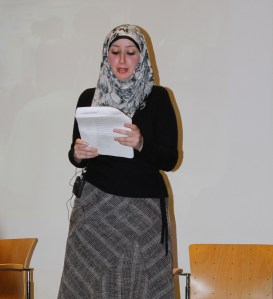
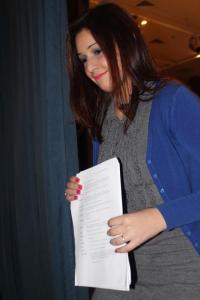
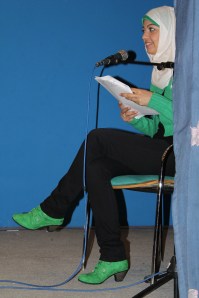
Just a few months ago, a play written by the renowned Palestinian writer Samah Sabawi was read at one of Gaza’s cultural centers, which continue to thrive despite Israel’s ceaseless attempts at cultural de-development. Nearly all the participants who performed the play were women, as was the case with the vast majority of the audience. They were not accompanied by husbands, brothers or fathers in order to attend or to perform.

Events like this, however, hardly ever make it into the mainstream media. Moreover, any mention of a considerable number of women going out without a hijab instantly provokes expressions of surprise by those who have only heard about Gaza through mainstream and particularly Western publications. To say women in Gaza are also allowed to drive would sound like a lie to many ears.

Women are not the only part of this story. To claim that Gaza is “Islamist” automatically dismisses the existence of the leftist and secular groups there, most of which denounce religion in its totality. Homogenizing “life in Gaza” could not be more obvious than in The Independent feature.

Of the six interviews the author conducted, one was with a Hamas official, while four were with blue-collar male workers, and the remaining one was with an unemployed man. Despite being at odds with Israel, five of them belong to the category of “ready to forget the past,” has no problem inviting former Israel prime minister Ariel Sharon for coffee, and even views Yitzhak Rabin — the man behind the Iron Fist that broke hundreds of bone in the lead up to and during the first Palestinian intifada — as a man of peace.

With the exception of the Hamas official, the interviewees followed suit in reiterating the same unconditional desire to achieve peace with Israel that one might think no other viewpoint existed. At the same time, they viewed Hamas as the primary source of their distress. Israel was seen as only secondary to their everyday ordeal.

That no evidence was provided to challenge the views in question suggests that there is none — just as the author claims to have found no women able to speak to him. Thus, portraying the residents of Gaza as a homogenous people who all experience life in the same way is condescending at best and Orientalist at worst. The views expressed in the article are undeniably extant but do not reflect the reality.

Israel, which has launched two deadly assaults on Gaza in less than five years, is rarely perceived as a friendly entity. The vast majority of the politicized and non-politicized segments of Gazan society are not ready to “forget the past” that continues to shape the lives of 1.1 million local Palestinians officially registered as refugees at the United Nations Relief and Works Agency.

Rana Baker is a student of business administration in Gaza and writes for the Electronic Intifada

This article appeared here: http://www.al-monitor.com/pulse/originals/2013/04/gaza-misconceptions-women.html#ixzz2RVnXaJdB

Gaza film Condom Lead first Palestinian short to enter competition for Cannes Film Festival

A Palestinian film has for the first time made it into this year’s competition for the Cannes Film Festival.  The film Condom Lead is created by Identical Gaza twins Tarzan and Arab.  The pair are known for their creative and unique styles.

 “Condom Lead is a short, enigmatic parable about what it means to be human in a time of war. It is a story that could happen anywhere – anywhere there is, ever has been, or ever will be war; anywhere there is a man and a woman and a room. An intense, darkly comic study of what becomes of ordinary passions between a man and his wife in the long interstices of war’s heightened reality, Condom Lead is a story about sexual frustration on the edge of time’s knife and in the crosshairs of war’s guns, a dream of the hope for intimacy and love in a brutal, divisive world.”

About Tales of a City by the Sea

The play Tales of a City by the Sea is a unique and poetic journey into the lives of ordinary people in the besieged Gaza strip prior to, during and after its bombardment during the winter of 2008.  Jomana, a Palestinian woman who lives in the Shati (beach) refugee camp in Gaza falls in love with Rami, an American born Palestinian doctor and activist who arrives on the first Free Gaza boats in 2008. Their love is met with many challenges forcing Rami to make incredible decisions the least of which is to take a dangerous journey through the underground tunnels that connect Gaza to Egypt.  Although on the surface this love story appears to explore the relationship between diaspora Palestinians and Palestinians under occupation, there is a broader and more universal theme that emerges – one of human survival and tenacity.  Tales of a City by the Sea avoids political pitfalls, ideological agendas and clichés by focusing on the human story of the people in Gaza. Although the play’s characters are fictional, the script is based on real life events and is a product of a collection of real stories the author Samah Sabawi and her family have experienced during the events of the past several years. Sabawi has written most of the poetry in the play during the three-week bombardment of Gaza in 2008/2009.

The writer Samah Sabawi is a Palestinian-Canadian-Australian published writer, commentator and playwright.  She has travelled the world and lived in its far corners, yet always felt as though she was still trapped in her place of birth Gaza.  The war torn besieged and isolated strip has  shaped her understanding of her identity and her humanity.  So what else could Sabawi do but to indulge in Gaza’s overwhelming presence and to succumb to tell the stories of her loved ones back home.  Her most recent play Tales of a City by the Sea is dedicated to them and to all of those who still manage to have faith and hope even as the sky rains death and destruction.

The script is available to interested theatre makers upon request.  Please email play3wishes@gmail.com for more information.

Ms. Sabawi speaking at the Launch of the The People's Charter To Create a Nonviolent World

Photo courtesy http://thepeoplesnonviolencecharter.wordpress.com/launch-events/

Follow Samah Sabawi on Twitter @gazaheart

Samah Sabawi’s professional bio can be found here

For more information on Samah Sabawi: http://en.wikipedia.org/wiki/Samah_Sabawi

Let Gaza surprise you!

By Samah Sabawi

20130122_115944

Gaza is one of the most reported on and yet least understood places on earth.  Its mere mention conjures up images of war victims, war criminals, piles of rubble, militants with guns, dead children and weeping mothers.  A simple google search will bring up disturbing images of heart break, terror and destruction.  But all of this is an infliction on a place that has neither surrendered its identity nor lost its beauty to decades of violent Israeli occupation.

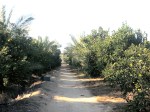
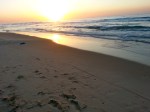
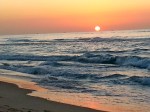
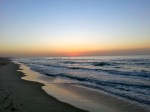
Gaza is a city of many tales.  While some are about loss, grief and misery, many others are about enduring love, triumphant moments, tenacity, passion, music and hope that lives beyond the confines of the siege and the occupation.  If you dig deeper than the negative headlines and the devastating news reports you will find many pleasant surprises.  You can take a walk along Gaza’s gorgeous fields, enjoy its magical sunsets, get to know its warm people, visit its ancient sites and eat its delicious dishes.  You will find in Gaza everything that would make you love life with a passion!  So join me here to explore some of Gaza’s unknown side.

The Arts:

There is a common belief that Gaza’s art scene is all but dead.  While it may be true that art in general is not a great priority for the people in Gaza who are too concerned with bigger financial and political issues, Gazan artists continue to create and to excel in their fields.  There is also an appreciation of the need to encourage art in children starting from a young age.

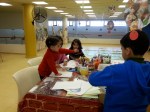
One establishment worthy of salutation for supporting the arts is the Qattan Centre for the Child in Gaza.  This cultural centre is an oasis for the hearts and the minds of children.  Equipped with a large library painted in vibrant colors and comfortable eye soothing furniture the QCC in Gaza focuses on developing the children emotionally and intellectually through visual art, music, education, cultural events and much more.

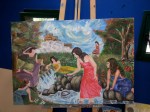
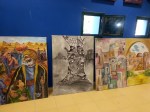
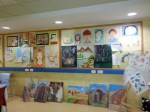
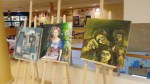
Below are some images of the QCC in Gaza.  Keep in mind all of the paintings you’ll see in some of these photos were in fact painted by children under 15 years of age at the centre.

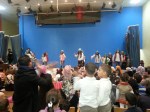
The Qattan center was built on land donated by the Gaza municipality and has succeeded in meeting its goal of creating an educational and stimulating space for children and their caregivers.  Parents are encouraged to join their children in the library, engage with them over art and craft activities, or just watch them proudly as they perform their song and dance routines.

Membership at the QCC is free of charge to all children in Gaza from all walks of life and some of the classes offered charge a small symbolic fee.  Many of the events are also free of charge such as the concerts captured in the video below that took place as part of the winter camp activities in January 2013.  In this video below you’ll see a variety of instruments, you’ll hear music of both Arab and western origins ranging from Gershwin to Darweesh.

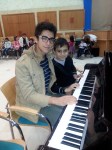
Also worthy of special salutation is the Gaza Music School and its incredible teachers and talented children.  The children featured in the next video are nine years of age.  They are very dedicated to the art they practice in spite of all the challenges they face including Israel’s bombardment of the Gaza Music School  in 2009.


The landscape

The Gaza Strip is densely populated mostly by refugees who fled Israel’s war of ethnic cleansing in 1948 and have not been allowed to return to their homes since.  As the population continues to grow in the besieged strip the natural landscape changes to make way for more cement structures and buildings to accommodate this growth.

However, population growth is not the only challenge facing Gaza’s green spaces.  Agricultural land  is shrinking as Israel usurps more of Gaza’s water supplies and if that’s not enough, Israel’s siege, blockade, frequent bombardment and occasional land incursions have left their mark on many of Gaza’s farming land.  A recommended report that sheds great light on this is the UNISPAL report Farming without Land, Fishing without Water.

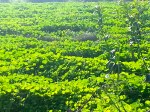
Below are two pics of bombed trees in our farm in Gaza. The first depicts a tree totally uprooted from the power of a one ton bomb blast.   The second photo  depicts a tree that was uprooted from the blast, flew in the air and actually landed straight on top of another tree.

Despite all of the challenges and the uncertainties of Israel’s incursions and bombings, some farmers have insisted on maintaining their land.  When visiting their farms you get a sense of what Gaza’s landscape looked like before Israel’s war of ethnic cleansing began.   You can imagine how before the refugees were chased into the far corners of their homeland to settle into camps under occupation, how most of Gaza’s natural landscape would have looked like.

The Sea

Perhaps the most important feature of Gaza is its sea.  It is the only landscape that remains unchanged, unaffected by the occupation and the aggression.  The sea is an open recreational space that is free of charge.  For Gazan families the sea is a cure for all of life’s problems.

The food

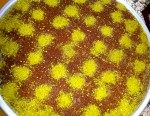
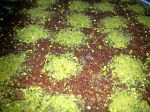
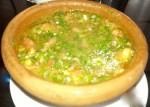
Finally, no matter where you go to in Palestine, you will always be overwhelmed with warm hospitality and great food.  Gaza is no different.  Here are some pics of some of my favourite dishes, but if you’re looking for a more comprehensive list along with recepies I highly recommend you visit The Gaza Kitchen.  Bon appétit or as they say in Gaza Saha we afya!

What hope sounds like: a performance by Gaza’s children at the Gaza Music School

The children of the Gaza Music School performing to a French and Egyptian delegation early January 2013. The boys in this clip are around 9 years of age. According to Qattan Foundation’s website, the Gaza Music School (GMS) was established “in response to growing demand for music education voiced by children and parents who attend the Qattan Center for the Child (QCC) in Gaza City, one of the A. M. Qattan Foundation’s main projects.” The Gaza Music School was completely destroyed by Israel during its attack on Gaza in 2008 and was rebuilt since then. A testimony to the resilience of the Palestinian people. To find out more information about the school and Qattan Foundation visit the following linkhttp://www.qattanfoundation.org/subpage/en/gms.asp?sectionID=654


Gaza audience feedback following the public reading of Tales of a City by the Sea

Photo Gallery: Gaza public reading of Tales of a City by the Sea

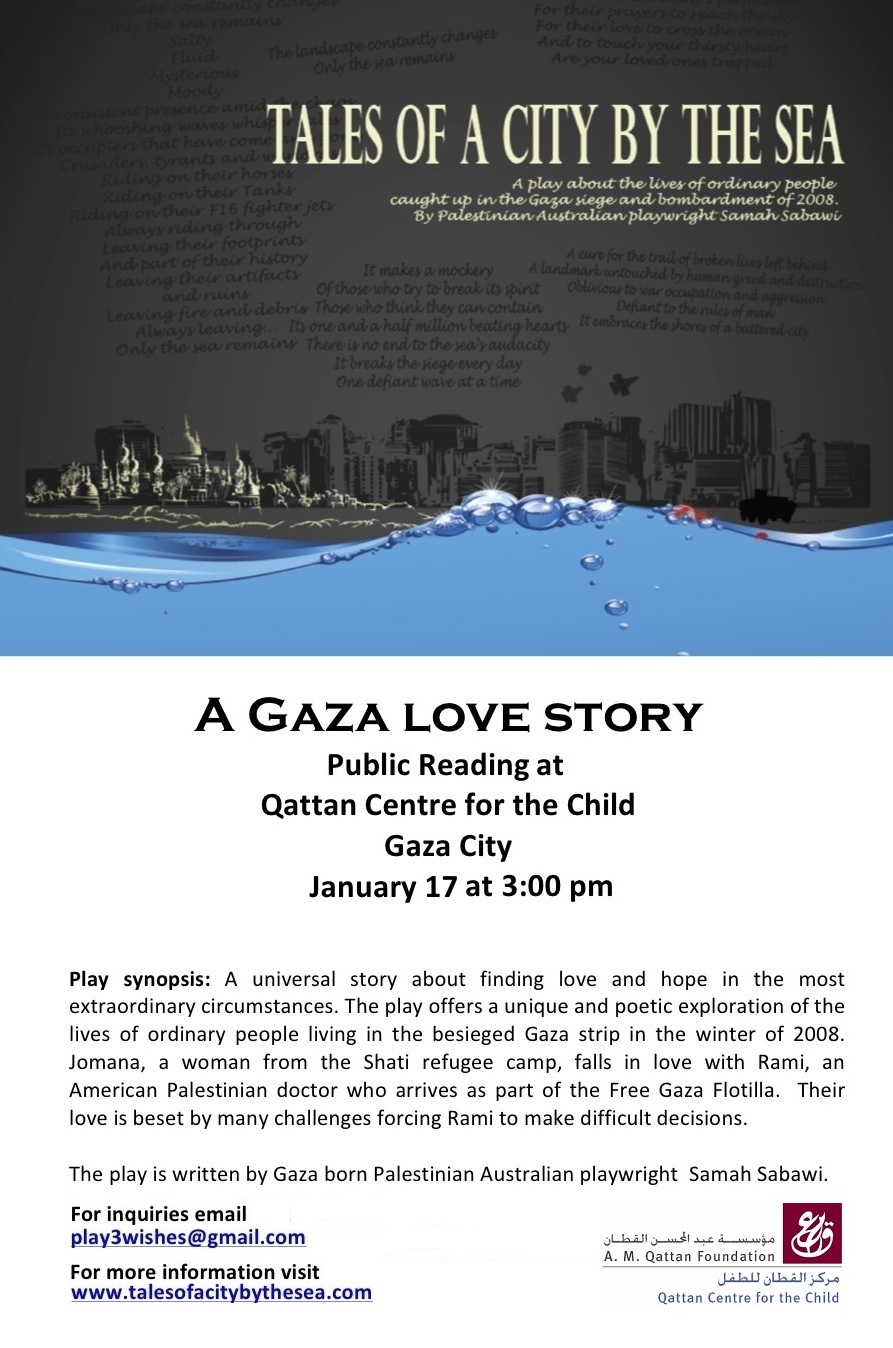
A reading of the play Tales of a City by the Sea took place in Gaza city at the Qattan Centre for the Child followed by a discussion on January 17th  2013.   The reading was part of ongoing efforts by international artists to break the cultural siege of Gaza and to work collaboratively with local talent.  What resulted from this event was a profound experience for both the writer, the cast and the audience.  The audience feedback (video will be uploaded next week) highlighted the need for creating more space for cultural and artistic events in the besieged Gaza strip.

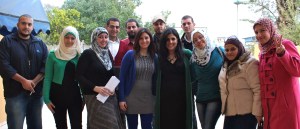
The Gaza team from left: Khaled Harara, Eman Hilles, Sameeha Olwan, Ayman Qwaider, Mohammed Ghalayini, Manar Zimmo, Alaa Shoublaq, Samah Sabawi, Mahmoud Hammad, Najwan Anbar, Alia Abu Oriban and Ayah Abubasheer.

Sameeha Olwan

Sameeha Olwan reading the part of Jomana.

From left: Mohammed Ghalayini, Ayman Qwaider and Mahmoud Hammad

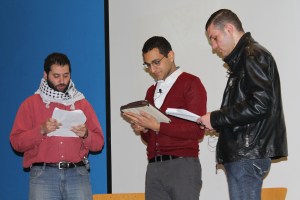
From left Mohammed Ghalayini reading the part of Rami, Ayman Qwaider reading the part of Ali and Mahmoud Hammad as Mohanad.

554355_10152424530600562_1359321734_n

Manar Zimmo reading the part of Lama.

From left:  Mahmoud Hammad, Alaa Shoublaq, Mohammed Ghalayini and Ayman Qwaider

From left:  Mahmoud Hammad as Mohanad Alaa Shoublaq as Abu Ahmed, Mohammed Ghalayini as Rami and Ayman Qwaider as Ali.

Eman Hilles

Eman Hilles was the narrator of our Tales.

Mohamad Akilah

Gaza esteemed musician Mohamad Akilah.

Najwan F. Anbar

Najwan Anbar reading the part of Um Ahmed

In Gaza Tales of a City by the Sea at Qattan Centre for the Child

FinalPoster

Gaza prepares for Christmas: “the people of Gaza cling to life…the smiles of the children attest to it … the happy mothers … the open shops, the noisy traffic…Gaza vibrates with life”

Posted on Dec 18, 2012 in DioceseSlide

GAZA – Traditionally, the Latin Patriarch of Jerusalem, His Beatitude Fouad Twal, visits the parish of the Holy Family in Gaza before Christmas.  He did this year on the third Sunday of Advent and celebrated Christmas Mass for the faithful in Gaza.  The communications team of the Latin Patriarchate was in Gaza three days early and met with the parishioners in anticipation of this visit.

This year, Christmas has a special dimension for Catholics of the Holy Family Parish in Gaza. In the three weeks since the end of the Israeli operation “Column of Defense,” the parish has seen the ceasefire as “a miracle.”  Patriarch Fouad Twal who went for the first time to Gaza since the ceasefire,  explained in his Sunday homily that “Christmas is a gift from Heaven, but the good will of men so that there may be peace is also needed.”  He also invited Christians “to live a strong faith”  in order to continue living in this Holy Land where the Holy Family passed during the flight to Egypt and to remember that “even Jesus suffered injustice.”  According to the parish priest, Father Jorge Hernandez, IVE: “the parishioners are very appreciative of this visit and it is also a little of Jerusalem that came here to them, and this touches them very much in their faith life.”  To thank all those who supported them with their prayers and their gifts during the war, the parish celebrated an official Mass of Thanksgiving. The pastor said “that they all know we have prayed for them.”

After yesterday’s Mass, the Patriarch, together with  Bishop Marcuzzo, Vicar inIsrael, as customary, met with the families for the exchange of Christmas greetings. The General Administrator of the Patriarchate, Fr. Humam Khzouz, who coordinated the entrance of the delegation to the Gaza Strip and the Chancellor, Fr. George Ayoub, were also part of the Patriarchal delegation.

The small Catholic parish of the Holy Family has exactly 185 faithful. Among the 1.6 million Gaza inhabitants, a crowded area of 360 sq. kilometers, there are 1,550 Christians (Greek Orthodox for the most part) now only half of the 3,000 in 2008.


Christmas, however, will be celebrated after the bombs.  So life goes on in Gaza. Eight days of mass destruction left  traces on houses, public buildings and schools. Along the roads are found several ruins as those of the football stadium where the stands collapsed after the stadium was struck by bombs. In the midst of the rubble, violence still resonates and on their faces “exhaustion is seen by the dark circles around the eyes” as Bishop Marcuzzo noted yesterday.

By this, we must recognize, the people of Gaza cling to life. The smiles of the children attest to it in front of our photo cameras, the happy mothers and the daring of their sons, the open shops, the noisy traffic. In fact, Gaza vibrates with life. Men, women, children confronted with violence, scarcity, the conservatism that strongly rules daily life, they suffer from a high unemployment rate (60% of the population) and from the weight of the days without some distraction. But the inhabitants here also live the joyful feasts and marriages. In the Catholic parish, for example, there are on average 1- 2 marriages and 3 – 4 baptisms a year.

Immediately after the ceasefire, the three Catholic schools of the Gaza Strip, which accommodate 1500 students of which the overwhelming majority are Muslims, organized the resumption of classes. The two Catholic schools of the Holy Family reopened their doors. The School of the Rosary Sisters instead had to wait until the following Monday in order to repair broken windows because of the explosions. “The winter cold was arriving and they needed to act quickly” says Sister Davida, Principal of the School. In this school where four Rosary Sisters serve, the principal tells of the resuming of classes: “many children made great effort to concentrate after thirty minutes of class. Some psychologists from Caritas came to help them restart by playing and singing. Restoring to a child the sense of security is a long process.”

The relentless drama continues in the interior of each person. Father Jorge Hernandez noted, together with the School Principal, different problems in children of school age. “When the bell announces the end of classes, when an airplane flies above their heads, some students are afraid” they explain. “Other children stay in small groups near the walls. They always have the behavior of war. They are afraid of the silence, of the grand silence.” The Pastor then says “In Gaza now, when a child begins school, he has already seen two wars. And he is not yet 4 or 5 years old.”


To these children born in war and who live in war, the parish proposes a pastoral life of prayer  and playful activity to help them grow “normally” in this little strip of overpopulated land that suffers the embargo by its neighbors. More than ever the religious communities that live in Gaza strain themselves to do everything to help the faithful of the parish, but also the Orthodox and the Muslims so that they catch again their breath after the recent events. The parish is supported by three sisters of the Incarnate Word Institute, to which the pastor also belongs as well as the new parochial vicar, Father Mario, who arrived just three weeks ago.

At their side work the Rosary Sisters and the Missionary Sisters of Charity of Mother Teresa, who are dedicated to disable children. Through “the festive oratorio”, children, parents and families can lead an almost normal life. There are some beautiful moments, the people come to develop themselves, to pray, to see each other and to play. So as in the streets of Gaza, also in the parish life resumes its rights, forgetting the daily problems of security, the health services but also the constant problems with electricity.

The parish is an island of life, where calm seems reestablished again, away from the images of a Gaza “ghost city”. Of course, they have rediscovered their life, but with an embargo. As the Patriarch has said on several occasions “the people of Gaza do not have a normal life. They live in an open-air prison.” On Saturday afternoon, before the arrival of the Patriarch, in the parish courtyard some youth were playing ball, the scout band had its rehearsals, the crib was ready, the Christmas tree decorated, the divan straightened up and the Sunday lunch prepared.  It is here that the Patriarch greeted the parishioners the following day, extending to them personally his Christmas wishes.

A mother of a family who welcomed us for Friday evening dinner said: “We will resume our daily life. It was really a very hard period, it was not easy, but with the children we are ready to celebrate Christmas. We need it to live well.” The Christmas tree, the crib, the imminent birth of a fifth child shows that there is life here. Right here! And in our parish we are preparing for Christmas with forgetting the sick and elderly persons. In the ten days that precede the Christmas feast, the pastor visits 4 elderly or sick (that is, 40 persons in all) each evening in the company of a small delegation of youth and the Sisters of the Incarnate Word. We shared in four of these meetings. The visitors, about fifteen, this evening, in the blue night of the Holy Land joined together in prayers and songs, distributing holy water and small gifts. Sometimes the priest administers the anointing of the sick. Father Jorge explains: “For three years, since I am here, I saw that this little round of visits interests many. In the beginning we started with five, now the movement has expanded. All the youth today want to participate. We are obliged to organize turns. During the year, we also distribute communion to the sick. At times it also happens that   2-3 scouts come along to offer their service.

On Tuesday, December 18, the Latin Church in Gaza expects 450 persons for the traditional “Christmas Concert” organized every years at this time of years in the context of the Baroque Music Festival, supported by the service of Cultural Cooperation of the French General Consulate in Jerusalem. On the evening of December 24, maybe some parishioners will have obtained permission from the Israeli authorities to go for Christmas Eve in Bethlehem. But all cannot have it. Those who remain in Gaza will welcome near the living crib His Excellency, Bishop Shomali, Auxiliary Bishop for Jerusalem who will spend Christmas Night in the company of the Parish faithful. And not only that… as many non-Catholics will come to rejoice at the coming on earth of the Prince of Peace and to pray with the pastor who has a message of Christmas:  “that the Savior may give His peace to the people of Gaza and especially to the leaders of the region. That He may also give us the strength to continue advancing.”

Christophe Lafontaine

Click here for more Christmas in Gaza images or go this link https://picasaweb.google.com/medialpj/LePatriarcheAGazaPourNoel2012#slideshow/5822930124911516418


A comprehensive analysis of the arguments surrounding the call for a cultural boycott of Israel

By Samah Sabawi

This paper was prepared for the 7arakat Conference: Theatre, Cultural Diversity and Inclusion November  2012 and was first published in the 7arakat conference E:Proceedings. 

Introduction

International artists find themselves standing at a crossroad between their desire to support all forms of artistic expression, Israeli or otherwise, and the Palestinian civil society’s call to support a cultural boycott of all Israeli state sponsored forms of art. Some argue art and culture are apolitical and boycotting them is an infringement on freedom of expression.  They insist that art is a language of peace and building bridges. Others argue that culture and art are in fact political and can serve as tools of political propaganda and repression.  They highlight the responsibility of artists to affect change by raising awareness about political and social issues. In this paper, I will set out to explore the relationship between the culture and politics within the Palestinian Israeli conflict, while examining the arguments for and against the Palestinian Civil Society’s call for a cultural boycott of Israel.

Boycott Divestment and Sanctions – BDS

Confronting a failed peace process and a disappearing Palestinian state, and inspired by the South African movement to end apartheid, Palestinian civil society in 2005 set out to build a rights based grassroots movement that adopts a non-violent form of resistance based on international law and the universal declarations of human rights. They called on people of good conscience around the world to apply boycotts divestments and sanctions on Israel until Israel ends its occupation of Palestinian land, including East Jerusalem, and fulfills its obligations under international law toward the Palestinian refugees, granting full equality to the Palestinian citizens of the state of Israel. Endorsed by 170 Palestinian political parties, organizations, trade unions and movements representing Palestinians in the Occupied Territory, inside Israel’s 1948 boundaries, as well as in Diaspora, the 2005 BDS call represents the voice of the majority of Palestinian civil society and its three demands articulate a unified Palestinian vision that cannot be dismissed. The BDS call is now endorsed by hundreds of leading international human rights activists, including prominent figures such as Stephane Hessel (2010), co-author of the Universal Declaration of Human Rights and Holocaust survivor.

The Palestinian Campaign for Cultural and Academic Boycott of Israel (PCABI)

In 2006 the majority of Palestinian cultural workers, including most filmmakers and artists along with hundreds of international cultural workers and artists issued a unified statement in support of BDS. Today the list of artists who have publically joined the cultural boycott and have cancelled performances in Israel includes celebrities from around the world like Pink Floyd’s Roger Waters, Annie Lennox, Brian Eno, Devendra Banhart, Tommy Sands, Carlos Santana, Elvis Costello, Gil Scott-Heron amongst many others. The list also includes some incredible writers like Eduardo Galeano, Arundhati Roy and Alice Walker, as well as accomplished filmmakers such as Ken Loach and Jean-Luc Godard.

However, not all artists respond favorably to the boycott call. Some still choose to perform in Israel like pop icons Elton John, Madonna and Lady Gaga to name a few. These artists insist that performing in Israel is about promoting peaceful co-existence by bringing people together. They maintain that cultural events such as concerts are apolitical and should remain so. They complain that the boycotts single out Israel unfairly and that artists – according to Elton John – should not “cherry-pick” their conscious (“Elton John performs in Israel”). They also argue that boycotts are a blunt instrument that amounts to collective punishment of the Israeli people.

Is culture apolitical?

In order to understand the relationship between culture and politics within the Palestinian Israeli context it is important to review the history of Palestinian culture and the political challenges it has faced throughout the years of the Palestinian struggle for freedom.

In an article that appeared in Haaretz (15 May 2012) commemorating Nakba, Dr. Hanan Ashrawi described Palestinian society prior to Israel’s establishment in1948 as highly developed commercially, artistically and culturally. Its economic development was one of the highest in the Arab World and its high school enrolment was second highest with 379 private schools as early as 1914, and dozens of bookstores. In fact, Ashrawi wrote that between the years 1911 and 1948 Palestine had at least 161 newspapers, magazines and other publications and a vibrant cultural scene with cinemas, live theatres and musical concerts both by local artists as well as visiting giants like Egyptian icon Om Kalthoum and the Lebanese singer Farid Alatrash.

All of this was disrupted in 1948 when Israel was established on the ruins of Palestinian villages. Since then Palestinian culture became the target of a systematic and deliberate attempt at erasure by the Israeli authorities. For example, a story which broke out only this year on Al Jazeera titled “The Great Book Robbery” uncovered how during the process of establishing the state of Israel, librarians from Israel’s National Library accompanied the Israeli army into Palestinian homes after their residents were driven out and systematically took all the books that were left in these houses. The books included priceless volumes of Palestinian Arab and Muslim literature, including poetry, works of history, art and fiction. Thousands of these books were destroyed but some were added to the library’s collection and remain till this day in the Israeli National Library, designated, abandoned property – of course totally disregarding the fact that this property does belong to a people who were forced to leave and never permitted to return to their homes or to be reunited with any of their assets, including their books.

Another example of the politicization of culture in the Palestinian Israeli context is how British and then Israeli authorities often targeted not only Palestinian political leaders, but also artists and intellectuals, imprisoning them, banishing them into exile, and even assassinating them. Amongst the artists and intellectuals assassinated by Israel were writer Ghassan Kanafani (Abukhalil 2012) and poet and intellectual Wael Zuaiter (Jacir 2007). Also of great significance to this discussion is how during Israel’s invasion of Lebanon in 1982, Israeli forces looted and confiscated the accumulated national archives of the Palestine Liberation Organization, which included valuable and rare collections of films and other Palestinian cultural artifacts (IMEU 2012).

Israel’s attack on Palestinian culture continues today and takes many different shapes and forms. Palestinian artists in the occupied and besieged West Bank and Gaza suffer the same fate as all other Palestinians living under occupation. They are discriminated against, their movement is restricted, and their most basic human rights are denied. Israel does not distinguish between culture and politics. In 2005, when Former deputy director general of the Israeli foreign ministry, Nissim Ben-Sheetrit, launched the ‘Brand Israel’ campaign he admitted  “We are seeing culture as a hasbara toolof the first rank,and I do not differentiate between hasbara and culture” (Ben-Ami 2005). This was abundantly clear in the aftermath of Israel’s three-week bombardment of Gaza during the winter of 2008-2009. As the world witnessed in shock the incredible devastation and human suffering of an imprisoned 1.5 million people mostly refugees and half under the age of 18, Israel brushed off all criticism, blaming the outrage over its actions on bad public relations. Its solution to improve its image as revealed in a New York Times article (Bronner 2009) was not to address its record of violations, but to grant an extra $2 million from the Israeli Foreign Ministry’s budget to improve its image through “cultural and information diplomacy”. Arye Mekel, the ministry’s deputy director general for cultural affairs, was quoted in the article saying, “We will send well-known novelists and writers overseas, theater
companies, exhibits…This way you show Israel’s prettier
face, so we are not thought of purely in the context of war” (Bronner 2009).

Mekel’s quote is a perfect illustration of how, if you dig beneath the surface, you’ll find that many Israeli state sponsored events that may seem to be simply cultural and for pure entertainment purposes are in fact driving political agendas and whitewashing crimes similar to those committed in Gaza.  In fact, Israel goes so far in its manipulation of cultural events that it has made it a condition for artists who receive state funding to sign a contract stipulating they commit to “ promote the policy interests of the State of Israel via culture and art, including contributing to creating a positive image for Israel” (Laor 2008).  In other words, Israeli artists who are sponsored by the Israeli state are required to support the policies of the state in public and to remain silent on Israel’s discrimination and atrocities against the Palestinians. This was confirmed when Israeli pop music artist Idan Raichel admitted in an interview published on Australia-il.com (2008) the nature of the relationship between the state and its sponsored artists: “We certainly see ourselves as ambassadors of Israel in the world, cultural ambassadors, hasbara ambassadors, also in regards to the political conflict”.

Can cultural events bring people together?

Having established that culture in the Israeli Palestinian context is not apolitical and cannot be seen in isolation of the political environment, I’d like to move on to address the second argument made by opponents of the cultural boycotts who favor performing in Israel as a way to ‘bring people together’ and to promote ‘co-existence’ through joint Palestinian Israeli cultural projects.

First of all, let’s look at the benefit of the joint cultural projects. Will these joint projects pursue an agenda for justice and equality or will they bring two unequal sides together – an occupied and an occupier – and promote an illusion of symmetry? Projects that don’t aim to end Israel’s occupation and oppression of the Palestinian people only promote the normalization of the status quo. That is why increasingly more and more Palestinian artists are turning away from these joint ventures, often refusing to accept badly needed funds and the promise of fame and success, because they recognize that the price for participation – normalizing oppression – is too high to accept.

Secondly, the idea that a concert in Israel can bring Palestinians and Israelis together is absurd when one considers that millions of Palestinians who live under Israel’s military control are prevented by Israel’s apartheid policies from attending. To clarify, when concerts are held in Israel, Palestinians in the West Bank do not enjoy the same access to them as Jewish settlers living on land confiscated from Palestinians in the West Bank. In fact, even when cultural events take place inside the Occupied Territories, for example in Ramallah, Palestinians in other enclaves and Bantustans within the occupied territories or those who live in Gaza, or Palestinians who hold Israeli citizenships – are often not allowed to attend due to the hundreds of Israeli checkpoints in the Occupied Territories and tricky permit systems, all designed to fragment and control Palestinian society.

Israel’s system of apartheid and segregation touches every aspect of Palestinian life and excludes Palestinians from many opportunities that are afforded the Jewish people. This issue of exclusion was at the center of the controversy at the Shakespeare’s Globe Theatre, as international and local artists expressed dismay at The Globe for inviting Israel’s national theatre Habima to participate in the ‘Globe to Globe’ festival. A protest letter which appeared in The Guardian (29 March 2012) and was signed by an impressive number of celebrities, including first artistic director of Shakespeare’s Globe, Mark Rylance, Trevor Griffiths, Sonja Linden, and Emma Thompson, pointed to the fact that “…by inviting Habima, the Globe is associating itself with policies of exclusion practiced by the Israeli state and endorsed by its national theatre company”.

International artists have an ethical responsibility to address this issue of exclusion and discrimination, which is central to the reality of the conflict. The real questions artists need to ask themselves are: Do we want to promote a culture where we feel comfortable performing before an audience that is selected by way of racial privilege? Do we want to engage with Israeli artists who have committed by way of signing a legal contract to whitewash Israel’s system of discrimination and oppression? How can we accept the claim that concerts or cultural events can ‘bring people together’ when these events often work to promote and to support an existing system of discrimination designed to keep the people apart?

Protecting artistic freedom of expression

Israel has argued that the cultural boycott infringes on artistic freedom. While it is true that Israeli artists are free to express and share their art with the world, Palestinian artists face tremendous challenges with stifling travel restrictions, arbitrary detention, political repression and various roadblocks that get in the way of them holding rehearsals, exhibiting their work or even performing the simplest tasks, which becomes quite impossible under occupation.

Today, Palestinian artists and theatre makers are caught in an intricate and multi layered system of oppression. Take for example the Freedom Theatre in Jenin and the tremendous challenges they face. A Human Rights Watch report this year (27 July 2012) accused Israel and its perceived security arm the Palestinian Authority of  “trampling on the rights of Freedom Theater’s staff,” adding that  “[a] theater should be able to offer critical and provocative work without fearing that its staff will be arrested and abused.”

The HRW statement referred to Israel’s ongoing system of arbitrary arrests and detention and called for an investigation into allegations of mistreatment, raising the concern that since the murder of its director and co-founder, Juliano Mer-Khamis, in April 2011, the Israeli occupation forces have “repeatedly raided the theater and beaten and arbitrarily arrested employees”.

Israel’s occupation and system of discrimination infringes daily on the Palestinian artists’ freedom of expression.  So the question here is should Israeli state sponsored artists’ freedom of expression override that of the Palestinians? There is Hypocrisy to the Israeli claim that it does. In 1984Enuga S. Reddy, then director of the United Nations Centre Against Apartheid, responded to similar criticism about the cultural boycott of South Africa; the following is an excerpt of his press briefing published on the PACBI website:

“It is rather strange, to say the least, that the South African regime which denies all freedoms … to the African majority … should become a defender of the freedom of artists and sportsmen of the world. We have a list of people who have performed in South Africa because of ignorance of the situation or the lure of money or unconcern over racism. They need to be persuaded to stop entertaining apartheid, to stop profiting from apartheid money and to stop serving the propaganda purposes of the apartheid regime.”

Profiting from the occupation

But profiting from apartheid and serving its propaganda purposes is precisely what artists do when they cross what the Palestinian solidarity movement now calls the world’s largest picket line’ (Billet 2012).  Take for example Madonna’s Israel Peace Concert during which Madonna told her fans in Tel Aviv’s Ramat Gan stadium, “It’s easy to say I want peace in the world, but it’s another thing to do it”. Her recipe for peace was simple; she told her fans that “[i]f we rise above our egos and our titles and the names of our countries and names of our religions, if we can rise above all that, and treat everyone around us, every human being with dignity and respect, we will have peace” (Steinberg and Bronstein, 2012). But the reality is that Madonna’s peace speech was lost on the Palestinians, who were denied access to her ‘peace concert’ and who remain locked up behind Israel’s high walls and barbed wires.

More significant is the fact that Madonna’s so called ‘peace concert’, which gave lip service to peace, in fact was successful in promoting tourism in Israel, bringing in 4,000 tourists with some fans paying up to NIS 5,000 for VIP tickets and accommodation packages (Domke and Halutz 2012).  So in reality, the concert was great for Israel, its economy, its image and its institutions but did not do much for the cause of working toward creating a real environment for a peace with justice.

Singling out Israel

Some argue that boycotts single out Israel unfairly and that artists – as Elton John said  – should not “cherry pick” their conscious (Daily Mail 19 June 2010). Some Israeli artists feel that there is a sense of prejudice, as was expressed by Habima’s artistic Director Ilan Ronen:

We come to the Globe along with 37 countries and languages. And this is the only theatre, and the only language, that should be boycotted? Everything is OK in those other countries – no problem at all? Artists should not boycott other artists… I think, as an artist, that this is wrong. We should have a dialogue with everybody. We should discuss and disagree. (Tonkin 2012)

But Palestinians have every right to single Israel out for occupying and oppressing them, and to call for the help and the solidarity of the international community in a non-violent, peaceful form of resistance that is anchored in human rights and progressive liberal values. Ronen’s assertion that Israeli artists are unfairly singled out is also misleading. Unlike South African academic and cultural boycott, which was actually a “blanket” boycott, BDS does not target individualIsraeli academics, writers or artists. Israeli artists are welcome to cooperate with Palestinian artists as long as the projects they are working on together do not whitewash Israel’s occupation, ignore the inequality and discrimination against Palestinians or work to promote Israel’s softer side, while the state continues its gross violations of the human rights of the Palestinians. Israeli artists who receive Israeli state funding are in fact under contractual duties, as illustrated earlier, to do just that.   

Boycotts raise awareness

As this debate continues, it is important to note that even when artists choose not to abide by the boycott call, the controversy that surrounds their performances or their participation in Israeli sponsored events at times within itself serves to educate and raise awareness around the issues and creates opportunities for discussions and for constructive dialogue about what is going on in Israel/Palestine.

This was apparent here in Melbourne when the Boycott fever caught on with the Melbourne International Film Festival in 2010.  At the time, the makers of the film Son of Babylon, having realized that the Melbourne Film Festival was sponsored by Israel, tried to boycott the event. The film’s director Mohamed Al-Daradji and producers Isabelle Stead and Atia Al-Daradji demanded the film, a Palestinian co-production, not to be shown in protest against Israel’s “illegal crimes against humanity” (Quinn 2010).  The festival director Richard Moore declined the request and the film was shown as scheduled. However, this incident created waves of media coverage as most major news outlets and tens of bloggers around the world weighed in their opinion.  The controversy opened the gates to debate and discussions around Israeli actions and the ethics of the boycott movement. This was a refreshing change given that before the Boycott calls, Israel was only in the spotlight when a major event took place; often a suicide bombing, rocket attacks wars or massive bombardments.

Conclusion

Palestinian Civil Society’s call for a cultural boycott of Israel is a legitimate non-violent form of resistance that aims to put international pressure on the state of Israel in order to end its occupation and discrimination policies against the Palestinian people.  Neither Palestinians nor Israelis believe that culture is apolitical. Israel’s assault on Palestinian culture is well documented and its targeting of Palestinian cultural figures has been denounced by various human rights groups. Israel uses culture as a branding tool to promote its softer side and to whitewash its violations of the Palestinian people’s basic human rights. Palestinians also view their art and their culture through the prism of their struggle for freedom justice and equality. From erasure to resistance, Palestinian culture today is an expression of the Palestinian people’s story with all its dimensions, including the political. For Palestinians art is a form of resistance; theatre is political mutiny, dance is rebellion, and singing is liberation.

Works Cited

Abukhalil, As’ad. “Ghassan Kanafani: In Our Memory.” Alakhbar English. Web. 12 July 2012.

“An interview with Idan Raichel.” Australia.il.com. Web. Hebrew. 2008.

Ashrawi, Hanan. “Recognizing Nakba, reaching peace.” Haaretz. Web. 15 May 2012.

Ben-Ami, Yuval. “About Face.” Haaretz. Web. 20 Sept. 2005.

Billet, Alexander . “Madonna sings for apartheid; yet campaign to boycott Israel grows stronger.” Electronic Intifada ChicagoWeb. 12 June 2012.

Bronner, Ethan. “After Gaza, Israel Grapples with Crisis of Isolation.” New York Times. Web. 18 March 2009.

“Call for Academic and Cultural Boycott of Israel.”  Palestinian Campaign for Academic and Cultural Boycott of Israel [PCACBI].  Statements. Web. 6 July 2004.

“Cultural Boycott: Statement by Enuga S. Reddy, Director of U.N. Centre Against Apartheid at a Press Briefing (1984).” Palestinian Campaign for the Academic & Cultural Boycott of Israel [PACBI]. Web. 11 January 1984.

Domke, Ronit and Avshalom Halutz. “Madonna draws 4,000 tourists to Israel for MDNA concert premier.”  Haaretz. Web. 29 May 2012.

“Elton John performs in Israel after string of other artists cancel appearances.” Daily Mail Online. Web. 19 June 2010.

“Fact Sheet:  Palestinian Culture: 64 Years Under Israeli Assault.” The Institute for Middle East Understanding [IMEU]. Web. 2 August 2012.

Hessel, Stephane. “Gaza Flotilla: Global Citizens Must Respond Where Governments Failed”. Huffington Post. The Blog. Web. 15 June 2010.

“Israel/Palestinian Authority: Theatre Group Hit From Both Sides”. Human Rights Watch. News. Web. 27 July 2012.

Jacir, Emily. “Material for a Film: Retracing Wael Zuatier.” Electronic Intifada. Web. 16 Jul. 2007.

Laor, Yitzhak . “Putting out a contract on art.” Haaretz. Web. 25 July 2008.

“Palestinian Civil Society Call for BDS.”  BDS Movement.  Statements. Web. 9 Jul. 2005.

Quinn, Karl. “Festival threatened over Israel link.” The Age. Web. 4 August 2010.

Steinberg, Jessica and Dani Bronstein.  “Madonna kept Tel Aviv crowd waiting ‘until she got her Gummi Bears’.” The Times of Israel. Web. 4 June 2012.

“The Great Book Robbery.” AlJazeera. Web. 24 May 2012.

Tonkin, Boyd. “Artists should not boycott other artists.” The Independent. Web. 28 May 2012.


Biography

Samah Sabawi is a writer, political analyst, commentator, author and playwright. She is co-author of the book Journey to Peace in Palestine and writer and producer of the plays Cries from the Land and Three Wishes. Sabawi is currently in the process of working on her third play Tales of a City by the Sea – a love story set against the backdrop of Israel’s bombardment of Gaza in 2008-2009.
Sabawi is a policy advisor to the Palestinian policy network AlShabaka and former public advocate for Australians for Palestine. Her past work experience include holding the position of Executive Director and Media Spokesperson for the National Council on Canada Arab Relations (NCCAR) and working as Subject Matter Expert (SME) on various countries in the Middle East’s cultural and political landscape for the Canadian Foreign Service Institute’s Center for Intercultural Learning.

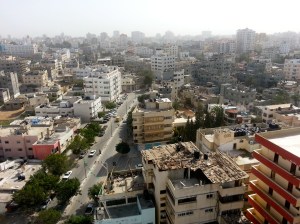
Gaza 2012: Palestine’s Long Walk to Freedom

By: Haidar Eid

Published Wednesday, December 12, 2012

AlAkhabar English


The long walk to South Africa’s freedom is marked by two immensely tragic events: the Sharpeville massacre in 1960 and the Soweto Uprising in 1976, both of which led to the galvanizing of internal and international resistance against the apartheid regime. Ultimately, these events would lead to the long-called for release of Nelson Mandela and to the end of one of the most inhumane systems the world has ever seen.

Without Sharpeville and Soweto, among other landmarks towards victory over settler colonialism, South Africa would still be ruled by a minority of fanatic, white settlers claiming to fulfill the word of (their) God.

Palestine’s long walk to freedom has gone through similar harrowing events, beginning with the 1948 Nakba to the latest eight-day onslaught on Gaza.

In order to understand Gaza in 2012, one ought to trace its origin back to 1948. Two thirds of the Palestinians of Gaza are refugees who were kicked out of their cities, towns, and villages in 1948. In After the Last Sky, the late Palestinian thinker Edward Said argues that every Palestinian knows perfectly well that what has happened to us over the last six decades is “a direct consequence of Israel’s destruction of our society in 1948…”

The problem, he argues, is that a clear, direct line from our misfortunes in 1948 to our misfortunes in the present cannot be drawn, thanks to “the complexity of our experience.”

At 139 square miles, Gaza is the largest refugee camp on earth, a reminder of the ongoing Nakba. The inhabitants of Gaza have become the most unwanted Palestinians, the black heart that no one wants to see, the “Negroes” of the American south, the black natives of South Africa, the surplus population that the powerful, macho, white Ashkenazi cannot coexist with.

Hence the calls to “flatten” Gaza and “send Gaza back to the Middle Ages.”

In 2008-9, Gaza was bombed by Apache helicopters and F-16 jets for 22 days, killing more than 1400 civilians. As if that was not enough, Israel decided to return to Gaza in 2012 and repeat the same crimes in eight days, this time killing more than 175 civilians and injuring 1399. These are massive losses for a population of just over 1.5 million people.

Israel’s airstrikes, which damage essential infrastructure and terrify the civilian population, are a form of collective punishment against the Palestinian people. Even more, they are war crimes forbidden under international humanitarian law, specifically the Geneva Conventions.

Yet Israel consistently gets away with war crimes. The official, government-based “international community” does not seem interested in the suffering of the native Palestinians. The much-admired, “better than Bush” American president, Obama, thinks that “Israel has the right to defend itself.” The same right does not apparently apply to Palestinians.

Likewise, the British Foreign Secretary William Hague believes that Hamas is “principally responsible” for the current crisis, as well as the ability to bring it most swiftly to an end. This is in spite of the deadly siege imposed on Gaza for more than five years, so much so that Israel even used calorie counting to limit the amount of food that entered Gaza during the blockade.

The fact that Palestinians in Gaza are not born to Jewish mothers is enough reason to deprive them of their right to live equally with the citizens of the state of Israel. Hence, like the black natives of South Africa, they should be isolated in a Bantustan, in accordance with the Oslo terms. If they show any resistance to this plan, they must be punished by turning the entire Strip into an open-air prison.

Both the US and the UK display deliberate and unconscionable ignorance in the face of the brutal reality caused by Israel to Gaza. As a result of Israel’s blockade on most imports and exports and other policies designed to punish Palestinians, about 70 percent of Gaza’s workforce is now unemployed or without pay, according to the UN, and about 80 percent of its residents live in grinding poverty.

But don’t Obama and Hague know this?!

As Hamid Dabashi put it:

Obama is fond of saying Israelis are entitled to defend themselves. But are they entitled to steal even more of Palestine, terrorise its inhabitants and continue to consolidate a racist apartheid state…? Was South Africa also entitled to be a racist apartheid state, was the American south entitled to slavery, India to Hindu fundamentalism?

The only option for Palestinians is to follow the same route as the South African struggle. The South African internal campaign aimed to mobilize the masses on the ground rather than indifferent governments around the world. What hope could they have gotten from the likes of Margaret Thatcher, Ronald Reagan, and Helmut Kohl? It was left to ordinary South Africans and global citizens to show their moral rejection of crimes committed by the ugly apartheid system.

In South Africa’s long walk to freedom, there was no compromise on respect for basic human rights. Apartheid’s attempts to point fingers at “black violence” and “intrinsic hatred” toward Western civilization and democracy, did not hold water.

Similarly, international civil society, and some governments, have seen through Israel’s propaganda campaign where the aggressor is turned into the victim. Across the years, Palestinians have been completely dehumanized. Instead of Reagan and Thatcher, we have Obama and Hague, blaming the victim and condemning resistance to occupation, colonization, and apartheid.

But South Africans did not wait for the American administration to “change its mind.” The global BDS campaign, steered by South African anti-apartheid activists, coupled with internal mass mobilization on the ground, was the prescription for liberation, away from the façade of “independence” based on ethnic identities. Similarly, the Palestinian call for boycott, divestment, and sanctions has been gathering momentum since 2005. Gaza 2012, like Soweto 1976, cannot be ignored: it demands a response from all who believe in a common humanity.

Gaza 2012 has, undeniably, given a huge impetus to this process by making all Palestinians inside and outside of historic Palestine realize that “Yes, We Can!” We are no longer the weaker party, the passive victim who does not dare bang on the walls of Ghassan Kanafani’s trunk in Men in the Sun, but rather Hamid in All That is Left To You, the Palestinian hero who decides to act.

Haidar Eid is Associate Professor of Postcolonial and Postmodern Literature at Gaza’s al-Aqsa University and a policy advisor withAl-Shabaka, the Palestinian Policy Network.

Original article appeared here https://talesofacitybytheseadotcom.wordpress.com/wp-admin/post-new.php


As people dig out of the rubble, a Palestinian doctor says civilians were targeted by Israeli attack

Published on Nov 27, 2012 by 

The Nomadic Memorial Cast Lead

Translation in French  Translation in Arabic

On 21 September 2012, the International Day of Peace, the Nomadic Memorial Cast Lead was first performed in The Hague, City of Peace and Justice. From the 30st October till the 2nd of November 2012, the nomadic monument was shown in Bozar, Centre for Fine Arts in Brussels. For the finissage on the 2nd of November 2012 – All Souls’ Day –  the acknowledged Palestinian playwright and actor, Taher Najib gave a lecture-performance.

Reminiscent of a graveyard, the Cast Lead installation consists of 1430 unique books ‘floating’ above the floor in battle-array. Each copy of the book has the name of one of the casualties of Operation Cast Lead, carried out by the Israel Army in Gaza during 2008/2009, on its cover. The books contain texts by writers, artists and thinkers from both the East and West. Each of these books is a monument filled with knowledge that proved incapable of changing the course of events.

Would you like to cooperate in the realisation of this work of art? For the price of €65, you will receive your own unique book as part of the work of art Click to order the book


map of the installation for Bozar, Brussels

Exhibition Bozar

Taher Najib

BOZAR
www.bozar.be

The project is a co production of Ontwerpwerk, Den Haag; Vlaams-Nederlands Huis deBuren, Brussels; Stef van Bellingen, Erwin Jans and Felix Villanueva.

For more information and to donate to this project go to  http://www.gegotenlood.nl/en 


Samah Sabawi: Gaza and the responsibility of the international community on 3CR Radio

Why Israel will lose the war on Gaza

By Samah Sabawi

Israel’s current assault on Gaza will not bring Israel peace nor will it force the Palestinians to surrender.  Three years ago, Israel launched a brutal attack on the city it occupies and besieges killing more then 1400 Palestinians, mostly civilians, and injuring thousands more while destroying most of Gaza’s infrastructure and turning vast landscapes where houses once stood into rubble. What happened in the years since then is a testimony of the Palestinian people’s real weapon – tenacity, a weapon no one in Israel can understand nor truly match.  A weapon Palestinians possess that will see them through until they gain their freedom.

When foreigners visit the Occupied Territories they are often struck by just how resourceful Palestinians are, how positive they remain and how ineffective Israel’s policy of subjugating them is. Yes, Gaza is an impoverished, besieged, overcrowded and occupied strip of land, but a closer look helps shed some light on exactly what it is that Israel is up against. 

This past year, despite the crippling siege on Gaza, some amazing things happened.   Gazans stood on the cutting-edge of urban agriculture:  they were learning through a UN funded project to produce fish and vegetables on their tiny rooftops.  The skill of learning to farm without soil in confined spaces is necessary in a place like Gaza where 1.6 million residents are cramped into 360 square kilometers of land and where much of the agricultural land is off limits because Israel maintains a 300-metre deep zone along the length of the border fence denying Palestinians access to their prime agricultural land.

Gaza opened its first ever paintball park bringing equipment and protective clothing through the tunnels that link Gaza with Egypt.  The game referee Rami Eid told Reuters this was important so “the youth of Gaza can play games that are played around the world”.  

Gaza also hosted this year for the first time an actual circus along with clowns and acrobats.  The circus that travelled through Egypt’s Rafah border brought happiness to many children who had never had such an experience.  Gaza also hosted its first ‘PalFest’, an international Palestinian literature festival along with poets and musicians coming from all over the world.

If that’s not enough to impress, Gaza opened its first restaurant for the deaf.  The stylish Atfaluna restaurant near Gaza port was hailed as one of a few facilities for the disabled in a besieged impoverished city where waiters and cooks use sign language. The restaurant was realissed with help from the Drosos Foundation of Switzerland in order to generate income for the deaf in Gaza, where the unemployment rate is over 25 percent.

This year, as always, the youth in Gaza were finding ways to express their creativity and their skills.  From amazing daredevil Parkour, learning how to surf, to rap songs and art exhibits, they were finding their confidence and were healing from the aftermath of the trauma of Israel’s last destruction of their city.

This year, Gazans lead the way to inspire people around the world as they literally turned rubble into art.  Gazan women driven by the determination to self-empowerment mixed with environmental awareness turned garbage and rubble into pieces of art that can be sold, this project was made possible with funding from the non-government organization ‘Supporters of Palestinian Environment’.

Despite the restriction on building supplies, Gazans used the tunnels to bring in cement and iron and have rebuilt many of the structures that were destroyed.  A highlight for many was the walkway ‘corniche’ by the sea side which many proudly posted photos of on their facebook profiles.

Within the walls of their big prison and in spite of the siege and the frequent Israeli bombardment, the people of Gaza managed to find the space to create, to dream, to build and to hope.  This is the essential stuff that resistance is made of.  This is why Israel’s recent attack will not defeat the Palestinians and will only hurt Israel in the end, exposing it for the tyrannical state that it is.  

Israel has launched a war to break the Palestinian spirit, to destroy all they’ve rebuilt, to uproot all that they’ve replanted.  This is a war on the Palestinian people’s tenacity to resist despair. Israel will lose this war because it fails to understand what it is up against.  A state that only knows how to destroy will never understand the art of turning rubble into masterpieces.  

Reliving Gaza 2009: Searching for Words!

In January 2009 when Israel bombarded Gaza for three weeks, they called their assault ‘Operation Cast Lead’, Amnesty International had a better way to describe it; they called it ’22 Days of Death and Destruction’.  Today, we are reliving that nightmare once again, and once again I find myself searching for words…

Searching for words

Gaza…I search desperately
For words… for definitions
To tell the story of ammunitions
Exploding in a child’s body
I try to shout my indignation
But I am lost in vocabulary
Drowned in phrases as old as me
And I am as old as the Occupation
I need new words

How hard it is to find
Definitions that can restore
Humanity to a small strip of land
Along the Mediterranean shore
Siege, starvation collective misery
Familiar words in my head they linger
Bombs fall from the sky every day
Powerless words I can’t use any longer
I need new words

“Palestine is occupied….”
These are now hollow words…
“Palestinians are oppressed…”
These are now daily words…
“Palestinians are dispossessed”
These are now…tired words
“Palestinians….have a right to exist”
Words often spoken…worn out words
I need new words

Gaza…my home city
My earliest memory of Jasmine flowers and  meramiah tea
My first taste of sour lemon dipped in salt
My first climb on an almond tree
Gaza, my destiny
My father’s heart sky and sea
My mother’s first love
My sister’s first breath
My pride and dignity

Gaza is under fire
Obliterated by hate
Strangled by a demonic desire
To erase my history
Gaza is in pieces
And I…the writer…
I’m speechless
What language can possibly save me?
What words?

Samah Sabawi January 2009

“Gaza” from the soon to be released album “Sounds That Can’t Be Made”.

Gaza

When I was young it all seemed like a game
Living here brought no sense of shame
But now I’m older I’ve come to understand
Once we had houses
Once we had land
They rained down bullets on us as our homes collapsed
We lay beneath the rubble terrified

Hoping.. Dare we dream?
We gave up waiting
For us, to dream is still a dream

When I woke up, the house was broken stones
We suddenly had nothing
And nothing’s changed

We live, eight people, in this overcrowded heat
Factory-farmed animals living in our own sweat
Living like this is all my baby brother ever knew
The world does nothing. What can we do?
We will kick the ball
We will skip the rope
We will play outside. Be careful
We will paint and draw. We will say our prayers

Outside the pitiless sun bleaches the broken streets
The darkness drops in the evening like an iron door
The men play cards under torchlight
The women stay inside
Hell can erupt in a moment day or night

You ask for trouble if you stray too close to the wall
My father died ..feeding the birds
Mum goes in front of me to check for soldiers

For every hot-head stone ten come back
For every hot-head stone a hundred come back
For every rocket fired the drones come back

For thirteen years the roads have all been closed
We’re isolated. We’re denied medical supplies
Fuel and work are scarce. They build houses on our farms
The old men weep. The young men take up arms.

We’re packed like chickens in this town of block cement
I get headache from the diesel. When it rains, the sewers too
I had no idea what martyrdom meant
Until my older brother.. my older brother
I’m sorry. I can’t continue.

You sow the wind, you reap the whirlwind, it is said
When people know they have no future
Can we blame them if we cannot tame them?
And when their hopes and dreams are broken
And they feel they might as well be dead
As they go, will we forgive them
If they take us with them?

Stay close
Stay home
Stay calm
Have faith

With the love of our family we can rise above anything
Someday surely someone must help us
With the love of our family we can rise above anything
Someday surely someone must help us
Even now we will go to school
Even now we will dream to dream
Someday surely someone must help us

Nothing’s ever simple – that’s for sure
There are grieving mothers on both sides of the wire
And everyone deserves a chance to feel the future just might be bright
But any way you look at it – whichever point of view
For us to have to live like this
It just aint right
It just aint right
It just aint right

We all want peace and freedom that’s for sure
But peace won’t come from standing on our necks
Everyone deserves a chance to feel the future just might be bright
But any way you look at this – whichever point of view
For us to have to live like this
It just aint right
It just aint right
It just aint right

It’s like a nightmare rose up slouching towards Bethlehem
Like a nightmare rose up from this small strip of land
Slouching towards Bethlehem

It’s like a nightmare rose up from this small strip of land
Slouching towards Bethlehem

Stay close
Stay home
Have faith

I can’t know what twist of history did this to me
It’s like a nightmare

With the love of our family
We can rise above anything
Some day surely someone must help us…

http://marillion.com/music/lyric.htm?id=824

Gazans produce fish and vegetables in tiny rooftop spaces

by Sara Hussein

GAZA CITY, Palestinian Territories, Oct 29, 2012 (AFP) – Abu Ahmed looks out over a sea of grey, empty Gaza rooftops, and smiles as he looks back at the lush greenery sprouting in tubs and pipes on top of his apartment building.
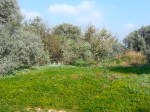
He is part of a United Nations agency project to introduce cutting-edge urban agriculture to Gaza City, teaching Palestinians to farm without soil in the space available to them in one of the world’s most densely populated places.

Most of his rooftop is given over to an aquaponic system, which produces food by linking fish tanks of tilapia with gravel-filled planters.

The integrated system feeds the water from the fish tanks into the plant beds, where Abu Ahmed’s crops — lettuce, peppers, broccoli, celery and herbs — are fertilised by waste produced by the tilapia.

As the water trickles through the gravel, the plants absorb nutrients from the fish waste, cleaning the water, which then replenishes the tanks.

“The idea really was to help the poorest people in Gaza be able to grow some of their own food, and healthy food, grown without pesticides,” explains Mohammed El Shatali, the project’s deputy manager.

For Abu Ahmed, the project has been a major success.

Not only is he using the integrated aquaponic system, he had also set up his own subsidiary hydroponic system, growing additional crops in plastic pipes that are fed by the same water that runs through the aquaponic system.

“I had a bit of experience with agriculture and farming before, but nothing like this,” he says, examining the leaves of a celery plant.

Thanks to the project, the 51-year-old has been able to feed his 13-member family fresh vegetables and fish throughout the summer.

“The fish taste great, although I’m trying not to eat too many of them because I’m breeding new ones so I won’t have to buy more.”

There have also been other benefits from the system, he says, explaining that it cools the apartments below by providing shade.

“It’s great for the children. Nowadays they don’t see farming, they barely see trees or plants. It’s great for them to see this because it gets them interested in growing and planting things.”

Gaza’s 1.6 million residents live on just 360 square kilometres (140 square miles) of land, and much of that is off limits because Israel maintains a 300-metre (yard) deep exclusion zone along the length of the border fence.

Power cuts threaten fish

In Gaza’s main towns and cities, empty land is being eaten up by the construction of multi-storey apartment buildings, leaving little space for agriculture.

The challenges prompted the UN’s Food and Agriculture Organisation (FAO) to look for new ways to maximise crop production in tiny spaces.

In Gaza City’s Zeitun neighbourhood, 34-year-old Eman Nofal tends crops in a small yard next to her apartment. Peppers have been her biggest success this year, and both sweet and spicy red peppers dot the greenery in her planters.

Nofal’s husband was killed in fighting between rival Palestinian groups Fatah and Hamas in 2006, leaving her the sole provider for their four children.

When she heard about the project, she thought it could ease the cost of feeding her family.

“It’s been great. It’s really easy, the children even help me maintain the plants,” she says, acknowledging that the concept was somewhat alien at first.

“All our lives, we learnt that farming meant growing things in the ground, in soil, so it was strange to hear it was possible to grow in water and gravel, but I love the idea.”

Nofal says the project also gives her pleasure.

“Just the way it looks is really nice. Sometimes I come out here just to enjoy the greenery and to watch the fish play with each other. It relaxes me.”

The project has faced setbacks, including the Gaza-specific challenge of power cuts of up to 12 hours a day, which shut down the pumps that transfer water between the fish tanks and plant beds.

“Electricity has been one of the most difficult challenges,” says Chris Somerville, an urban agriculture consultant with the FAO.

“At 30 degrees centigrade (86 Fahrenheit), the capacity of the water to hold oxygen reduces, and during the summer many of the beneficiaries had fish die.”

New participants will receive a battery-powered pump to tide them over during power cuts, and the FAO is experimenting with fibres that could be used in hydroponic systems to retain moisture when power cuts stop the water flow.

Initially, the project also had to overcome a certain level of scepticism, Somerville says.

“To tell agrarian societies that you’re going to grow plants without soil can sometimes be a bit of a jump,” he laughs.

But the project has been so successful that the next cycle will expand from 15 aquaponic participants to around 80, with another 80 homes operating hydroponic systems.

It will be the first time the FAO has implemented aquaponics on this scale, and the agency is now looking at implementing the project elsewhere in the world.

“To be able to take this Gaza model and bring it to other countries would really be a massive achievement,” Somerville says.

This article appeared in http://www.mysinchew.com/node/79207?tid=10

Public Reading at La Mama October 13th Melbourne Australia

A play that explores the lives of ordinary people living in the besieged Gaza strip in the winter of 2008. Jomana, a woman from the Shati refugee camp, falls in love with Rami, an American Palestinian doctor who arrives as part of the Free Gaza Flotilla. Breaking the siege sparks their love – but can it be sustained?

Public Reading: La Mama Theatre, October 13th at 2pm


To book online go to http://www.trybooking.com/BZDI

Tales of a City by the Sea is a unique and poetic journey into the lives of ordinary people in the besieged Gaza strip prior to, during and after its bombardment in the winter of 2008.

Jomana, a Palestinian woman who lives in the Shati (beach) refugee camp in Gaza falls in love with Rami, an American born Palestinian doctor and activist who comes on the first Free Gaza boats in 2008. Their love is met with many challenges forcing Rami to make incredible decisions the least of which is to take a dangerous journey through the underground tunnels that connect Gaza to Egypt.

Although on the surface this love story appears to explore the relationship between diaspora Palestinians and Palestinians under occupation, there is a broader and more universal theme that emerges – one of human survival and tenacity.

Tales of a City by the Sea avoids political pitfalls, ideological agendas and clichés by focusing on the human story of the people in Gaza. Although the play’s characters are fictional, the script is based on real life events and is a product of a collection of real stories the author Samah Sabawi and her family have experienced during the events of the past several years. Sabawi has written most of the poetry in the play during the three-week bombardment of Gaza in 2008/2009.

Creative Producer: Rand Hazou

Rand Hazou was born in Jordan. His family are from Jerusalem. Rand is an Australian/Palestinian academic and theatre facilitator. In 2004 Rand was commissioned by the UNDP to travel to the Occupied Territories in Palestine to work as a theatre consultant running workshops for Palestinian youths. In 2009 Rand was awarded a PhD in Theatre and Drama at La Trobe University. His thesis examined the latest wave of political theatre in Australia dealing with Asylum Seekers and Refugees. In 2011 Rand was awarded a Cultural Leadership Skills Development Grant from the Australia Council for the Arts to develop The 7arakat|Harakat Project, involving a series of theatre-related initiatives between Australia and Palestine. As part of this grant, Rand travelled to Palestine in October 2011 to participate in an internship with Al-Kasaba Theatre in Ramallah. Rand is currently undertaking an internship with Multicultural Arts Victoria. As an academic he has taught across a wide variety of subject at La Trobe and Monash Universities. He is currently a lecturer and tutor in the theatre and drama program at La Trobe University.  For more information on the 7arakat project visit http://www.centreforcreativearts.org.au/projectspace/7arakat.phps

The Cast

Osamah Sami

Osamah Sami is an actor and writer of Iraqi heritage. Born in 1983 in Iran – he migrated to Australia in 1995.  Osamah has worked extensively on stage, including playing the role of Saddam Hussain in “Saddam: The Musical”, as well as other productions, including Sinners (La Mamma), Homebody/Kabul (Theatre@Risk), Long Day’s Dying (La Mamma), Baghdad Wedding (Belvoir St.), Blackbox 149 (La Mamma)…His TV roles include East West 101 (SBS), City Homicide (Seven), Rush (Ten), Sea Patrol (Nine), series regular in the 13-part series Kick (SBS), the lead role in Tony Ayres’ award winning tele-movie Saved opposite Claudia Karvan, the lead in Dee McLachlan’s feature film “10 Terrorists” and the award winning short 296 Smith Street as well as the feature film Lucky Miles.  He is currently working on a feature film with director Tony Ayres “Ali’s Wedding” which he has co-written with Andrew Knight.

Veronica Porcaro

Since graduating from Flinders University Drama Centre, Veronica has had a very diverse and dynamic acting career in Theatre, Film, Television and Role Playing/Training across many arenas from mainstream theatre and television to educational and political theatre, script development and corporate work.  Her credits include: The Grace of Mary TraverseSix Characters in Search of An Author, Stories from the UndergroundA Translation in HistoryTwelfth NightThe Jungle of Cities10 x10 play seriesMeat Pies and MortadellaNile BlueGP, Water RatsHeart Break HighMurder CallBlue HeelersSatisfactionWhatever Happened To That Guy and Neighbours.

Hannah Norris

Hannah Norris is a widely acclaimed actress of the independent and professional stages of Australia. She is perhaps best known for her powerful performance of the one-woman show My Name is Rachel Corrie (Daniel Clarke) in Melbourne and Adelaide, receiving Adelaide Critics Circle and Victorian Green Room Award nominations, and the 2010 ATG ‘Curtain Call’ Award for Best Female Performance. Hannah has recently returned to Melbourne from a national tour of David Williamson’s Let the Sunshine (Hit Productions) and is currently working on a 2013 production of Tahli Corin’s One for the Ugly Girls. For more info, go to www.hannahnorris.com.au

Wahibe Moussa

Wahibe Moussa is a performance-maker, writer and Green-Room award winning actor, currently studying in the Master of  Writing for Performance at the Victorian College of the Arts. She has gained respect as a Cultural/Language Consultant through Theatre and television projects.  Wahibe’s writing practice is informed by her work with diverse Refugee and Indigenous communities, and her interest in connections between the personal and political; the exchange of power within relationships.  As a Community Artist, Wahibe works collaboratively in Theatre, Visual Art and Writing Projects in Melbourne and Sydney.

Jomana Najem

Jomana Najem has a background in Film Production and literary journalism, and has been extensively involved with the Arabic speaking community for the last ten years in various capacities.  Jomana has also written, directed and produced several short films and documentaries. She has worked both behind and in front of the camera as an actor and television presenter. She has is the writer of a feature length film script that centres around the lives of several Lebanese Australians, and their struggles to overcome their past. “The Borrowed Prophet” is currently in pre-production and has been endorsed by the Lebanese and wider Arabic speaking community.

Majid Shokor

Majid Shokor is a writer, researcher, and actor for stage and screen.   Originally from Baghdad, he lives and works in Melbourne.  Since his arrival in Australia in 2001, he has appeared in many plays, short films, TV series and the feature film Lucky Miles, for which he was also the cultural consultant.  He worked with many acclaimed directors and writers such as Jean-Pierre Mignon, Daniel Keen and Nigel Jamieson to name few.  His performances have received critical acclaim and been honoured with two prestigious Green Room Award nominations for Best Actor in Independent Theatre, in 2005 and 2009.  Majid holds a Master degree (Honours) and a Post-Graduate Diploma (1st class Honours) in Community Cultural Development from the Victorian College of the Arts – Melbourne University

Ryan Smith

Ryan is a second year student and is currently studying arts at La Trobe University. He has been involved in many highly successful productions in their student theatre program. He has also been highly involved in amateur theatre companies in his home town. He has a large background in musical theatre. This is Ryan’s first production outside of his university and local area.

Beth Sherwell – lighting and sound

Beth is no stranger to the world of theatre, television and drama; having worked on the TV show Neighbours as well as various other films. Most recently she played the character of Amy March (the youngest sister) in the  production ‘Little Women’.  ‘Tales of a City by the Sea’ is Beth’s first technical gig, she is currently completing a degree in English and Drama Majors.

James Crafti – lighting and sound

James Crafti is co-manager of Under the Hammer an Activist Artists Hub in Coburg a place he founded to explore art within a social justice framework. Crafti completed a Bachelor of Creative Arts at La Trobe in 2009 and directed plays at La Trobe including Creationism, Rope and Seven Jewish Children. In 2010 James worked as an assistant director on Melbourne Worker’s Theatre’s show Yet to Ascertain the Nature of the Crime. Crafti also directed two plays with Platform Youth Theatre Mutha and The Deserters, and is now serving on Platform’s Board. He is currently undertaking his Masters in Community Cultural Development at the Victorian College of the Arts.