New Gaza Documentary Flying Paper captures children’s creative resilience through the kite culture

April 15, 2013
Gaza beach kite record @Eman Mohamed


A new documentary, “Flying Paper,” takes us on a cinematic journey into the kite culture among Palestinian youth in the Gaza Strip, and their quest to shatter the Guinness World Record for the most kites ever flown.

The film will be shown at Athens International Film Festival in Ohio starting this week [Editor’s note: the article was originally published before the Festival took place. The Athens International Film and Video Festival took place between April 12 and April 18 2013].

Flying Paper tells the uplifting story of Palestinian youth in Gaza in the run-up to the world record-breaking event, showcasing the creative resilience of youth making and flying kites despite the hardship in their lives.

The feature-length documentary film was directed by Nitin Sawhney and Roger Hill, and co-produced with a team of young filmmakers in Gaza. Told through the lens of a handful of children from Jabaliya refugee camp and Seifa village, the film seeks to convey a unique, compelling narrative of life from a place that is very often misrepresented in the mainstream media.

Co-directors of Flying Paper and key members of the production team discussed the film.

Back in 2006, Nitin Sawhney, Assistant Professor of Media Studies at New School for Public Engagement, co-founded the media initiative Voices Beyond Walls (VBW) to run digital storytelling workshops with Palestinian youth in refugee camps, in the West Bank. French freelance photographer Anne Paq joined VBW in 2008. In winter 2009, Sawhney met US documentary filmmaker Roger Hill. They both wanted to shoot a film in Gaza, different in style to most documentaries on Palestine. The subject remained to be determined.

After a first trip to Gaza, Sawhney went back in summer 2010 to set up VBW youth media program in Jabaliya camp. Hill joined him as a trainer, and Paq came later to follow up with the program participants.

Sawhney and Hill felt it was necessary to produce a documentary-length film that would reach wider audiences. They had heard about a forthcoming kite festival, organized by the UN. The Guinness record-breaking attempt seemed to be an ideal cinematic story.

At the end of the youth media program, Sawhney challenged the best trainees: “If you’re really good, I want you to work with me and Roger on a new film project.” They signed on right away. Nearly a dozen youths aged 12-16 moved on to the production set, filming footage across Gaza and documenting the record-breaking festival.

The two central settings of the film are Jabaliya camp and Seifa village. Seifa sits close to Gaza’s northern border with Israel, inside the “buffer zone,” a military no-go area with watchtowers and shooting spots just meters away. Jabaliya, with the largest refugee camp in Gaza, is very densely populated.

To fill in the back-story, Sawhney and Hill looked for good kite makers as potential characters profiling the youth before, during and after the Guinness Record attempt. With the help of the UN, they found a family in Seifa.

Kite maker Musa, young charismatic leader, and his sister Widad, witty and sarcastic, are primary characters. The grandfather, Abu Ziad, village governor, also appears in the film to highlight the connection between his generation and the youth through the kite making tradition. Abeer, 19, leader among the young graduates from VBW program, is narrator and co-producer. “I enjoyed playing both roles,” she says. “I wanted to do make an impact through this film.’’

Abeer was fully involved in the making of Flying Paper, providing contextual information, conducting interviews, filming, giving feedback. “Abeer really helped to carry the film along. She has been vital on camera and behind the scenes,” Hill observes.

Paq, co-producer and photographer, worked with Abeer developing a voice narration, shooting additional segments with her and about daily life in Gaza. Based in the West Bank and often travelling to Gaza, Paq organized film showings, contributed with regular feedback, and facilitated sharing feedback from the Palestinian youth.

Video editor Ahmed Elabd and Emmy award winning editor Rafael Parra took Flying Paper through its final cut. World-acclaimed composer Nitin Sawhney, based in London, contributed with original music throughout the film. Animator Daniel Nienhuis produced animated sequences in the film.

Uzma Hasan, London-based independent producer, came on board last September. Hasan joined to help the film crew to raise finishing funds for completion, and get the film out to wide audiences worldwide.

According to Sawhney, this film is important because it’s purely told through children’s voices. “Those kids live under threat, yet they’re the most hilarious, charming kids you’ll ever meet,’’ the co-director adds.

For Hill, making the film in the voice of Gazan youth was crucial. “I valued the fresh perspective, energy and creativity that the youth brought,” he points out.

Similarly, Paq underlines the films doesn’t have experts talking with the children, or instead of them. “The voices of the youth aren’t taken away; it’s them talking to the camera,” she hints.

Far from being ignored in the film, the general situation in Gaza serves as background for the story. “The film shows many positive things about Gaza, but doesn’t remove the bigger picture,” the photographer clarifies.

The tone of Flying Paper is playful and uplifting. “For a documentary coming out of Gaza, the fact that it keeps you laughing, and breaks your heart, is amazing,” Sawhney notes. Hill thoroughly enjoyed telling a small story within the larger social-political context, with the intention to attract larger audiences who can learn about life in Gaza through the story.

Paq thinks a serious, heavy documentary doesn’t quite reach the public. “If you have a story offering a different dimension, you can touch people in a much stronger way,’’ she argues. Hasan shares similar thoughts. “This film throws a different line on a very over-politicized situation,” she says. “Its essence is incredibly simple, beautiful, and universal.”

Flying Paper captures children’s creative resilience through the kite culture. Sawhney believes the poetics of kites is an easily accessible metaphor for Gazan children. A struggle, in the act of making, and a sense of freedom, in the act of flying.

On the day of the kite festival, children turned up on the beach, ready to fly over 7,000 kites at once. “All those kids looking happy and proud of their achievement send a powerful message to the world,” Paq reflects. Among the many beautiful scenes, Paq points to one where Musa finds his kite broken, and repairs it. “It’s a strong metaphor for life in Gaza, where Palestinians rebuild their lives again,” she says.

Flying Paper was very well perceived in the local communities where it was filmed. “People welcomed a story that isn’t just about their suffering. There’s life, culture, community, love,’’ Hill emphasizes.

Jabaliya camp and Seifa were heavily bombed during Operation Pillar of Defense, last November. Paq was in Gaza to film more shots with Abeer for the final scenes. During the war, Paq shot some new footage. After careful discussion, the co-directors decided not to include the new material in the film, not to alter its narrative.

After three years in the making, Flying Paper was completed at the end of last year. The filmmakers successfully raised $28,956 from 286 backers via Kickstarter for completion of the final cut. Additional funding was secured through small grants and tax-deductible donations.

Private screenings were held in the US last year, and a showing was organized in Seifa, last February. Flying Paper has so far been accepted for screening at the Athens International Film Festival in Ohio (12th-18th April) and atLondon Palestine Film Festival on the 7th of May.

Abeer invites everyone to watch Flying Paper: “We wanted to show the truth in a simple way, through a small story.’’

‘’I hope the film sends a humanizing message that children in Gaza are like all children in the world,” says Hill.

 This article was originally published on the website progressive.org on April 8th 2013 and was retrieved from EMAJ magazine 
***

Gaza film Condom Lead first Palestinian short to enter competition for Cannes Film Festival

A Palestinian film has for the first time made it into this year’s competition for the Cannes Film Festival.  The film Condom Lead is created by Identical Gaza twins Tarzan and Arab.  The pair are known for their creative and unique styles.

 “Condom Lead is a short, enigmatic parable about what it means to be human in a time of war. It is a story that could happen anywhere – anywhere there is, ever has been, or ever will be war; anywhere there is a man and a woman and a room. An intense, darkly comic study of what becomes of ordinary passions between a man and his wife in the long interstices of war’s heightened reality, Condom Lead is a story about sexual frustration on the edge of time’s knife and in the crosshairs of war’s guns, a dream of the hope for intimacy and love in a brutal, divisive world.”

Palestinians perform Carmen with Swiss choir

Monday, 15 April 2013

Reuters – published on AlArabiya

Palestinian musicians from the West Bank collaborated with a Swiss choir to perform George Bizet’s renowned opera, Carmen.

The concert took place in Bethlehem’s Convention Palace.

Playing alongside musicians from the The Edward Said National Conservatory of Music (ESNCM) Orchestra were members of the Palestinian Youth Orchestra, made up of Palestinian students aged between the ages of 12 and 19 who live in the West Bank.

The young musicians are taught by Palestinian, European and American musicians.

Director of the Edward Said National Conservatory of Music, Jalil Elias, said the event showed just how talented the young musicians are.

“This is a very unique event for the Edward Said National Conservatory of Music because it needs very qualified people to work on it, particularly as it is the opera of Carmen. Our students and teachers worked with this organization to ensure the success of this event which is the first of its kind to happen in Palestine. With this high performance we have proved that Palestinians are highly qualified and are able to do such an event in our country,” said Elias.
Set in the Spanish city of Seville in the 19th century, the opera tells the tale of a passionate love story between Carmen, the fiery Spanish gypsy girl who seduces Don José, a naïve soldier who goes mad with love with tragic consequences for them both.

The young musicians taking part in the show said they were delighted to be a part of such a performance.

“This is a professional orchestra and today we will play with opera singers from Switzerland, who are famous and who sing opera in a unique way. As Palestinians playing with these people it makes us very happy and has touched and changed us,” said Lamar Jaleel, who plays the violin.

The St. Michel Choir is made up of singers between the ages of 16 and 25 years from Fribourg, the capital city of the Sarine district.

Friboug is a medieval town that sits on the cultural border between the German and French speaking parts of Switzerland.

Colombian pianist and conductor Juan David Molano has been the ESNCM’s Principal Conductor since his appointment in 2011.

“I can relate that perfectly with the situation in Palestine. They are just [too] oppressed to flourish their cultural capacities and I think this is the occasion for them to look outside this oppression and this gives them more strength in character and they are really having the benefit of all this,” said Molano, who conducted the orchestra.

The ESNCM works in partnership with the Fondation les Instruments de la Paix (Switzerland) and the Geneva Conservatoire, where Molano is also a professor of piano.

Local residents filled the auditorium seats and concert-goers expressed their joy at witnessing the progress of their young Palestinian musicians.

“The performance is really amazing and the participation of Palestinian youths with an international opera from a country like Switzerland prove that the Palestinian youths are excelling in their musical abilities and are representing Palestine to the world. Being able to play with this opera means that they have reached a very good level,” said one concert attendee, Maha Jabeer, from Bethlehem.

The Edward Said National Conservatory of Music was set up in 1993 after five Palestinian musicians and music teachers carried out a study on the status of music in Palestine in 1990 and found a huge lack of musical education in Palestinian society.

This article appeared on  AlArabiya

Al-Akhbar: Visualizing Palestine Design Against Injustice

Written by: Yazan al-Saadi

Published Sunday, April 14, 2013 by Al-Akbar English 


A quote at the bottom right corner of the graphic reads: “We are not in search of death, we are looking for real life.” The words are from the 1989 declaration of the Tiananmen Square hunger strike.

This was Visualizing Palestine’s first infographic and it was quite a compelling start.

More than a year later, other stunning infographics were produced. These elegant images range from a simple demonstration
of childhood births at Israeli checkpoints to a more complex image detailing the inequality of water distribution in the West Bank.

“Visuals are important because of their speed, its adaptiveness to social media, and the fact that the mind captures more from visuals than from texts,” Joumana al-Jabri, one of the co-founders, remarked to Al-Akhbar during a lunch on a Sunday afternoon that gathered most of the VP team at her apartment on Bliss Street.

The use of images and graphs to emphasize the daily injustices experienced by Palestinians by the Israeli colonial occupation is not entirely unique, but what makes the works produced by VP groundbreaking is the group’s ability to streamline and bond documented facts with eye-popping visuals.

The bread and butter of the project’s work are rooted in its embrace of a multi-disciplinary approach. In this way, diverse strands are tied together, further strengthening the emotional and intellectual impact of each graphic.

The staff of VP are very much aware of the power they hold.

In the Beginning…

The idea of VP was conceived by Ramzi Jaber in the early months of 2011. Like most good tales, it began with a journey and personal questions.“The story I tend to tell is this: I was part of TEDxRamallah, and for a year and a half I was going from village to village, asking myself why as Palestinians are we in this mess and who is doing something about it,” he said.

On his trips, he’d hear shocking statistics, like the fact that each year, 700 Palestinian children are incarcerated in Israeli jails. To Jaber, the injustices committed in Palestine are “the most documented injustices on earth.”

“I was shocked on two levels – shocked by the whole colonial aspect and the sheer injustice, and shocked by my own ignorance,” he said.

At the same time, Jaber was in awe of the growing popularity of TED, prompting him to think about how to take Palestine’s statistics and “present it through the power of storytelling.”

In April of that year, Jaber attempted to establish such a project using volunteers. According to him, he spent months organizing two workshops that brought in researchers and designers, but zero graphics were produced. According to him, the problem they faced was two-fold: the amount of expertise required was difficult to find since this was a new endeavor and it required a stable, committed team rather than volunteers.

Soon after, Joumana al-Jabri, a designer and architect mainly based in Dubai, and Ahmad Barclay, an architect by training, were brought into the fold. Immediately, they began looking for others.

Naji El Mir, a designer based in Paris, and Hani Asfour, founder of PolyPod, a multi-disciplinary designing company located in Lebanon, became key partners at VP, as well as the main designers behind many of the graphics.

“Infographic is like an iceberg, you see one-tenths of it and there is so much below that of work being done. We needed researchers, people who sit down and do huge amounts of research and we still need more,” Jaber said.

Today, VP is a small core team of eight individuals, most in their twenties and thirties, and each providing their own unique skill set. Recently, Saeed Abu-Jaber, a young designer from Jordan was hired. In terms of research, text, and copy-editing, Zaid Amr, in Palestine, and Chris Fiorello, in Beirut, were added.

“Most of the people are from a mixed background so this adds a nice flavor to the design. We aren’t brought together by nationality or driven by jingoistic tendencies, and we are not an activist project that simply wants to save ‘the poor helpless victims,’” Barclay stressed.

Infographic 101

How does VP create an infographic?Mainly, if an urgent news story breaks out, the team decides to develop an infographic in order to give context to what is happening. “Often, or almost always, the news is misrepresented or isn’t given context by the media. The rule of thumb tends to be that if the news is more prominent, it is more likely to lose its context,” Jaber said.

The final element, which is not the main focus of VP presently, is to highlight the absurdities of daily injustices. As an example, Jaber spoke of how Israel prohibits Palestinians holding different color-coded IDs from marriage, a restriction he had personally experienced and was keen on highlighting sometime in the future.

Once a topic is selected and fleshed out through various brainstorming sessions, the researchers gather the data and verify sources. From there, it is passed on to Barclay who molds it into a story.

The hardest part, according to Barclay, is the ability for one close to the data to take a step back and try to look at the bigger picture. He pointed out that there may be topics that simply can’t be visualized easily, topics and data that are segregated by borders, complicated stories that are hard to simplify on a static, two-dimensional image.

“It’s a good and bad exercise, in the sense that how do you get to the core message that strikes people and is rooted in analysis and facts? How do you tell the story to engage and motivate people, without becoming jingoist? How do you get people to understand an idea better or that the continuation [of injustice] isn’t inevitable?” he emphasized.

Abu-Jaber, the newest hire, said, “The beautiful thing is choosing. Finding that point of the story that grabs you. I like the process. It is quite fantastic because you’re learning something new while you’re designing. Essentially, you need to educate yourself.” For Abu-Jaber the work with VP offered a much more meaningful experience than his previous experiences working in fashion and magazine design.

“The work I used to do before made me feel dead inside. But this has a point and I feel like I’m doing something meaningful. This is like design activism,” he chuckled.

After this stage, a brief is made and shared with the designers, who proceed to translate the words into an alluring visual. The visual product is reviewed in order to ensure that the story is still intact.

“The facts are always the red-line. We actually go beyond, and try to maneuver the story to put the context in because you can take the facts out of context. So we maneuver it to include context, and puts the fact right where it needs to be,” Jaber said.

Once all parties are satisfied, it is published online.The final step is to track the graphic’s impact, seeing who shares it and what type of debates it generates. This entire process can take anywhere between three days and three months.

The structure behind the process came out of a lot of trial and error, or as Jaber joked, “more error than trial.” But a structure was shaped, and in the spirit of the project, it was presented as an infographic available online for others to see and use.

Yet even now, the production isn’t entirely without kinks. “We need more effort, more people,” Jaber stated, “People who are dedicated, committed, and have the required skills. It’s harder than getting money.”

Funding, the bane for every organization on the planet, is particularly an issue, especially for a team that is independent from political backing. The VP team are planning to tap into crowd-funding campaigns through sites like Kickstarter, rather than the traditional grant route. This way, they hope, will continue to ensure the project’s ideological independence.

Visualizing International

Since its first graphic, VP has steadily been building a strong following, particularly within the NGO, civil society, and international solidarity sectors. For Jaber, it’s a sign that VP is on the right track.

“Success to me is that our visuals are being used effectively. I’ve heard that people have used them in conferences and in schools. They use our visuals to deliver a message, and the more that effectively happens, the better,” he said.

As another sign of success, the graphics by VP have been translated into more than seven languages, such as Arabic, French, Spanish, Korean, and Finnish. They have penetrated parts of the mainstream media, popping up in Al Jazeera English, the Huffington Post, and elsewhere. And there is still more to come.

“Our next plan is to move into other media. We are very keen to go into animation, dynamic infographics, or even crowd-designed graphics,” Jabri stated.

But it is the ambitious concept of Linked word Visualizing Justice that has the most potential. The idea builds from the successes of VP and first conceived during an American tour by Jaber.

“We were being contacted by lots of people around the world who wanted to use the same form of visual styles for their causes and communities. They saw that communications is what rallies and mobilizes people together. So we wanted to provide tools and platforms for people to do the same thing in other cause. That’s our plan, but right now we are barely surviving as it is,” Jaber explained.

“Visualizing Justice became our platform that allowed us to transfer knowledge and become an umbrella for other groups to visualize topics other than Palestine – such as Visualizing Syria, Visualizing Burma, and Visualizing Water,” Jabri said.

Jaber reflected on the end-game for VP. He pointed to how the end of Apartheid was brought about by the achievement of a “world-wife understanding.”

“When people understand, it translates into action. Positive change is happening, whatever it is,” Jaber said with a wide smile.

The Japanese technological-fashion designer Issey Miyake once wrote, “Design is not for philosophy, it’s for life.” Can design really change realities and lives? In the case of Visualizing Palestine’s designs, it seems to ring true.

This article first appeared here

The Economist: A theatre of protest “The Island” opened to packed audiences in Palestine’s Jenin refugee camp

ADAPTED from South Africa’s Robben Island, where Nelson Mandela was jailed under apartheid, to an Israeli prison cell, Athol Fugard’s play “The Island” has opened to packed audiences in the Jenin refugee camp on the Israeli-occupied West Bank. Confined to a concrete floor set in a sea of sand, two cellmates keep up their morale by rehearsing a production of Sophocles’s Antigone, in which a woman chooses to die rather than obey the king’s decree not to bury her brother, a political dissident. “You won’t sleep peacefully,” Antigone tells the king when he condemns her to death.

Despite its transposed setting, the play retains its poignancy. Almost every Palestinian on the West Bank has a brother, father or husband whom the Israeli authorities have, at one time or another, locked away. At present, 4,500 are behind bars. Jenin may have the highest rate of any town. Imprisonment has become a male rite of passage, as well as a place of higher education: many opt for distance learning at Israeli universities.

Ahmad Rokh, one of the actors in “The Island”, who has served four prison terms, was first put inside at the age of 14. The refugee camp in Jenin was a prime source of suicide-bombers during the second intifada (uprising) that lasted from 2000 to around 2005. Nearly a decade on, it has recovered a sense of humour. The audience laughs at the prisoners dressed in drag.

The theatre has had to overcome a troubled phase. Two years ago its founder, Juliano Khemis, a half-Palestinian, half-Jewish actor, was killed in circumstances that neither the Israeli nor the Palestinian authorities have explained. The Freedom Theatre has reopened its drama school after a hiatus of more than a year.

Though the number of Palestinian political prisoners has halved since the height of the second (and most recent) intifada, it is still twice as high as it was a dozen years ago. Those behind bars include hundreds of stone-throwers, 15 members of the Palestinian parliament and 170 people held without trial under “administrative detention”. The Palestinian Authority also runs its own prisons, where scores of leading members of Hamas, the Islamist group that rejects Israel’s existence, have been locked up.

When an Israeli production of the same play was performed at the Hasimta Theatre in Jaffa three years ago, the director, Alon Tiran, observed members of the audience leaving “in a different mindset from when they arrived”. He could not ask for more than that, he said. In Jenin, reactions have been more pronounced. “We are all Antigone,” says Ahmad Jbarah, better known by his nom-de-guerre, Abu Sukar, who attended the play’s opening. “The more the oppressor condemns us as criminals, the more heroic we are,” he says. Mr Sukar was in prison for 27 years for his part in a bombing in Jerusalem in 1975 that caused 15 civilian deaths.

This article appeared here

Art As Resistance: Centre for Palestine Studies to host representatives from Jenin Freedom Theatre at Columbia University’s Middle East Institute April 14

Centre for Palestine Studies

Please join us for a panel discussion with videos and presentations by representatives from the Jenin Freedom Theatre in Palestine. The panelists will discuss the following:

  • What is it like to make theater in Occupied Palestine and why is this work important?
  • What is the relationship between theatre and politics in Palestine as practiced at The Freedom Theatre?
  • How does the theatre continue its work under severe repression, murder and arrests?
  • What are the similarities/differences in acting education between the U.S. and Palestine?

Panelists

Faisal Abu Alheja is 23-yr-old Palestinian actor trained at The Freedom Theatre in Jenin. He has performed in Animal Farm, Fragments of Palestine, Men in the Sun, Sho Kaman and is currently in rehearsal for The Island. Faisal was a member of the Playback Theatre troupe in 2012 and has toured in Germany, Austria, and Switzerland.

Ahmad Al-Rokh is a 24-yr-old Palestinian actor trained at The Freedom Theatre in Jenin. He has performed in Animal Farm, Men in the Sun, Journey, Sho Kaman and is also currently in rehearsal for The Island. Ahmad was a member of the Playback Theatre troupe in 2012 and has toured in Luxembourg, France, and Belgium.

Gary English is a Board of Trustees Distinguished Professor, Professor of Theatre, of the University of Connecticut. He is also the Founding Artistic Director of Connecticut Repertory Theatre, as well as the current Artistic Director of The Freedom Theatre in Jenin.

This event is co-presented by the Friends of the Jenin Freedom Theatre (www.thefreedomtheatre.org) and the Center for Palestine Studies at Columbia University and co-sponsored by the Network of Arab American Professionals – NY (NAAP-NY), ArteEast, and Alwan for the Arts.

This event is free and open to the public and on a first-come, first-seated basis. RSVP recommended to palestine@columbia.edu.

APRIL 14, 2013, 5PM
Room 501 Schermerhorn
Columbia University
Enter Gates on 116th Street & Amsterdam or Broadway
Facebook: https://www.facebook.com/events/441878539223779/

For more information go to the Centre for Palestine Studies

Palestinian Singer Oday Khatib Awaits Israeli Military Trial

This article appeared April 4 on the World Music Network

Palestinian Singer Oday Khatib Awaits Israeli Military Trial

Oday Khatib, the young Palestinian singer of Arabic classical music and protégé of Riverboat Records artist Ramzi Aburedwan, has been charged with stone-throwing, facing up to ten years in prison if he is convicted. Testimonials from around the world have been written in protest at the charge, from teachers and associates who know him, with many expressing a profound skepticism at the credibility of the charge.

Oday’s father, Jihad Khatib, claims that his son was arrested while waiting for a friend he was meeting for dinner, a victim of the indiscriminate nature of occupying forces in the West Bank. Talking to Musa Abuhashhash, a field worker for the Israeli human rights organization B’tselem, Jihad noted that nearby some youths were throwing stones, ‘and when the soldiers chased the kids, it did not come to his mind that the soldiers would go for him. Otherwise he would have run away.’

Born and raised in the Al Fawwar refugee camp near Hebron, Oday had never been arrested before and had always been known for his singular dedication to music, gaining a reputation for his interpretations of Palestinian protest songs from an early age. ‘Oday is not interested in throwing stones or getting involved in this. Since he was nine years old he was interested only in music’, his father said.

As a teenager Oday became celebrated as the star singer of Aburedwan’s Ramallah-based Association Al Kamandjâti, an orchestra set up to provide access to music for Palestinian children under occupation in the West Bank. He has since toured internationally with a number of ensembles, including Al Kamandjâti, as well as participating in music education and outreach projects in Europe.

OdayKhatib

Julia Katarina, the British Mezzo-Soprano who put her opera career on hold to teach voice lessons at Al Kamandjâti for three years, was among many musicians from around to voice her support for Oday: ‘He is very generous with his art, and just loves singing beyond all else! He is a true singer, and I imagine the only way he is surviving prison is by singing. I hope he sings in the military court,’ Julia writes, because if Oday’s accusers can find ‘an ounce of humanity in their hearts, they will release him.’

Such a prospect appears unlikely, however; according to the author and blogger Sandy Tolan, in 2010 the conviction rate in military trials for such alleged offenses was about 399 out of 400, a figure accompanied by a growing clamour among settler communities in the West Bank to have stone-throwing treated as akin to live fire by the IDF.

Support Association Al Kamandjâti: http://www.alkamandjati.com/en/home/

Follow Sandy Tolan’s blog: http://ramallahcafe.com/

This article appeared on  World Music Network

Press Release: Palestinian Museum’s Groundbreaking Ceremony Set for 11 April 2013

[issued by the Palestinian Museum on 3 April 2013.]

The Welfare Association, celebrates on Thursday, 11 April, the groundbreaking ceremony for the Palestinian Museum in the town of Birzeit. The museum, which will open its doors in Fall 2014, will be dedicated to the exploration and understanding of the culture, history, and society of Palestine and its people and will be a space that brings together an innovative mix of exhibitions, research, and education programs, acting as an agent of empowerment and integration and a place for inspiration, dialogue, and reflection.

The concept behind the museum is a transnational institution bringing together Palestinians from all over the world. It will not be confined by borders, barriers, and geopolitics. It will be a physical and virtual space for those living in Palestine and those living abroad, enabling them to explore their shared past, present , and future. The museum will be an innovative, world-class research and cultural institution that mobilizes Palestinians and encourages them and others to ask questions about important issues while simultaneously engaging a global audience of scholars, researchers, and anyone interested in learning more about Palestinian culture and heritage.

Omar Al-Qattan, Chairman of the Museum Task Force stated: “The Palestinian Museum is created to encourage new thinking about Palestine and its people. It is a place for a continual conversation about the most important issues facing us today, which will be conducted through a variety of forms of expression. The project is about Palestinians, but it is not simply for them: we want to create a space that is inclusive, welcoming, and informative, but is also international in its reach and audience. The Birzeit Building will be a hub in a network of partnerships with local and international organizations that focuses on the present, history, and future of Palestine.”

The building will house a collection of objects and historical documents that date from the modern period to the present that will be held by the Palestinian Museum in public trust for the benefit of current and future generations. A digital archive will hold information about the museum’s collection in addition to the existing collections of other Palestinian cultural institutions. The museum is also building a cutting edge digital platform that will form a major part of its ongoing program.

The idea for a museum was first discussed in 1997, when members of the Welfare Association’s Board of Trustees recognized the need to establish a modern historical museum in Palestine dedicated to preserving and commemorating the recent Palestinian past; in particular the Nakba (Catastrophe) of 1948 —the watershed event of 20th century Palestinian history which led to the displacement and dispossession of 750,000 Palestinians.

“A series of conceptual changes over the years have reconfigured the museum’s purpose. “When the Museum opens its doors in 2014, it will do so as an institution dedicated to celebrating, preserving, interpreting, exhibiting, and making accessible Palestinian culture, history, and art to the museum’s visitors and audiences. Our vision for the Palestinian Museum is founded upon the belief that a museum presents information, asks questions, and provides opportunities for visitors to explore and engage with different aspects of culture and history in order to reach their own informed conclusions,” said Jack Persekian, Director and Head Curator.

Designed by the Dublin-based architectural firm, Heneghan Peng, the building is a modern structure that will cover forty dunums (40,000 m2) of land adjacent to Birzeit University. Construction of the building will be done in two phases. Phase 1 will consist of a built area of 3000 m2, and will include a climate-controlled gallery space, an amphitheater, cafeteria with outdoor seating, classrooms, storage, gift shop and staff offices. During Phase 2, which will be completed within ten years, the museum will expand to 9000m2 and will include more gallery space for temporary and permanent exhibitions, an auditorium, additional classrooms, and a library.

###

About The Palestinian Museum
The Palestinian Museum is a flagship project of the Welfare Association, an independent not-for-profit organization providing development and humanitarian assistance to Palestinians since 1983.

For more information log on to:

www.palmuseum.org or www.facebook.com/ThePalestinianMuseum

Twitter: @palmuseum

Media contacts

The Palestinian Museum
Rana Anani
Communications & Media manager
ranani@palmuseum.org
Tel: 02.2974797/8
Cell: 0599782995


History told through art: Palestinian scholarship student Bisan Abu Eisheh makes his mark in London through his unique exhibits.

By Denise Marray

 Gulf Times

When ordinary household objects are taken out of context and displayed under glass as exhibits in an art gallery, they look alien and misplaced. But each of these simple utensils has a history and when the history is told they acquire a quite unexpected poignancy.

Bisan Abu Eisheh is the young Palestinian artist who made it his business to collect the objects from the rubble of houses bulldozed by the Israeli authorities as illegal structures built without planning permission. So the objects taken from demolished houses are symbolic of shattered family homes and who knows what heartbreak, anger and despair they represent.

“The house demolitions are part of an Israeli government plan to minimise the percentage of Arabs who live in the city of Jerusalem and accommodate the settlements which are expanding,” he explains.

Bisan is a Palestinian conceptual artist who is the first recipient of a scholarship awarded by the Caspian Arts Foundation. The foundation is a not-for-profit organisation set up to provide scholarships for students from the Mena (Middle East and North Africa) region who wish to pursue their post-graduate studies in Fine Arts, Film Photography or Fashion at one of the leading colleges that comprise the University of the Arts London.

Bisan is now undertaking a two year MA in Fine Art at Central Saint Martins College of Art and Design in London. He recalled the moment when he was told he had been awarded the scholarship. “It was a real pleasure and honour for me,” he says.

On arriving at St Martins he became even more appreciative of the excellent grounding in the arts he had received at the International Academy of Art in Palestine. “It was a very good four years preparation for me and I was very proud of my background because it was very diverse and we were introduced to lots of concepts and ideas and received many tutorials from visiting artists,” he explains.

At St Martins he appreciates the vast resources and opportunities for attending workshops in many subjects including video, sound recording, woodwork and metalwork. He also finds London inspiring. “London is an MA in itself with all its rich cultural and historical resources and archives,” he says.

However, studying at St Martins as one of a 4,500 strong student body representing top talent from around the world makes him aware that to succeed as an artist requires many skills including how to manage your time and career. “It’s a great challenge; you need to fight for your tutorials. You are not that spoiled. It prepares you well for the art world because it’s a tough environment – it’s an ocean – you can’t take a break,” he says.

Bisan admits that his experience of growing up in Palestine has strongly influenced his work. “I like art that has a message. Maybe I am very much affected by my background and feel responsible to say something,” he reflects. His father, a theatre playwright, TV presenter and director was imprisoned from 1980 to 1983 for his role in fighting against the occupation.

Bisan’s wearying experience of crossing checkpoints as part of his daily routine in Jerusalem has left its mark. But he has taken this exasperation and tried to shape it into something transforming through his art. So it was that visitors to the Victoria and Albert Museum in London recently had the experience of going through ‘border controls’ to enter the Middle Eastern section which was cordoned off by volunteers for the purpose.

They found themselves  participating  in one of Bisan’s performance art concepts which afforded a completely new interpretation of the usual process of applying for and being granted access through the issuing of permits. Instead of being asked to fill in a form under the usual categories, visitors were asked to describe themselves as they wished. They were given access on the basis of how they represented themselves as individuals.

“I guaranteed them access according to what they wanted and their understanding of their selves; not according to how I wanted to see them,” Bisan explains.

He is also working on a project undertaken jointly by Art School Palestine, the Delphina Foundation and the British Council, which will be exhibited at the Institute of Contemporary Arts in London in June. The basis for the project is a Travel Guide on Jerusalem, published by Eyewitness, which Bisan in conjunction with others is ‘editing’ in order to give a more accurate impression of the city.

“I bought the Travel Guide here in England and it almost totally ignores any Palestinian existence or narrative. I used ‘post-it’ notes and transparencies overlaid over maps to fill in the missing information,” Bisan says.

He then sent the book to Ramallah and asked people to interact with it and add their own contributions.  When it is returned to him he will transform it into another art medium, possibly using video.

Clearly there is a political dimension to his work; his frustration with the guidebook is evident.

“This book is 90% guiding you to Israel – it’s a totally Israeli narrative. Even when describing the souk in the old city of Jerusalem it says that if you are interested in buying things the modern malls in the West side of the city have more to offer. It’s like they are saying: ‘You can go and look but we don’t really advise you to buy anything or spend money over there’,” he comments.

Nina Mahdavi, Founder and Chair Trustee of the Caspian Arts Foundation, is motivated to assist talented artists from the Mena region to reach their full potential.

She was born in Iran but her family left during the revolution and she was educated in Europe and the US. Her career background is in property investments and she describes art as “my personal passion”.

She is impressed with the talent and creativity in the Mena region, and through fund raising and corporate sponsorship intends to expand the scholarship programme, which is open to all regardless of nationality or religious background. She aims to offer practical support for students after they graduate and have to find their feet in the intensely competitive art world.

“We’re trying to partner with different institutions to give a platform to students after they graduate through residencies or internships or participation in exhibitions,” she says. She also emphasises the importance for students to understand the commercial aspect of their careers which can be very challenging.

Partners include Christie’s, the Delphina Foundation, Sotheby’s, the Lahd Gallery and the University of the Arts London which includes Central Saint Martins, the London College of Fashion, Camberwell College of Arts, Wimbledon College of Art, London College of Communication and Chelsea College of Art and Design.

This article appeared here 

AlMonitor: Palestinian Children’s Museum Goes Green

By: Dalia Hatuqa for Al-Monitor Palestine Pulse. Posted on April 3

In a land where space is limited, and public parks and gardens are few and far between, a Bethlehem-based mother of two is working on opening a museum for children — who comprise more than 40% of the Palestinian population — with a special focus on green living and sustainability.

Drawing inspiration from visits to children’s museums across the globe, Layla Kaiksow has a one-of-a-kind museum in mind for Palestinian children — one that can help them not only learn about sustainability and conservation, but also get them immersed in their culture away from the confines of theclassroom.

“In Palestine, people are conscious of the environment in many ways, but in a lot of other ways they are not,” Kaiksow said. “Traditionally, Palestinians have not been a wasteful people, but as things ‘developed,’ trash became rampant and conservation isn’t exercised as it once was. We need to plant green ideas in children’s heads from the outset.”

Plans for the new museum — expected to open in the summer of 2014 — are still at an early stage. The museum, which targets children between the ages of one to 12, as well as their families and educators, is slated to not only be environmentally friendly, but also culturally rooted.

The exhibits will be designed to teach children about local culture and traditions, shedding light on the environment and sustainability, and garnering more interest for math and sciences away from the traditional methods being used in schools.

A water exhibit is also in the making so children can learn about why this precious resource is particularly coveted in the region, along with instructions on how to use it sparingly. “We are not shying away from politics in the museum,” Kaiksow said. “But it’s also not our focus, so we may teach the kids some political facts on a basic level.”

The museum is being created using the “only local” toolkit outlined by the Madison Children’s Museum, known for its commitment to sustainability and community collaboration. This means that during its foundation, local architects, curators and exhibition designers will be hired, and local and recyclable materials will be used whenever possible.

For the math and science exhibitions, the museum is teaming up with Al-Nayzak, a local organization that focuses on encouraging scientific innovation among young Palestinians. Shams/Ard, Palestine’s first green design firm, will be building the museum’s furniture (and some of the exhibitions) out of discarded, recycled or locally produced materials. “The aim of this museum is to teach children through play about green concepts and sustainability, among other things,” said Danna Masad, one of the Shams/Ard architects.

As part of the museum’s vision to promote the use of sustainable energy and support the prevalence of green ideas in the Palestinian territories, unconventional methods will be used during the renovation and building phase. This includes setting up a geothermal heating and cooling system in the building, as well as installing a solar energy and grey wastewater treatment system. There are plans to also operate a mobile museum in the form of a bus running on bio-diesel in the months following the museum’s opening.

The exhibits will be designed with Palestinian culture in mind, using objects made in cities like Hebron, known for its glass and traditional ceramics, and Bethlehem, where hand-stitched embroidery is made. With that in mind, one of the workshops envisioned will include a station where kids can make their own embroidery using felt and glue. Another is an arithmetic exhibit where children can learn about the traditional process of making ceramics, and stack plates as they solve math problems.

An old historic villa that’s just a few streets away from Manger Square and the Church of the Nativity was chosen to house the museum. An architecture firm that restores historic buildings throughout Bethlehem will renovate the house. The structure itself was chosen for its proximity to the city’s religious sites and its vaulted ceilings, large windows, arched doors and spacious backyard where an old pine tree provides shade over what is to become a large play area.

While the renovation of the building is being funded by the Russian government, the museum itself has so far only received funds from individual donors. A Kickstarter campaign is in the works for the summer and the long-term goal is to form an endowment for the museum. In the meantime, the museum is aiming for individual donations and grant monies.

Kaiksow is hoping that the museum will attract Palestinian children from all over the territories and from inside Israel. She envisions that, with the right exhibitions, the museum will be a destination for educators interested in teaching children through interaction and creativity.

This article appeared at AlMonitor

Dalia Hatuqa is a contributing writer for Al-Monitor‘s Palestine Pulse. A print and broadcast journalist specializing in the Middle East, she is based in the West Bank city of Ramallah and writes for several publications about politics, the economy, culture, art and design. On Twitter: @DaliaHatuqa.


PNN: Istanbouli Theatre Will Represent Palestinian Suffering at the Arab Festival of Arts at Douz, Tunisia

Palestine News Network

Theatre director Kassem Istanbouli is preparing his participation at the 4th Arab Festival of Arts at Douz, invited by the Tunisia Ministry of Culture and the municipality of Douz. This year the Festival of Douz will show the work of theatre companies coming from Morocco, Tunisia, Algeria, Libya and Lebanon at the Es-Salaam Theatre space from 5 to 10 of April.

Istanbouli has expressed his great satisfaction not only by the fact that he has been invited to the Festival of Arts of Douz but also because cultural exchanges of this nature are taking place within Arab countries and this makes a strong contribution to enrich cultural ties between the countries.

Istanbouli Theatre will bring to Douz “Koum Yaba” theatre play, a black comedy speaking of the suffering of the Palestinian people since year 1948 and up-to-date, and inspired by the writings of Palestinian author Salman Natour. Istanbouli started to perform this theatre play after the attack to Gaza, bringing it to the streets and squares of Beirut, in front of the USA embassy in Lebanon, at the Palestinian refugees camps, at the universities of both Lebanon and Syria. Also “Koum Yaba” has been performed at 2008 Gaza Festival, at 2010 Earth day Festival, at the first anniversary of Nakba, at Madrid, at the Theatre Festival of Beiaia (Algeria) and at Chile last January 2013.

This article appeared here

(Video) Global Street Art: MOCAtv Series Focuses On Palestinian Graffiti

Global Street Art, the newest MOCAtv series to hit YouTube, turns to the world of Palestinian graffiti in its latest episode. Featuring the work of artists Hafez Omar, Areej Mawasi, Majd Abdel Hamid and Hamza Abu Ayash, the five-minute clip explores the use of street art as a means of communication in Ramallah, the de facto capital of the Palestinian Authority, and beyond.

The street artists take turns explaining their own struggles with freedom of expression and how the expanding medium has helped them to establish their political beliefs and showcase their artistic talents in the public realm.

“In the first Intifada it was more about conveying political messages than being aesthetically pleasing,” says artist Hafez Omar. “Today, however, there is more aesthetic quality to the murals.”

Watch the video above and let us know what you think of the shift in the Palestinian street art movement in the comments. Want more? Check out last week’s episode on Libya’s graffiti scene here.

This article appeared at the Huff Post Arts & Culture  


The Independent: A plea from Palestine’s first female director Judge me by my films not my gender

TUESDAY 02 APRIL 2013

One recent trend in world cinema that has become hard to ignore is the rapid emergence of Arab women film-makers. Directors such as Saudi Arabian Haifaa Al-Mansour, Palestine-American Cherien Dabis and Lebanese Nadine Labaki have been feted at festivals all round the world. Acknowledging this new wave, the Birds Eye View Film Festival is this year celebrating female Arab film-makers.

Not that all the directors involved relish their work being judged in terms of their gender or Arabic background. Annemarie Jacir is often called Palestine’s “first woman feature film director” but the label is clearly beginning to grate a little. Jacir (whose new feature, When I Saw You, opens the festival next week) would prefer to be acknowledged as a film-maker in her own right rather than as a standard bearer for Arab womanhood.

“I don’t think women make different kinds of films to men,” Jacir states. “You just want to be a film-maker. Yes, I am Palestinian, yes, I am a woman – but I am so many other things too… it does box you in at times.”

Read more…

Travel to and explore Palestine’s cultural landscape: Summer academy in Ramallah

Posted on 25 March 2013

European Union National Institute of Culture

3 weeks in Ramallah, live, work and join our visual journey! Summeracademy Ramallah is inviting participants from all walks of life and all corners of the world to meet and mix with Palestinian participants! We will explore the cultural landscape of the region and facilitate the contact within all aspects of Palestinian life, society and close neighborhood. We want to discover unseen images and collect unheard stories that will give a fresh impression of contemporary life in Palestine. Date: 13 August – 3 September.

Our participants will be encouraged to follow their own vision as well as working in groups. By using the full range and capacity of audio-visual and time-based media we will elaborate each work piece to its full potential. The participants will have the opportunity to present their artistic results in the final exhibition.

Of course, we will have a rich social life too. Every season new cafés are popping up all over the place where you can have a shisha while taking snacks. Visit stylish restaurants and colorful  barbecues which are open until 4 in the morning. Ramallah´s nightlife offers an interesting cultural program of free concerts of Arab, Classical or Rock music in public spaces. You can listen to lectures in lush gardens under fig trees, watch Art House Films at Al Kasaba, dip into the world of the Hip and the Beautiful at Bar Beit Al Aneesa, listen to famous Khalas Rock band or Arab singer-songwriters and a lot more to explore and have fun.

We look forward to make excursions to Bir Zeit, and if possible, to Jerusalem and Nablus to visit galleries, artistic projects and theater projects, Slow Food initiatives etc.

If you have personal questions, please let us know: office@summeracademyramallah.org!

To apply for the workshop please go to Application in the menu bar or click here.

Excursions to several cultural organizations in the region, e.g.:
Al Qattan Foundation,  Al Sakakini Cultural Center,  Al Kasaba CinemaBir Zeit MuseumArt School RamallahMahatta Art GalleryAl Ma´amal Art GalleryAl Hoash, Al Riwaq Architectural CenterDanish House in PalestineThis Week In Palestine(Monthly Cultural Magazine)

Nabila Irshaid offers her expertise in art in public space, participative art, art as a process and audio – visual concepts. She can provide her knowledge about the cultural landscape of Ramallah and its surroundings and has some knowledge about local life.

Tobias Hammerle will be the second instructor during the workshop and will share his many technical skills and experience in teaching all over the world.

More information about the Instructors 2013 you’ll find here.

This article originally appeared here

Classical music moves into the camps of Palestine

Published March 23rd, 2013 – 07:00 GMT on AlBawaba
How often does one see pictures of brave Palestinian children facing up to Israeli soldiers and tanks, armed only with stones in their hands and often paying with their lives for daring to do so?

Ramzi Aburedwan was one such child, who grew up in the refugee camp of Al Amari near Ramallah. At the tender age of 8, he witnessed his best friend being killed during an Israeli military operation. He then found himself throwing stones during the first Intifada and as a street combatant Aburedwan seemed destined for an Israeli prison or a Palestinian martyr’s poster. But fate decided to intervene.

At 17, he was invited to a music workshop in Al Bireh, adjacent to Ramallah, where he fell in love with the art and started to learn to play the viola. Replacing stones with a musical instrument led to a journey of channelling his anger into creativity and of personal transformation.

After studying for a year at the Edward Said National Conservatory of Music (ESNCM) in Ramallah and thereafter attending a summer workshop in the United States — at the Apple Hill Centre for Chamber Music of New Hampshire — he enrolled at the Conservatoire National de Region d’Angers.

In 2000 Ramzi created the ensemble “Dal’Ouna”, music that symbolised the link between East and West. It flowed from an encounter between Palestine and France, from the melting of pure traditional Middle Eastern songs with mixed jazzy compositions, played on Western classical musical instruments (viola, violin, clarinet, flute, guitar, piano), and traditional Eastern instruments (bouzouk, oud, darbouka, bendir, etc).

In 2005, he was awarded the “DEM” gold medal for viola, chamber music and music theory. While in France, he also learnt to play the piano.

Yearning to share his knowledge and experience, and inspire a new generation of Palestinians, by helping their anger and frustrations find musical expression, Aburedwan established Al Kamandjâti (The Violin) in October 2002. It was to be the place where Palestinian children and youth could learn music and develop their culture.

In August 2005, Riwaq, the Palestinian architectural organisation engaged in conservation and rehabilitation, completed the renovation of the Al Kamandjâti Music Centre in the old city of Ramallah and it was here that Aburedwan launched his nonprofit musical enterprise, funded mainly by European donors.

Taking music to the people, Al Kamandjâti set up music schools for Palestinian children in various cities, villages and refugee camps. These music schools offer children the opportunity to learn to play music, to discover their cultural heritage as well as other musical cultures, but above all to explore their creative potential.

In addition, Al Kamandjâti produces numerous concerts and several music festivals throughout the year as part of its mission to bring music to all Palestinians.

Aburedwan explains the rationale: “Perhaps the least recognised effect of the violent Israeli occupation on the lives of Palestinian people is the undermining of culture, art and leisure. When a regime wants to weaken a people, it uses psychological, cultural and physical means. It attempts to erase tangible evidence of that people’s unique cultural heritage. Our struggle must be cultural and militant, artistic and political, and economic. But on no account should we forget the primary reason behind the projects and activities led by Al Kamandjâti, which is to educate children, who suffer most from the unjust politico-economic situation.

“We cannot afford to sit back and wait for favourable political decisions which would establish a Palestinian State,” he says. “We must proactively work on galvanising Palestinian cultural life. We must give our children the opportunity to think beyond soldiers and tanks. They must think creatively, not about the destruction of their country, but about rebuilding their way of life and future.”

In the West Bank, Al Kamandjâti today provides music training to around 500 students in places such as the Al Amari, Jalazon, Qalandiah and Qaddura refugee camps, the village of Deir Ghassana, the old cities of Ramallah and Jenin, and in Tulkarem.

Since 2005, Al Kamandjâti, with ten French musicians, has also organised annual music workshops in the Palestinian refugee camps of Lebanon, where, today, they have 60 students at Bourj el Barajneh and Shatilla.

In Palestine, Al Kamandjâti employs 22 musicians who teach violin, viola, cello, guitar, flute, clarinet, oboe, bassoon, trombone, trumpet, saxophone, piano, accordion, oud, nay, Arabic percussion, orchestra, singing, harmony, choir, improvisation and music theory.

“Music is a universal language,” Aburedwan says. “We encourage Palestinians to use this artistic tool to harmonise and enrich their cultural life, promoting international awareness and recognition of the Palestinian nation.

“Through music, Al Kamandjâti seeks to show that education and culture can transcend and overcome the Israeli violence from which Palestinians suffer,” he adds. “Learning music provides children with a form of expression to channel their energy creatively and constructively. Are not today’s children tomorrow’s adults? Classical music is, for the children, a discovery. We introduce each one to an instrument. Moreover, these workshops enable children to gather in a disciplined setting, whether as neighbours or friends or new acquaintances”.

Many young international musicians have been working at Al Kamandjâti, discovering music and a practical approach to mastering various instruments with Palestinian children. Jason Crompton came from New Jersey four years ago to visit his sister in occupied Jerusalem and after learning about Al Kamandjâti, he stayed on to teach piano and conduct the orchestra. He learnt Arabic to communicate with the children and eventually married a fellow teacher from Italy, Madeleine, who teaches the flute and also works with UNRWA schools in the refugee camps around Ramallah. They have a child and now live in Ramallah.
“The feeling of sharing in the musical experience with anyone who wishes to indulge is special and we believe that we belong here,” Crompton says.

Their story lends credence to the oft-held belief that music transcends both borders and barriers. At Al Kamandjâti, it has been an enriching experience for both the Palestinian children and the teachers of many nationalities.

Not only does Al Kamandjâti teach Palestinian children how to play music, it also teaches some of them how to repair, maintain and tune instruments.

Shehadeh, a young man who has been involved in setting up a local lute-making workshop, spent three months in Italy with stringed-instrument makers who had previously been to Palestine, learning to repair and make instruments. Today his workshop adjoins the Al Kamandjâti building in Ramallah.

Al Kamandjâti organises The Music Days Festival in June, in partnership with the French Cultural Centres Network. The festival lasts 12 days and takes place in more than ten Palestinian cities. A Baroque Music Festival follows in December and various churches in the cities of the West Bank and occupied Jerusalem host it.

Al Kamandjâti also engages in exchange programmes abroad with partner organisations. Some students have been given the opportunity to take part in music workshops abroad to improve their technical skills. Khalil, the coordinator, explains, “We had nine students who completed their scholarships in France last year — in violin, percussion, bass, clarinet and guitar, and two of them learnt how to fix string-section instruments.

“We have two blind brothers, Mohammad and Jihad, who today teach percussion and oud at the Helen Keller Centre in [occupied] Jerusalem,” he adds.

Today, Al Kamandjâti stands for Aburedwan’s transformation from a stone-pelter to a viola player and his dream of sharing his knowledge and experience with his people, bringing joy to the children growing up in refugee camps and under occupation.
This article appeared on http://www.albawaba.com/entertainment/palestine-camps-music-479027

Drama School in the West Bank Theatre of Hope

Students at the West Bank’s first and only drama school talk about their struggle to establish a theatre in the West Bank and their desire to change society for the better through theatre. Ulrike Schleicher spoke to three of them

When Palestinian Malak Abu Gharbia was 12 years old, she met the famous Syrian actor and comedian Doraid Lahham after a theatre performance. “He asked whether I wanted to become an actress one day too,” says Malak, who is now 20 years old. “I wasn’t able to say a single word.” Since the encounter, film and theatre have been part of her life. She soaked up everything that had anything to do with them, read plays and went to see performances whenever possible.

For the past half year, Malak has been able to live out her passion: she is studying acting at the theatre academy in Ramallah in the West Bank. Juliet in Shakespeare’s Romeo and Juliet was one of her first roles.

Malak, who was born in Jerusalem, learns various acting techniques such as improvisation as well as singing, fencing and pantomime five days a week. She also trains her voice and rehearses. Although the academy is the first and only acting school in the West Bank, her training is no different to what she would receive in Europe.

The academy was founded in 2009 with the help of the Folkwang University of the Arts in Essen, Germany. The teachers there advise the staff at the Ramallah academy and are helping them to build what will in future be a state-approved college. Exchanges and guest performances are part of the cooperation.

So far, the lion’s share of funding has come from Germany, but the Palestinian Authority in Ramallah would also like to contribute in the future. Speaking at the opening of the academy in 2009, Prime Minister Salam Fayyad said that the academy is helping to maintain the history, heritage and culture of Palestine.

Read more…


2013 London Palestine Film Festival

Welcome to the 2013 London Palestine Film Festival

This year’s programme comprises 24 events at the Barbican Cinema and University of London, involving 38 titles, 24 guest speakers, and the UK’s first international conference on Palestine and the Moving Image.

Opening with a gala screening of David Koff’s trailblazing 1981 documentary, Occupied Palestine, the 2013 programme boasts historic depth with rarities including a thematic session marking the 25th anniversary of the first intifada, and an outing for Elia Suleiman’s debut, Homage by Assassination (part of 1991 portmanteau The Gulf War… What Next?).

There’s plenty of fresh material on offer too, with some 20 premieres, including a sharp new doc on life in the Syrian Golan heights, a revealing account of the vast quarrying industries in the West Bank, and the story of a spectacular kite flying world record bid in Gaza. Exceptional shorts and animations run throughout the programme, along with some bold new experimental works from Palestine and beyond.

For more information on the festival visit Palestine Film Foundation

Suicide Note from Palestine: New play opens at The Freedom Theatre on April 4

One day before her final exams, Amal has a concerning nightmare: she is Palestine and she has decided to die.

Amal’s nightmare drafts between confusion, torture and despair – notions set as strange characters that symbolise some of the key players in world politics that shape the land, history, politics and the occupation of her country. Interrogated and manipulated, Amal is forced into a comatose state and can barely speak.

– This play is important because it’s pointing at the place of the pain inside the Palestinian people’s minds and hearts, says the Director, Nabil Al-Raee.

Suicide Note from Palestine is a window into the younger generation of Palestine; a generation just as hopeless about their present as they are about the future. The play provides a rare glimpse on the general depression, confusion and concerns of a people regarding its land.

Suicide Note from Palestine is a physical video/visual art performance, inspired by 4:48 Psychosis by Sarah Kane. It is an exploration of identity and uses social satire to present an image of the national trauma of the Palestinian people.

Suicide Note from Palestine is performed at The Freedom Theatre, Jenin Refugee Camp:
Thursday April 4 Première @16:00
Saturday April 6 @12:00 and @16:00
Sunday April 7 @12:00 and @16:00

For more information visit The Freedom Theatre website.

Recipes, Not Rockets: Cookbook Offers New Lens On Gaza

By EMILY HARRIS

For NPR

March 20, 2013 3:17 PM

When you think about the Gaza Strip, do you think “organic farming”? How about “family dairy”? Would you expect California pistachios to flavor made-in-Gaza baklava? Have you heard that Hamas has a 10-year plan to develop sustainable local agriculture?

new cookbookThe Gaza Kitchen, weaves little-known stories of Gaza food and farming among Palestinian home-cooking recipes. It highlights flavors particular to Gaza — both the crowded, skinny, famous strip of land pinned between Egypt, Israel and the Mediterranean, and the more extensive, southeastern Gaza District of historic Palestine that existed before the first major Arab-Israeli war in 1948.

“Cumin, garlic and chilis are kind of the quintessential trio of the cuisine,” co-author Laila El-Haddad, a Gazan now living in Maryland, tells The Salt. “Herby, peppery, lemony, piquant. A lot of green dill, as well as dill seeds, as well as sour flavors in all their forms — lemon, sour pomegranates, lots of peppers.”

El-Haddad and co-author Maggie Schmitt dreamed up this cookbook after Schmitt visited Gaza in 2009 and wrote a piece in The Atlantic, “Eating Under Siege,” describing how Israel’s severe restrictions on Gaza affect what people eat.

Doing background research, Schmitt found almost nothing online about local food, save for a few columns from El-Haddad’s blog-turned-book, Gaza Mom. The two talked and emailed, but first met in person on the ground in Gaza, when the Rafah border crossing to Egypt opened in 2010 and they could both travel there. They discovered people who have been displaced for decades preserving a very precise sense of identity through food.

“Third- and fourth-generation Palestinian refugees, who make up the bulk of Palestinians in the modern-day Gaza strip, really held on to the very specific food traditions of their villages, down to how they would finish a stew,” says El-Haddad. “Someone from the village of Beit Timma might finish their stew with fried onion, never garlic. Whereas someone from Gaza City would add dry red peppers, or generally add a lot of heat. And that would never be the case with the fahaleen, those from the farming, interior areas.”

Recipes cover salads, stews, breads, appetizers, desserts and drinks. Kishik, we learn, are breadlike disks of fermented wheat traditionally stored for months as a way to preserve milk products for cooking. The Gazan version uses sheep’s milk and red pepper flakes. Fattit ajir is a spicy roasted watermelon salad, a specialty of the southern Gaza strip. There is advice on what basic ingredients to have on hand, and Gazan “common sense” cooking traditions. For example, rinse chicken, rabbit or fish in cold water, with a bit of flour and lemon juice, before cooking.

By spending time in private kitchens, El-Haddad and Schmitt aimed not only to capture and codify Gazan cuisine, but to tell a new tale of Gaza. “For us, describing life in the homes, family economy, households, was really important,” says Schmitt, “because that side of the story in Gaza is almost completely unknown and underrepresented.”

The Gaza Kitchen tells a political story, too, with sidebars on U.N. food rations, electricity and water shortages, Israeli limits on trade and restrictions on fishing.

“Gaza was once famous for its fish,” El-Haddad and Schmitt write. “Now the Israeli Navy limits Palestinian fishing boats to just three nautical miles from the coast. Violations are punishable by violent harassment, boat seizure, arrest and gunfire.”

As part of the ceasefire between Hamas and Israel after shooting exchanges last November, the fishing limits were increased to six nautical miles off Gaza’s shores, still short of the 20 set by the Oslo Accords two decades ago.

However, an Israel official confirms a three mile limit was re-imposed March 21, in response to rockets fired from Gaza during President Obama’s visit. The official NPR spoke with did not know how long the three-mile limit will be enforced.

Setting food overtly into a political context is one way this culinary exploration of the region differs from the high-profileJerusalem: A Cookbook, published last year by the Jewish-Muslim duo of celebrated chef Yotam Ottolenghi and Sami Tamimi, the head chef at Ottolenghi’s London restaurants. Ottolenghi and Tamimi’s cookbook summarizes the city’s centuries of upheaval and disputed ownership today and takes on the “hummus wars” — passionate discussions over whether Jews or Palestinians bring the dish closest to perfection. But it mostly sticks to food.

“I think we dive further into the politics, and they kind of skirt it,” Schmitt says. “But reading between the lines, I feel like our intentions are kind of parallel, or sympathetic at least.”

Schmitt and El-Haddad say they’ve been asked to be part of a discussion with Ottolenghi and Tamimi, something The Gaza Kitchen authors would welcome.

“We like to say that when you’ve entered someone’s kitchen, when you’ve tasted their food, it’s harder to bomb that person,” El-Haddad says. “You begin to think of them as human beings.”

She hopes this peek into home cooking in Gaza starts a conversation about the place and people that “doesn’t include the words terrorism, fanatics and rockets.”

Below, two Gazan recipes for spring.


Recipe: Shay A’shab (Herbal Tea)

El-Haddad and Schmitt write that herbal tea, particularly sage tea, is a traditional way to end a meal, along with fruit and nuts. They found this refreshing herb combination at the Gaza Safe Agriculture Project organic farm.

6 sprigs lemon verbena

6 sprigs fresh mint

3 sprigs oregano or flat-leafed thyme

2 sprigs dried sage

2 sprigs Italian basil

1 sprig rosemary

Combine herbs in a pot and add boiling water. Steep for 5 minutes or until color is a pale yellow-green. Sweeten as desired.


Recipe: Avocado Salad

This recipe says avocados are not native to the Gaza area but were introduced by Israeli settlers. Israel pulled out all settlers from the Gaza strip in 2005, but El-Haddad and Schmitt write that “the avocados have been adopted with enthusiasm.” This mash may sound somewhat similar to guacamole but brings distinct flavors and presentation. El-Haddad and Schmitt call it “an elegant starter, part of the new Gazan repertoire.”

1/2 teaspoon salt

2 cloves garlic

1 green chili, chopped

2 small ripe avocados, peeled and seeded

Juice of 1 lemon

1 tablespoon yogurt

Extra virgin olive oil

Paprika, cumin and sliced lemon for garnish

Mash garlic and chili pepper with salt in a mortar and pestle. Add avocado, yogurt and lemon juice and mash until smooth, stirring the bottom of the bowl to make sure all the garlic is mixed in. Swirl the top of the salad with the bottom of a spoon in a circular motion creating a small canal, then drizzle with olive oil. Decorate with paprika and cumin as follows: Wet your thumb with some water, place it in a bowl of paprika, then press down on edge of avocado salad, leaving a red fingerprint. Repeat procedure, alternating paprika with cumin, all around the bowl. Garnish with thinly sliced lemon. Serve with Arabic bread.

Emily Harris is NPR’s Jerusalem correspondent.  This article first appeared here..


Let Gaza surprise you!

By Samah Sabawi

20130122_115944

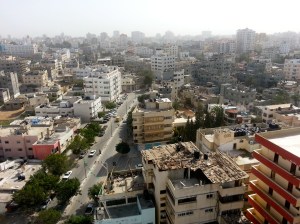
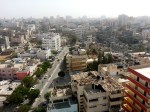
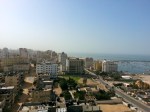
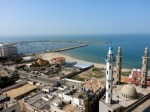
Gaza is one of the most reported on and yet least understood places on earth.  Its mere mention conjures up images of war victims, war criminals, piles of rubble, militants with guns, dead children and weeping mothers.  A simple google search will bring up disturbing images of heart break, terror and destruction.  But all of this is an infliction on a place that has neither surrendered its identity nor lost its beauty to decades of violent Israeli occupation.

Gaza is a city of many tales.  While some are about loss, grief and misery, many others are about enduring love, triumphant moments, tenacity, passion, music and hope that lives beyond the confines of the siege and the occupation.  If you dig deeper than the negative headlines and the devastating news reports you will find many pleasant surprises.  You can take a walk along Gaza’s gorgeous fields, enjoy its magical sunsets, get to know its warm people, visit its ancient sites and eat its delicious dishes.  You will find in Gaza everything that would make you love life with a passion!  So join me here to explore some of Gaza’s unknown side.

The Arts:

There is a common belief that Gaza’s art scene is all but dead.  While it may be true that art in general is not a great priority for the people in Gaza who are too concerned with bigger financial and political issues, Gazan artists continue to create and to excel in their fields.  There is also an appreciation of the need to encourage art in children starting from a young age.

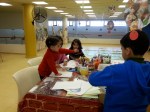
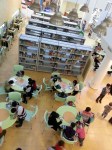
One establishment worthy of salutation for supporting the arts is the Qattan Centre for the Child in Gaza.  This cultural centre is an oasis for the hearts and the minds of children.  Equipped with a large library painted in vibrant colors and comfortable eye soothing furniture the QCC in Gaza focuses on developing the children emotionally and intellectually through visual art, music, education, cultural events and much more.

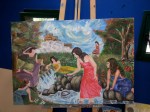
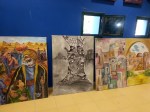
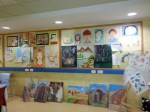
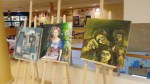
Below are some images of the QCC in Gaza.  Keep in mind all of the paintings you’ll see in some of these photos were in fact painted by children under 15 years of age at the centre.

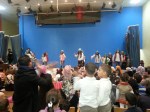
The Qattan center was built on land donated by the Gaza municipality and has succeeded in meeting its goal of creating an educational and stimulating space for children and their caregivers.  Parents are encouraged to join their children in the library, engage with them over art and craft activities, or just watch them proudly as they perform their song and dance routines.

Membership at the QCC is free of charge to all children in Gaza from all walks of life and some of the classes offered charge a small symbolic fee.  Many of the events are also free of charge such as the concerts captured in the video below that took place as part of the winter camp activities in January 2013.  In this video below you’ll see a variety of instruments, you’ll hear music of both Arab and western origins ranging from Gershwin to Darweesh.

Also worthy of special salutation is the Gaza Music School and its incredible teachers and talented children.  The children featured in the next video are nine years of age.  They are very dedicated to the art they practice in spite of all the challenges they face including Israel’s bombardment of the Gaza Music School  in 2009.


The landscape

The Gaza Strip is densely populated mostly by refugees who fled Israel’s war of ethnic cleansing in 1948 and have not been allowed to return to their homes since.  As the population continues to grow in the besieged strip the natural landscape changes to make way for more cement structures and buildings to accommodate this growth.

However, population growth is not the only challenge facing Gaza’s green spaces.  Agricultural land  is shrinking as Israel usurps more of Gaza’s water supplies and if that’s not enough, Israel’s siege, blockade, frequent bombardment and occasional land incursions have left their mark on many of Gaza’s farming land.  A recommended report that sheds great light on this is the UNISPAL report Farming without Land, Fishing without Water.

Below are two pics of bombed trees in our farm in Gaza. The first depicts a tree totally uprooted from the power of a one ton bomb blast.   The second photo  depicts a tree that was uprooted from the blast, flew in the air and actually landed straight on top of another tree.

Despite all of the challenges and the uncertainties of Israel’s incursions and bombings, some farmers have insisted on maintaining their land.  When visiting their farms you get a sense of what Gaza’s landscape looked like before Israel’s war of ethnic cleansing began.   You can imagine how before the refugees were chased into the far corners of their homeland to settle into camps under occupation, how most of Gaza’s natural landscape would have looked like.

The Sea

Perhaps the most important feature of Gaza is its sea.  It is the only landscape that remains unchanged, unaffected by the occupation and the aggression.  The sea is an open recreational space that is free of charge.  For Gazan families the sea is a cure for all of life’s problems.

The food

Finally, no matter where you go to in Palestine, you will always be overwhelmed with warm hospitality and great food.  Gaza is no different.  Here are some pics of some of my favourite dishes, but if you’re looking for a more comprehensive list along with recepies I highly recommend you visit The Gaza Kitchen.  Bon appétit or as they say in Gaza Saha we afya!