Video: Against The Tide ضد التيار

A message to the Israeli Occupation Forces who fear Palestinian Children

According to the Israeli human rights group B’Tselem, a 5-year-old Palestinian boy was detained by seven Israeli soldiers after throwing a stone on July 9th 2013. It is estimated that Israeli authorities arrest 700 Palestinian children every year.

You…

In the army uniform

Rifle in hand

And finger on the trigger

Standing on a hill

Dressed to kill

Breathing in the still

Air of the night

Breathing in

Every drop of light

Leaving only darkness

Breathing in

Every open field

Every tree

Every rock

Breathing in

Our space

Consuming us

And consuming all that surrounds us

You inhale our land

Our freedom

And exhale only oppression

You breathe out insecurity

And fear

Spew toxic words

Your lies

Pollute the atmosphere

Suffocating us

With tyranny

But nothing here

Nothing here

Nothing

Here

Can save you

Nothing can assure you

Or put your mind at ease

Nothing

No armor

No guns

No bombs

Can protect you

From our existence

Nothing you do

Can match

Our resistance

The cries of our babies

Are fierce

To your colonial ears

The cries of our babies

Are fierce

They penetrate you

And pierce

Through your armour

Dissolving it

Like white phosphorous

You

In the army uniform

Inside your tank

Wrapped in steel

Why do you fear

Walking amongst us

Our streets are filled with children

Does that terrorize you

You shoot one

Maim another

Arrest a few

But deep down you know

They will out live you

Out grow you

Out survive you

Their anger will explode

Inside you

So put down your guns

And take your drones out of our sky

Let our children paint it

Pastel blue

With a smiling sun

And a colourful rainbow

Part 2 Audio Samah Sabawi Commemorating the Nakba: a 3CR radio special

Exposing the ethnocentric nature of the state of Israel, the ethnic cleansing and denial of rights to the Palestinians and how we can put a stop to it all.

Rana Baker responds to Dawber’s article in The Independent: Misconceptions Abound On Gaza’s Women, Politics

By: Rana Baker for Al-Monitor Palestine Pulse

Posted on April 25.

It has become commonplace when reading about Gaza to come across descriptions of it as an “Islamist enclave” or “Hamas-controlled territory” and so on. In case someone exists who does not know what Hamas is all about, commentators make sure their readers understand that it is the “fundamentalist” group bent on the “destruction of Israel” and nothing else.

The Palestinians of Gaza, therefore, are often categorized as either ardent Hamas supporters or suppressed dissidents, including women, who receive the severest treatment imaginable, not only from the Hamas government, but also from misogynistic and backward average male residents. Such categorizations are then followed by sweeping generalizations about each of these stereotypes. Whereas the Hamas supporters consist of “terrorists” and “bloodthirsty barbarians,” the dissents are seen as peace-loving minorities who seek neighborly relations with Israel, the occupying entity.

A recent example of such portrayals can be found in a feature story published in The Independent on April 13. In “Tales from Gaza: What Is Life Really Like in ‘the World’s Largest Outdoor Prison’?” the author alledges to provides “a small snapshot into life in Gaza.” Before he proceeds, however, he assures us that what follows are “testimonies” by people “who can rarely get their voices heard.”

At the start of six interviews, the author makes clear that all of those featured are men not because that was his intention — he is a Westerner who believes in gender equality after all — but because in his two and a half days in Gaza, he could not find a woman willing to speak to him “independently.” In fact, the only occasion when he had the chance to speak to a woman, he tells us, was in the presence of a male guardian, the woman’s husband in this particular instance. Hence, while he was able to “give voice” to men, his attempts to do the same for women were all thwarted.

Such assertions play into Orientalist notions. This usually results from foreign journalists coming to Gaza with a set of preconceptions about the place and its people and then seeking to confirm them rather than verify them. While Gaza is, indeed, no haven for women or anyone else, there are thousands of educated women who are willing to speak for themselves and do so in every field, from medicine, theater, and politics to fishing and farming.

Just a few months ago, a play written by the renowned Palestinian writer Samah Sabawi was read at one of Gaza’s cultural centers, which continue to thrive despite Israel’s ceaseless attempts at cultural de-development. Nearly all the participants who performed the play were women, as was the case with the vast majority of the audience. They were not accompanied by husbands, brothers or fathers in order to attend or to perform.

Events like this, however, hardly ever make it into the mainstream media. Moreover, any mention of a considerable number of women going out without a hijab instantly provokes expressions of surprise by those who have only heard about Gaza through mainstream and particularly Western publications. To say women in Gaza are also allowed to drive would sound like a lie to many ears.

Women are not the only part of this story. To claim that Gaza is “Islamist” automatically dismisses the existence of the leftist and secular groups there, most of which denounce religion in its totality. Homogenizing “life in Gaza” could not be more obvious than in The Independent feature.

Of the six interviews the author conducted, one was with a Hamas official, while four were with blue-collar male workers, and the remaining one was with an unemployed man. Despite being at odds with Israel, five of them belong to the category of “ready to forget the past,” has no problem inviting former Israel prime minister Ariel Sharon for coffee, and even views Yitzhak Rabin — the man behind the Iron Fist that broke hundreds of bone in the lead up to and during the first Palestinian intifada — as a man of peace.

With the exception of the Hamas official, the interviewees followed suit in reiterating the same unconditional desire to achieve peace with Israel that one might think no other viewpoint existed. At the same time, they viewed Hamas as the primary source of their distress. Israel was seen as only secondary to their everyday ordeal.

That no evidence was provided to challenge the views in question suggests that there is none — just as the author claims to have found no women able to speak to him. Thus, portraying the residents of Gaza as a homogenous people who all experience life in the same way is condescending at best and Orientalist at worst. The views expressed in the article are undeniably extant but do not reflect the reality.

Israel, which has launched two deadly assaults on Gaza in less than five years, is rarely perceived as a friendly entity. The vast majority of the politicized and non-politicized segments of Gazan society are not ready to “forget the past” that continues to shape the lives of 1.1 million local Palestinians officially registered as refugees at the United Nations Relief and Works Agency.

Rana Baker is a student of business administration in Gaza and writes for the Electronic Intifada

This article appeared here: http://www.al-monitor.com/pulse/originals/2013/04/gaza-misconceptions-women.html#ixzz2RVnXaJdB

About Tales of a City by the Sea

The play Tales of a City by the Sea is a unique and poetic journey into the lives of ordinary people in the besieged Gaza strip prior to, during and after its bombardment during the winter of 2008.  Jomana, a Palestinian woman who lives in the Shati (beach) refugee camp in Gaza falls in love with Rami, an American born Palestinian doctor and activist who arrives on the first Free Gaza boats in 2008. Their love is met with many challenges forcing Rami to make incredible decisions the least of which is to take a dangerous journey through the underground tunnels that connect Gaza to Egypt.  Although on the surface this love story appears to explore the relationship between diaspora Palestinians and Palestinians under occupation, there is a broader and more universal theme that emerges – one of human survival and tenacity.  Tales of a City by the Sea avoids political pitfalls, ideological agendas and clichés by focusing on the human story of the people in Gaza. Although the play’s characters are fictional, the script is based on real life events and is a product of a collection of real stories the author Samah Sabawi and her family have experienced during the events of the past several years. Sabawi has written most of the poetry in the play during the three-week bombardment of Gaza in 2008/2009.

The writer Samah Sabawi is a Palestinian-Canadian-Australian published writer, commentator and playwright.  She has travelled the world and lived in its far corners, yet always felt as though she was still trapped in her place of birth Gaza.  The war torn besieged and isolated strip has  shaped her understanding of her identity and her humanity.  So what else could Sabawi do but to indulge in Gaza’s overwhelming presence and to succumb to tell the stories of her loved ones back home.  Her most recent play Tales of a City by the Sea is dedicated to them and to all of those who still manage to have faith and hope even as the sky rains death and destruction.

The script is available to interested theatre makers upon request.  Please email play3wishes@gmail.com for more information.

Ms. Sabawi speaking at the Launch of the The People's Charter To Create a Nonviolent World

Photo courtesy http://thepeoplesnonviolencecharter.wordpress.com/launch-events/

Follow Samah Sabawi on Twitter @gazaheart

Samah Sabawi’s professional bio can be found here

For more information on Samah Sabawi: http://en.wikipedia.org/wiki/Samah_Sabawi

Let Gaza surprise you!

By Samah Sabawi

20130122_115944

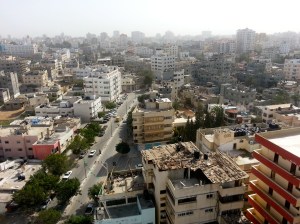
Gaza is one of the most reported on and yet least understood places on earth.  Its mere mention conjures up images of war victims, war criminals, piles of rubble, militants with guns, dead children and weeping mothers.  A simple google search will bring up disturbing images of heart break, terror and destruction.  But all of this is an infliction on a place that has neither surrendered its identity nor lost its beauty to decades of violent Israeli occupation.

Gaza is a city of many tales.  While some are about loss, grief and misery, many others are about enduring love, triumphant moments, tenacity, passion, music and hope that lives beyond the confines of the siege and the occupation.  If you dig deeper than the negative headlines and the devastating news reports you will find many pleasant surprises.  You can take a walk along Gaza’s gorgeous fields, enjoy its magical sunsets, get to know its warm people, visit its ancient sites and eat its delicious dishes.  You will find in Gaza everything that would make you love life with a passion!  So join me here to explore some of Gaza’s unknown side.

The Arts:

There is a common belief that Gaza’s art scene is all but dead.  While it may be true that art in general is not a great priority for the people in Gaza who are too concerned with bigger financial and political issues, Gazan artists continue to create and to excel in their fields.  There is also an appreciation of the need to encourage art in children starting from a young age.

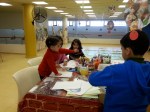
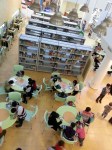
One establishment worthy of salutation for supporting the arts is the Qattan Centre for the Child in Gaza.  This cultural centre is an oasis for the hearts and the minds of children.  Equipped with a large library painted in vibrant colors and comfortable eye soothing furniture the QCC in Gaza focuses on developing the children emotionally and intellectually through visual art, music, education, cultural events and much more.

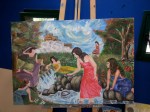
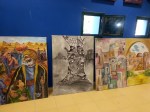
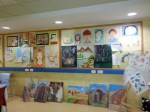
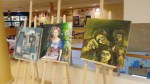
Below are some images of the QCC in Gaza.  Keep in mind all of the paintings you’ll see in some of these photos were in fact painted by children under 15 years of age at the centre.

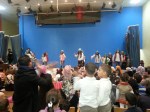
The Qattan center was built on land donated by the Gaza municipality and has succeeded in meeting its goal of creating an educational and stimulating space for children and their caregivers.  Parents are encouraged to join their children in the library, engage with them over art and craft activities, or just watch them proudly as they perform their song and dance routines.

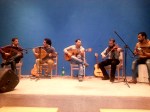
Membership at the QCC is free of charge to all children in Gaza from all walks of life and some of the classes offered charge a small symbolic fee.  Many of the events are also free of charge such as the concerts captured in the video below that took place as part of the winter camp activities in January 2013.  In this video below you’ll see a variety of instruments, you’ll hear music of both Arab and western origins ranging from Gershwin to Darweesh.

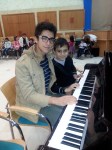
Also worthy of special salutation is the Gaza Music School and its incredible teachers and talented children.  The children featured in the next video are nine years of age.  They are very dedicated to the art they practice in spite of all the challenges they face including Israel’s bombardment of the Gaza Music School  in 2009.


The landscape

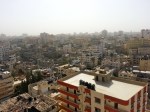
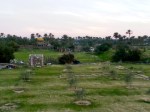
The Gaza Strip is densely populated mostly by refugees who fled Israel’s war of ethnic cleansing in 1948 and have not been allowed to return to their homes since.  As the population continues to grow in the besieged strip the natural landscape changes to make way for more cement structures and buildings to accommodate this growth.

However, population growth is not the only challenge facing Gaza’s green spaces.  Agricultural land  is shrinking as Israel usurps more of Gaza’s water supplies and if that’s not enough, Israel’s siege, blockade, frequent bombardment and occasional land incursions have left their mark on many of Gaza’s farming land.  A recommended report that sheds great light on this is the UNISPAL report Farming without Land, Fishing without Water.

Below are two pics of bombed trees in our farm in Gaza. The first depicts a tree totally uprooted from the power of a one ton bomb blast.   The second photo  depicts a tree that was uprooted from the blast, flew in the air and actually landed straight on top of another tree.

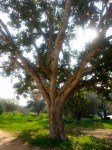
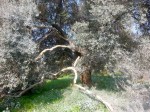
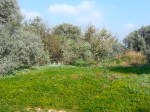
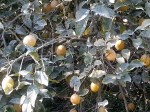
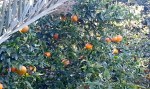
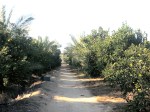
Despite all of the challenges and the uncertainties of Israel’s incursions and bombings, some farmers have insisted on maintaining their land.  When visiting their farms you get a sense of what Gaza’s landscape looked like before Israel’s war of ethnic cleansing began.   You can imagine how before the refugees were chased into the far corners of their homeland to settle into camps under occupation, how most of Gaza’s natural landscape would have looked like.

The Sea

Perhaps the most important feature of Gaza is its sea.  It is the only landscape that remains unchanged, unaffected by the occupation and the aggression.  The sea is an open recreational space that is free of charge.  For Gazan families the sea is a cure for all of life’s problems.

The food

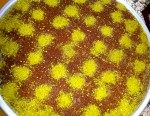
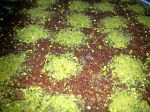
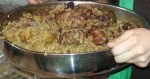
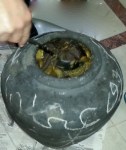
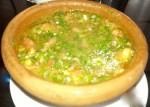
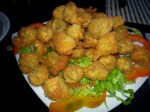
Finally, no matter where you go to in Palestine, you will always be overwhelmed with warm hospitality and great food.  Gaza is no different.  Here are some pics of some of my favourite dishes, but if you’re looking for a more comprehensive list along with recepies I highly recommend you visit The Gaza Kitchen.  Bon appétit or as they say in Gaza Saha we afya!

Video “Three Wishes: Palestinian and Israeli Children Speak Out”

Three Wishes in the Media

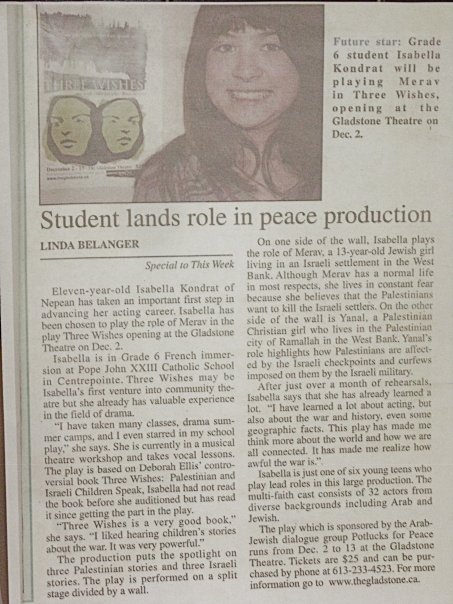
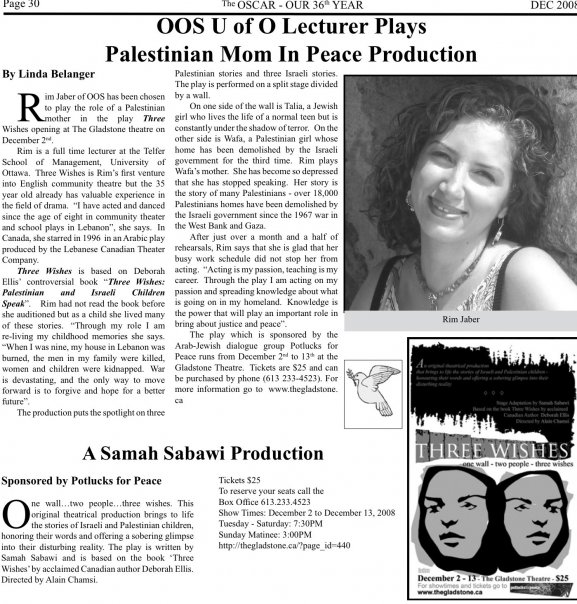
Three Wishes:  Ottawa Gladstone Theatre December 2008 

War from the eyes of a child – Education – New play focuses on Israeli-Palestinian conflict

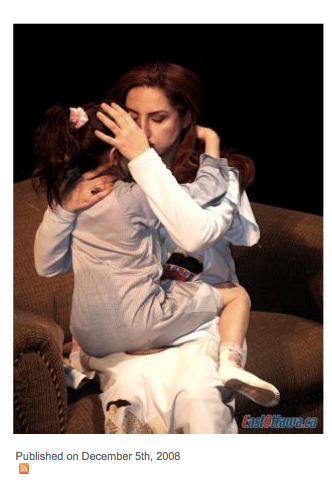
Orléans Star 12-07-31 11:56 PM Published on December 5th, 2008

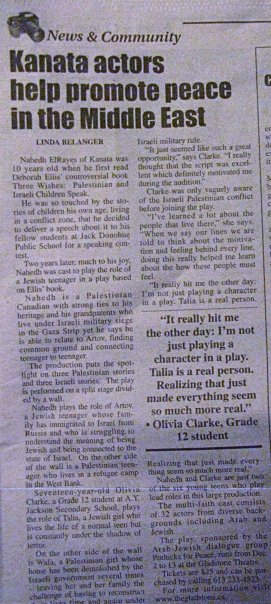
Divided by conflict and witnesses to violence, Israeli and Palestinian children speak out about their fears, hopes and dreams in a new Ottawa play that features two east-end teens in leading roles.

The stage adaptation of Deborah Ellis’ controversial book, Three Wishes: Palestinian and Israeli Children Speak, captures the honesty and straightforwardness only a child can share when the world around them is in turmoil. The production, written and produced by Ottawa’s Samah Sabawi and sponsored by the Arab-Jewish dialogue group Potlucks for Peace, puts the spotlight on three Palestinian stories and three Israeli stories. The play is performed on a split stage at the Gladstone Theatre, divided by a concrete wall topped with barbed-wire. It is on either side of this wall the lives of these children and their families unfold.

While every word in the play is lifted from the book, Sabawi has broken the dialogue up so a number of characters speak. For example, 18- year-old Hassan’s narrative has been cut so his family also shares in the storytelling. “It’s more like a conversation,” Sabawi explains.

Colonel By’s Kiera Polak, 15, plays the role of Yanal, a 14-year-old Palestinian girl. “I’ve learned a lot through the play,” she says, noting children in the Middle East have gone through hard times and want things to be fixed.

Meanwhile Orléans resident Dergham Shahrouii plays Hassan, who lives in a refugee camp in the West Bank. Injured by Israeli shelling, Hassan is confined to a wheelchair. On the other side of the wall is Artov, a Jewish teen whose family immigrated to Israel from Russia and is struggling to understand the meaning of being Jewish and being connected to the state of Israel. “These kids talk about the simple, human need to live a normal life,” Sabawi says of the interviews from the book. “(They talk about) how conflict affects their life at a personal level.”

The book, she continues, is “very compelling. These are real stories and real experiences.”

Sabawi read the book about three years ago after her then-nine-year-old son read it and put together a speech for class. The kids in the book, she explains, are so honest – there’s no politics. “I just loved reading their words.”

The children’s book gained infamy in 2006 when the Canadian Jewish Congress questioned the inclusion of the book in the Silver Birch reading program. At least four school boards in Ontario, including the Toronto District School Board, pulled the book from their shelves. While some said the request to remove the book was about age-appropriateness, others indicated it was a political move.

Sabawi, who says parents are the best judge of what their children can take, doesn’t recommend the play for those under the age of eight. “The play is about kids in a conflict zone,” she explains. “This is serious stuff.”

Hoping to raise awareness with her production, Sabawi notes that people tend to discuss the conflict in “grown-up” terms with maps, statistics and borders. The conversation is distant and sometimes the human cost is forgotten, she continues. “The Middle East is not about angry men or Paris or fights between extremists,” Sabawi says. “People live there and their stories need to be told.” “Three Wishes” runs until Dec. 13 at the Gladstone Theatre, 910 Gladstone Ave. Tickets are $25 and can be purchased by phone at 613-233-4523 or online at http://www.thegladstone.ca


Photo Gallery: Rehearsing for Public Reading at La Mama in Melbourne

This slideshow requires JavaScript.