Palestinian singer Mohamad Assaf responds to Israeli occupation army spokesperson Avichay Adraee’s ‘lies’

Palestinian singer Mohamad Assaf, a finalist in the Arab Idol TV show has responded to the Israeli occupation army spokesperson Avichay Adraee denying the allegation that he faced pressure to withdraw from the competition by the Hamas government in Gaza. According to Quds news Assaf wrote an angry response on Avichay Adraee’s Facebook page saying he regretted being forced to visit Adraee hateful page which reeked of lies and deception, but he felt he needed to respond.

Assaf wrote that neither him nor his family were threatened or pressured to withdraw and he pointed to how his pictures are hung everywhere in Gaza as proof that the people in Gaza support him. Assaf also responded to Adraee’s comment about him having a ‘brilliant’  voice saying what would really be ‘brilliant’ is if you stop killing our children and stop occupying our land so that our people can enjoy hearing our singing and not the sound of your bombs falling.

Translated from original article in Arabic which appeared at this link http://www.qudsn.ps/article/17585

Families Interrupted – Adalah opens an exhibition in support of victims of Israeli racist citizenship law

freehaifa's avatarFree Haifa

Families Interrupted – Adalah opens an exhibition in support of victims of Israeli racist citizenship law

I have a neighbor. He is a quiet man, working hard in construction and after work he would stay with his family. You rarely even see him in the neighborhood. One morning I saw him sitting in the street – he had a story to tell.

He is from Jenin. He married in Hallisa (our Haifa neighborhood) and came to live with his wife here. They are already married for some twenty years but he couldn’t get his papers right. As the occupation gets old, so do many of its victims. So, that night, my neighbor felt his heart was betraying him and hurried to the hospital. Apparently it was not that bad. After checking him and verifying that he was no dying, the doctors in the hospital called in the police, which, at 3:00 am, drove him to Jenin (some 45 km south east of Haifa) and threw him…

View original post 876 more words

AlJazeera: Palestinian pawns Egypt’s refugees

Author visits the “informal village” of Palestinians with no basic rights – not even official refugee status.

Neither Gezirat Fadel village in Sharqiya or its people are officially recognised by the Egyptian government [AP]
 

While Palestinians commemorate the 1948 “ethnic cleansing” of Palestine – the Nakba – the “catastrophe” neither started that year nor has it ended. The Palestinian people have suffered for generations. Today, they continue to be treated as second class citizens in their own homes, denied basic rights of mobility and secure livelihoods in the occupied Gaza Strip and the West Bank and live precariously in refugee camps in Lebanon, Syria and Jordan.

The Egyptian role in Palestine has historically differed from its Arab neighbours. In 1948, Egypt was the only country to close its borders to Palestinians, out of a principled interest in keeping Palestinians within their nation. The policy was in some ways long-sighted, as many of those who fled in 1948 have not been allowed to go back. It has often been suggested that the relative dearth of Palestinians in Egypt, or the higher socio-economic status of this group, could be attributed to this policy.

Palestinian refugees in Egypt

Recently, however, Arab activists have stumbled upon a sizeable group of 1948 Palestinian refugees in Egypt. A few months ago, a group of four Palestinian and Egyptian friends came across the mention of a mass exodus of Palestinians from Bir il-Saba’ village in 1948; the refugees were said to have gone to Egypt. The friends found it strange, as they and others had persistently inquired about the existence of Palestinian refugee groups in Egypt at the Palestinian embassy and organisations in Cairo. They called on others to help them locate this community, which they eventually tracked down.

A few hours north of Cairo, in the Nile Delta governorate of Sharqiya, is the village of Gezirat Fadel. It is aptly named “Gezira” – island – because of its physical isolation at the time of its foundation, and Fadel after the name of one of the founders of the village. For the past 65 years, this village has been almost completely off the radar, by choice or ignorance, of any institution – whether be it the Egyptian or Palestinian authorities, non-governmental organisations or activistsNeither the village nor the people are officially recognised by the Egyptian government, and thus the informal village is left with no infrastructure or public services, and the people with no basic rights – not even official refugee status. Since locating the village, the friends have visited it several times, gathering information on its history and current conditions, and have been lobbying Arab and Egyptian media to shed light on the neglected community.

For the anniversary of the Nakba, they called on other activists to join them to visit Gezirat Fadel, to commemorate the occasion and convey the simple message that this community of refugees would not be forgotten. As Syrine, a Palestinian activist from Jerusalem, put it: “These people, the refugees, are the biggest victims of the Nakba. They are the ones we should commemorate it with.”

I joined over 80 activists, who were predominantly Egyptian and Palestinian, but included Swedes, French, Iranians and others. On an early Friday morning, the buses drove out of Cairo, past the lush Delta fields, through the busy Sharqiya capital of Zaqaziq, and on to a dirt road that eventually became too narrow for the buses to continue.

The activists descended from the buses with dozens of Egyptian and Palestinian flags in hand and a banner that read:

“In memory of the Nakba, Gezirat Fadel will no longer be forgotten.
Egypt and Palestine, one people, one struggle.
From Egypt to Palestine, the revolution continues and will prevail.
We will return, one day, to Bir il-Saba’.”

As we walked towards the village, the path, filled with rubbish and lined with mud brick walls, was an indicator of what lie ahead. After a 20-minute walk, clay houses and Palestinian flags waving from hay rooftops appeared. The villagers, overwhelmingly young children, were excited by the news of visitors and lined the streets, Palestinian kufiyas draped from their necks and greeted us in their mixed rural Palestinian-Egyptian dialect.

While the trip was primarily humanitarian in purpose – the group came with toys for the children and doctors who paid house visits – the political nature of it was effusive. Though the organisers insisted upon the independence of the initiative, the identity of involved activists as core actors from the ongoing Egyptian revolution was belied either subtly or quite explicitly as it appeared on the banner. The ideals of the Arab uprising – ones that insist uncompromisingly on freedom and social justice – translate very directly into political stances which in the case of Palestine not only oppose Israeli forces’ brutality, but also reject intermediaries and facilitators of ongoing occupation and displacement, Palestinian authorities included.

Mired in poverty

In Gezirat Fadel too, politics was palpable. It became starkly apparent throughout the day that the isolation of this village has nothing to do with geography or ignorance, but rather has been constructed by Egyptian and Palestinian authorities and beneficiaries.

As we entered the village, we were greeted by a village head, the “omdeh“. One of the few educated members of the village, he works in Cairo and dressed in a suit that contrasted with a population where village elders were donned in traditional Palestinian dress and others in simple, often tattered clothing.

Standing on an elevated veranda before the villagers and visitors, the omdeh proceeded to warmly welcome the activists and referred to the Nakba as a celebration, a marker of the day that Palestinians will return to their homes, with all the embellishments of Arab oratory. The omdeh described the village in shining terms, claiming that villagers earn decent incomes and thanked for the support from Palestinian authorities and the Egyptians who have welcomed them as “guests”.

The performance stood in stark contrast to the private interactions of the omdeh with organising activists and with the realities of village life. The refugee audience was markedly acquiescent as the omdeh spoke. Among the crowd, an event organiser spotted an employee from the Palestinian embassy in Cairo.

The activists had brawled with the employee days before in Cairo, over the embassy’s persistent denial of the existence of a Palestinian refugee community in Egypt, despite evidence that the embassy had direct ties with the village omdeh and that the ambassador had himself paid a visit to the community. The activists have also had a turbulent relationship with the omdeh since first visiting the village; the omdeh had initially threatened the activists, telling them that he would inform Egyptian intelligence services if they returned to Gezirat Fadel.

The omdeh‘s remarks were incongruent with observations of village life. The conditions in which the Palestinians of Gezirat Fadel live are nothing short of appalling. The village is home to over 3,000 people. Other than a “guest building” – which consists of a large room that is used for community gatherings and is internally adorned with a banner thanking Palestinian Authority President Mahmoud Abbas for his contributions to the community – the village contains literally no public services. To say that the village was marked by poverty would be an understatement – on the way to the village, I spotted a young boy retrieving a tattered shirt from a pile of garbage and sewing it together to wear.

While the Gamal Abdel Nasser government had extended state services to Palestinians in Egypt, making it possible for Gezirat Fadel villagers to use state institutions at the same free or highly subsided prices offered to Egyptians, these rights were revoked in the Sadat era. The refugees must pay international fees to access most basic services; they have no right to property ownership.

A majority of the villagers are employed as day labourers on large tracts of land owned by Egyptian companies or families, as mechanics or in small shops in neighbouring villages, or collect and sort garbage. Donia, a 12-year-old refugee who walks for two hours each morning to join a reading class in a neighbouring village, said she aspires to work “for anyone who will employ me”.

While some mentioned the lack of legal rights, they were quick to thank Egypt for hosting them for so long. The hardships of their present lives were masked with evocations of their lost homeland. While most villagers have never laid eyes on Bir il-Saba’, even the youngest children describe it vividly, adding illustrative accounts of the night their grandparents were bombarded by Israeli fire in 1948, listing the death of relatives and recounting the journey to Egypt.

“We are Palestinian guests in Egypt, and will one day return to Bir il-Saba’,” was an unprompted phrase echoed by villagers of all ages. Eight-year-old Samih offered to show me his grandfather’s olive tree seeds, which he definitively told me that he will one day plant outside his family home in Bir il-Saba’.

Manipulation of power

While the population of many Egyptian villages may suffer from stark inequality and poor services, it seems particularly exasperated in the Palestinian case.

Basic rights for Palestinian refugees have often been presented by Arab officials as a contributor to resettlement, counter-productive to the right of return. What is apparent, though, is that these same institutions, while loudly touting their nationalism and dedication to the Palestinian cause, are largely removed from daily hardships experienced by the refugees.

One activist from Ramallah lamented the irony in the statements of Gezirat Fadel refugees who linked any hardships to a greater national cause and expressed pride in PA President Abbas, while in his home city political elites live relatively luxurious lives.

The link between personal interests and political institutions is a phenomenon that continues to have a real impact on people’s livelihoods in the Arab world. In the case of the Palestinian refugees, this is often intense, as in addition to community dynamics and Palestinian leadership, host countries add a layer of complication.

In the context of the Arab uprising, people are recognising and openly rejecting this manipulation of power. Despite the omdeh‘s threats, activists returned to Gezirat Fadel, openly challenged his statements in front of villagers and refused his monopolisation of the story of the refugee experience.

While for 65 years the right of return has been, and will continue to be, the essential demand of the Palestinian refugees, there is an evident need for an extension of basic rights to a community that suffers exponentially due to the politicisation of its identity. Arab governments’ hypocritical lip service to the Palestinian cause has long been transparent; Arab activists are now determined to bring it to an end.

Sarah Mousa graduated from Princeton University’s Woodrow Wilson School of Public and International Affairs in 2010, and was a 2010-2011 Fulbright Scholar in Egypt. She is currently a graduate student at the Center of Contemporary Arab Studies at Georgetown University. 

The views expressed in this article are the author’s own and do not necessarily reflect Al Jazeera’s editorial policy.

Gaza Sky Geeks backs tech startups in the Gaza Strip

The conflict-torn Gaza Strip produces more than 2,000 young graduates with technical degrees each year. Gaza Sky Geeks helps them launch their own high-tech businesses.

By Laura Mortara, Global Envision / May 29, 2013

In the isolated Gaza Strip, economic instability is a constant. But a startup accelerator called Gaza Sky Geeks Laboratory plans to help the region capitalize on one of its biggest assets: its technical graduates.

Between Gaza’s five universities, more than 2,000 young people graduate with technical degrees every year. Mercy Corps started the Arab Developer Network Initiative (ADNI) with a grant from Google.org a few years ago, and a number of programs supporting young entrepreneurs have come out of it, including Gaza Sky Geeks.

The laboratory will support standout technology entrepreneurs in Gaza, providing a wide range of free services designed to help them turn their ideas into viable investments. Global Envision connected with Reem Omran, co-founder of Gaza Sky Geeks, to talk about the effort – and whether Gaza could become the next IT hub in the Arab world.

What’s the blueprint for helping start-ups?
Reem Omran: The primary objective of Gaza Sky Geeks is to prepare start-ups for the next stage. We will provide logistical and consulting services, as well as workshops that can help them turn their ideas into concrete business plans capable of securing investment.

What resources does the accelerator offer?
Gaza Sky Geeks is outfitted with high-speed internet, desktop computers, iPads, and Androids[mc1] so that members have a reliable space to work on their projects. Members also have access to meeting spaces and a coffee shop, where they can network and collaborate on ideas.

What about events?
The accelerator hosts three types of events: workshops, hackathons, and mentorship programs and lectures. The workshops are held on a weekly basis and are designed to help with product development and promotion. Hackathons are held so that programmers have a forum to share ideas and explore software development. And the mentors are brought in to give developers feedback on their ideas and critique their business plans.

At the accelerator, are the resources and events free of charge?
Yes, you only need to be a member to use them.

What are the biggest barriers facing members?
Electrical shortages are common, and Gaza’s reputation as a conflict zone makes it difficult to attract investors. However, at the core the issues are the same as those facing start-ups everywhere. Many technology entrepreneurs are passionate about their field and ideas, but transforming a vision into a viable business plan is tricky. Most people in the IT industry in Gaza don’t receive a business education, let alone have experience running one.

How is Gaza Sky Geeks helping to bridge this gap?
This is where the mentors are key. As I mentioned, most programmers in Gaza don’t have experience running a business, and so sometimes their target audience is off or their marketing strategy isn’t practical, and so on. Mentors can provide valuable constructive criticism so that start-ups can strengthen their goals and infrastructure to become a feasible investment.

In the coming months, Gaza Sky Geeks will select the top five startups to participate in a three-month intensive acceleration program. Selected startups that participate in the acceleration program will be linked with five dedicated mentors who have varying backgrounds and experience. The three-month accelerator will also provide targeted business and technical training so each startup has a scalable business plan and validated prototype at the conclusion of the accelerator. Throughout the three-month program, each startup will work on a one- and three-minute pitch that they will give to potential investors at a Gaza demo day and regional road shows in cities such as Doha, Qatar; Amman, Jordan’ and Cairo.

• Stay up to date on Gaza Sky Geeks on Facebook and Twitter: @GazaSkyGeeks

• This article originally appeared at Global Envision, a blog published by Mercy Corps.

Hundreds of Palestinian refugees arrived into Gaza from Syria displaced for the second time and pushed into the furthest corner of their historic homeland

Yousef Al-Helou from the Real News conducted this report from Gaza on the growing number of Palestinian refugees who have come from Syria into the Gaza strip


Egyptian Siege on Gaza Day 5: 2400 Palestinians Stuck At The Rafah Terminal

occupiedpalestine's avatarOccupied Palestine | فلسطين

Tuesday May 21, 2013 08:14 by Saed Bannoura – IMEMC & Agencies

Tuesday May 21, 2013; the Himaya Center for Journalists Defending Human Rights has reported that more than 2400 Palestinians from the Gaza Strip are currently stuck at the Rafah Border Terminal between the Gaza Strip and Egypt, awaiting to be allowed through.

stuck_rafah[1]

In a press release, the center demanded the Egyptian Authorities to open the terminal without any delays, and to refrain from involving the Palestinians in internal issues in Gaza and Egypt.

It also demanded providing the Palestinians, stuck on the terminal, with temporary shelter and the needed care, and added that the border crossing must be continuously operating as agreed upon during meetings and arrangements, and called for applying all related laws.

Egypt closed the Rafah Border Terminal more than four days ago, leaving 2400 Palestinians stuck on the crossing, and preventing thousands of Palestinians from…

View original post 714 more words

The Real News Report from Gaza Palestinians mark Nakba

https://www.youtube.com/watch?v=8VV573AJNAU

Professor Stephen Hawking, BDS and the Zionists

ZazaFL's avatarzazafl

On Tuesday 7th May, BRICUP (British Committee for the Universities of Palestine) posted on their website and tweeted that Professor Stephen Hawking had declined an invitation to a conference in Jerusalem, to be hosted by war criminal Shimon Peres.

“Stephen Hawking declines invitation to attend Israeli conference

We understand that Professor Stephen Hawking has declined his invitation to attend the Israeli Presidential Conference Facing Tomorrow 2013, due to take place in Jerusalem on 18-20 June. This is his independent decision to respect the boycott, based upon his knowledge of Palestine, and on the unanimous advice of his own academic contacts there.”

BRICUP

Wednesday 8th May, the Guardian, Reuters, the BBC and much of the mainstream media had picked up the BRICUP news and were reporting it as Hawking joining the academic boycott of apartheid Israel. Guardian headline:

Stephen Hawking joins academic boycott of Israel

Physicist pulls out of conference…

View original post 919 more words

In photos: Palestinian Christians welcome Easter’s “Holy Fire” to Gaza

joecatron's avatarJoe Catron

Greek Orthodox Christians marked the beginning of Easter Sunday with a four-hour midnight service in Gaza’s 1,606-year-old Church of Saint Porphyrius last night.

On Friday, Israeli occupation authorities turned “dozens” of church members back from the Beit Hanoun checkpoint, despite their permits to spend Easter in the West Bank.

Those who reached Jerusalem faced “a battle camp scenario,” Hanna Amireh, a member of the Palestine Liberation Organization’s Executive Committee and head of the Presidential Committee on Church Affairs, told the AFP.

“It is not only that Israel has isolated our occupied capital from the rest of our country – forcing our people to apply for special military permits to access their families and holy places for religious occasions – but even Palestinians from Jerusalem were beaten when trying to reach the Church of the Holy Sepulchre,” Amireh said. “Even praying has become an act of resistance for Palestinians.”

Under…

View original post 103 more words

The Real News: Fears from fundamentalism are growing in Gaza after Hamas’ latest public modesty campaigns

Life behind Gaza,,,, A story from Anas

Zionist intellectuals offer a Pizza to Samer Issawi

Some of those who claim to be “Israeli intellectuals” have proven today that their arrogance and insensitivity far exceed those of Mrs. Netanyahu.

“Writers and poets, including Eli Amir, Amos Oz and AB. Yehoshua, turned in a personal letter to Samer Al Issawi, on hunger strike for more than 230 days, and called on him to stop the strike.” So we read in today’s (13/04/2013) press.

No, they did not wake up when Samer was arrest without any cause, as they didn’t protest at the imprisonment without trial of thousands of other Palestinians, including political activists, journalists and intellectuals. They didn’t even raise their voices while Samer was on a hunger strike for 200 days, as the continuing disregard to his cry for freedom puts his life under imminent danger.

freehaifa's avatarFree Haifa

Zionist intellectuals offer a Pizza to Samer Issawi

Israel’s Prime Minister’s wife, Mrs. Netanyahu, became a symbol of insensitivity, a local Marie Antoinette, when she famously offered pizzas to students activists on hunger strike against rising tuition fees. She didn’t express support for their just demands, nor did she show any admiration for their sacrifice or sympathy with their suffering. All she displayed was the light minded selfishness and hedonism of someone who is complete stranger to the notions of a just cause, struggle or sacrifice.

Some of those who claim to be “Israeli intellectuals” have proven today that their arrogance and insensitivity far exceed those of Mrs. Netanyahu.

“Writers and poets, including Eli Amir, Amos Oz and AB. Yehoshua, turned in a personal letter to Samer Al Issawi, on hunger strike for more than 230 days, and called on him to stop the strike.” So we read in today’s (13/04/2013) press.

No, they did not wake…

View original post 691 more words

The PLO’s dangerous land swaps rhetoric

The “land swaps” rhetoric is designed to protect the large Israeli settlement blocks and their buffer zones.

By Samah Sabawi

Published on AlJazeera 

Hailed as one of the best spokespersons for Palestine, veteran diplomat Afif Safieh impressed many during his four-city tour in Canada, earlier this year.

Safieh – the author of The Peace Process: From Breakthrough to Breakdown – is also the Palestinian Authority’s roving ambassador for special missions.

But while the messenger was admirable, the message was disturbing.

Safieh’s high degree of eloquence and refined diplomatic skills were not enough to conceal the current pathetic state of political stagnation and bankrupt strategic thinking that inflict the Palestine Liberation Organization (PLO) and Palestinian Authority (PA).

Safieh stressed his personal view that international intervention is needed for any peace agreement to be reached with Israel and repeatedly referenced international law as the basis for the demands the Palestinians are making. But his message was greatly compromised by the limitations of his official status as representative of the PLO.

In response to threats made by Canada’s Foreign Affairs Minister John Baird that the PA would face great “consequences” if it decided to make a case against Israel at the International Criminal Court, Safieh assured the Canadian government and the public that the Palestinian leadership has no “immediate plans” to pursue Israel at the ICC.

Ending ‘settlement’ 

This is disappointing to say the least, given that high level PLO/PA officials also assured the Palestinian people that once they secured member state status at the United Nations – which they did in November 2012 as an observer state – they would be able tohold Israel to account for war crimes that have so far gone completely unpunished.

So what is the plan for moving forward?

If Safieh’s interviews with Canadian media are anything to go by, the plan is apparently to save the peace process, even though it has led nowhere for 20 years.

He insisted that the fate of the peace process depends “on ending Israel’s settlement building”. This phrase has been repeated in PLO/PA official statements during the past several years with emphasis on “ending” settlement building or “freezing” the settlements, and no mention of dismantling the settlements and returning Palestinian land to its rightful owners.

To understand the implications of this language we only need to listen carefully to a key sentence Safieh repeated in various interviews while in Canada:

“There would be some territorial land swaps containing Jewish settlement blocs with Israel in exchange for an equal amount of land from the Israeli side.”

But this idea of land swaps began during a different era, before Israel colonised large amounts of land in the West Bank. In fact, it was first brought up in 1990 in Italy at a meeting jointly arranged by the Hebrew University of Jerusalem’s Harry S Truman Institute for the Advancement of Peace and an alliance of Arab academics and intellectuals.


Land swaps were brought up again at the Camp David Summit in 2000 and have continued to be part of the discourse. The problem is that while negotiations went on over the past two decades, settlements grew and today the settlements and their system of roads and infrastructure consume more than 40 percent of the West Bank. So how exactly do we envision land swaps today?

Safieh told the Canadian public and media that Palestinians would exchange their territorial land for equal amount of land from the Israeli side. But according to documents from the Palestinian Negotiation Support Unit leaked to Al Jazeera, the last land-swap proposal made by Israel in 2008 gave the Palestinians smaller, less significant patches of land that are of lesser agricultural quality. Moreover, this exchange excluded Jerusalem.

Safieh’s media catch phrase that the Palestinian leadership is being “unreasonably reasonable” is not accurate. The correct phrase should be that the Palestinian leadership is being unreasonably suicidal.

The “land swaps” rhetoric is designed to protect the large Israeli settlement blocks and of course their buffer zones, settler-only roads and infrastructure – all built on prime agricultural Palestinian land, from being included in any Palestinian state.

Land-swaps

As PLO representatives parrot the parlance of “land swaps”, they need to remember that these settlements they are protecting are responsible not only for destroying Palestinian livelihood, but also for theft of Palestinian resources most important of which is water.

Today, the PLO/PA has been boxed into an Israeli-American framework. Not only are they unable to realise that Israel has created the irreversible reality of a single state on the ground, they are not even capable of imagining a situation where they would change the mantra of direct negotiations with Israel to a call for international arbitration or a referral to the International Court of Justice.

Worse, as is evident from Safieh’s Canada tour, missing from the PLO/PA public discourse today is any serious advocacy for the rights of the millions of Palestinian refugees or the inequality suffered by Palestinian citizens of the state of Israel.

It is as if we are somehow meant to believe that an end to occupation that may lead to a deformed state on tiny patches of undesirable agricultural land, where less than a third of the total Palestinian population lives, is all that is needed to bring about peace.

Finally, this talk of “land swaps” evokes memories of decades of colonial oppression and total disregard for the indigenous people’s rights, the people whose lives are affected with every line drawn on some sterile map by well-suited men.

For the PLO/PA to lend legitimacy to Israel’s colonisation of Palestinian land by accepting the principle of land swaps and for them to adopt the same language as their occupiers is unforgiveable. Who then speaks in a language that represents Palestinian aspirations, advocates for their rights in the refugee camps, inside Israel and in the diaspora and challenges the injustices suffered?

Samah Sabawi is a Palestinian writer and Policy Adviser to Al-Shabaka, the Palestinian policy network.   

Follow her on Twitter: @gazaheart

The views expressed in this article are the author’s own and do not necessarily reflect Al Jazeera’s editorial policy.

Source Al Jazeera

vicbethlehem's avatarVisitor Information Center - Bethlehem

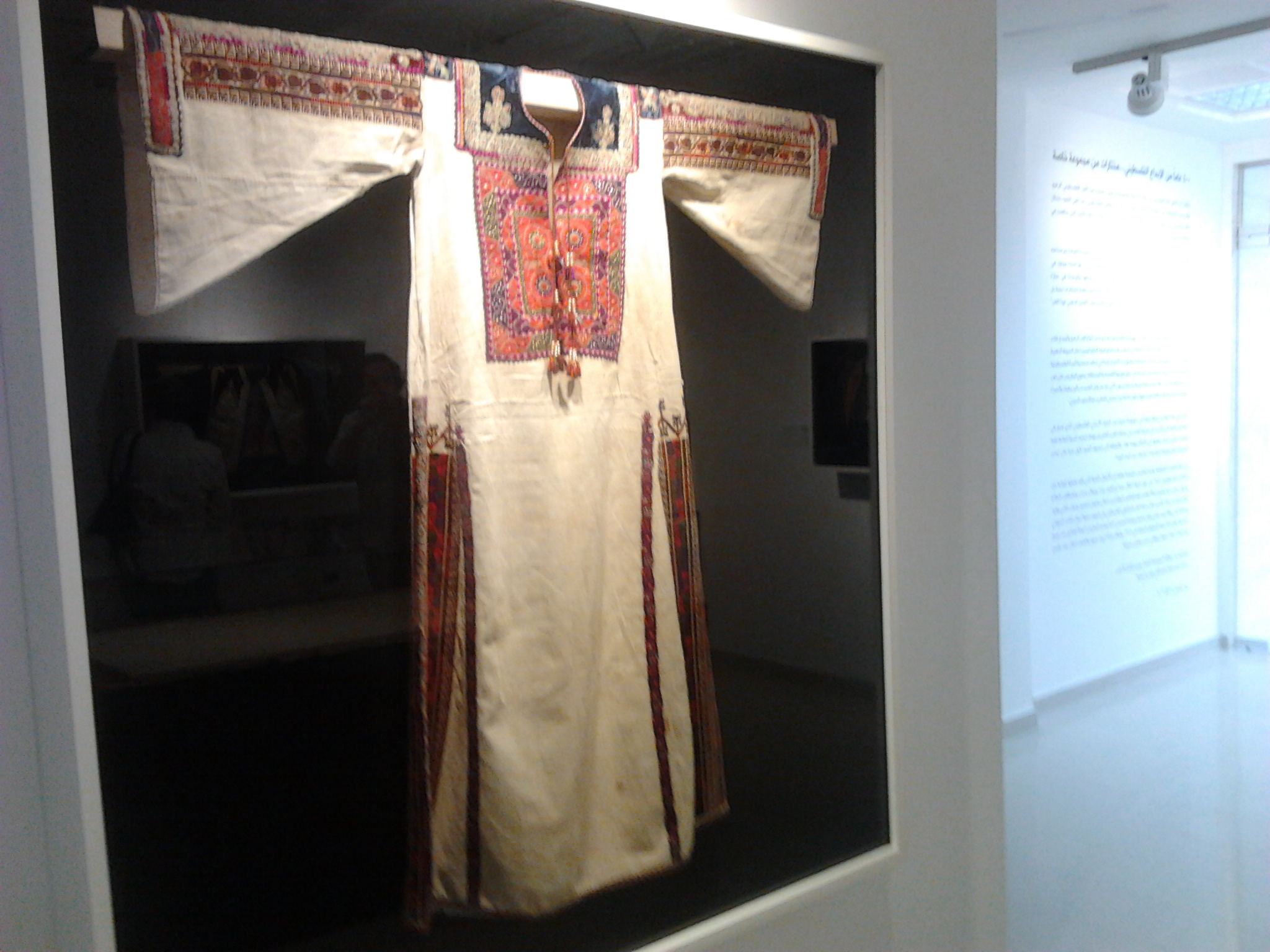
“400 Years of Palestinian Creativity” is a selection of multiple art works from a private collection of George Michel Al Ama, currently exhibited in the newly opened building of Bank of Palestine in Bethlehem. The bank is situated on the Jerusalem – Hebron road, very close to the Intercontinental Hotel in Bethlehem.

Traditional Palestinian Dress

“This exhibition is an attempt to present a new perspective on Palestinian fine art.” writes George Michel Al Ama

BOP - Exhibition

The exhibition presents:

  • Some of the items dating as far to 17th century
  • Beautiful carvings in the mother of pearl and wood made not only as souvenirs but also gifts for kings and presidents.
  • Glass and ceramic art, e.g. Palestinian Armenian Pottery
  • One of the extinct arts of Palestine: Dead Sea stone carving.
  • Art of embroidery of Palestinian traditional costumes – the essential component of Palestinian identity and culture.
  • Fine Art in painting and more of distinctive artists like…

View original post 82 more words

About Tales of a City by the Sea

The play Tales of a City by the Sea is a unique and poetic journey into the lives of ordinary people in the besieged Gaza strip prior to, during and after its bombardment during the winter of 2008.  Jomana, a Palestinian woman who lives in the Shati (beach) refugee camp in Gaza falls in love with Rami, an American born Palestinian doctor and activist who arrives on the first Free Gaza boats in 2008. Their love is met with many challenges forcing Rami to make incredible decisions the least of which is to take a dangerous journey through the underground tunnels that connect Gaza to Egypt.  Although on the surface this love story appears to explore the relationship between diaspora Palestinians and Palestinians under occupation, there is a broader and more universal theme that emerges – one of human survival and tenacity.  Tales of a City by the Sea avoids political pitfalls, ideological agendas and clichés by focusing on the human story of the people in Gaza. Although the play’s characters are fictional, the script is based on real life events and is a product of a collection of real stories the author Samah Sabawi and her family have experienced during the events of the past several years. Sabawi has written most of the poetry in the play during the three-week bombardment of Gaza in 2008/2009.

The writer Samah Sabawi is a Palestinian-Canadian-Australian published writer, commentator and playwright.  She has travelled the world and lived in its far corners, yet always felt as though she was still trapped in her place of birth Gaza.  The war torn besieged and isolated strip has  shaped her understanding of her identity and her humanity.  So what else could Sabawi do but to indulge in Gaza’s overwhelming presence and to succumb to tell the stories of her loved ones back home.  Her most recent play Tales of a City by the Sea is dedicated to them and to all of those who still manage to have faith and hope even as the sky rains death and destruction.

The script is available to interested theatre makers upon request.  Please email play3wishes@gmail.com for more information.

Ms. Sabawi speaking at the Launch of the The People's Charter To Create a Nonviolent World

Photo courtesy http://thepeoplesnonviolencecharter.wordpress.com/launch-events/

Follow Samah Sabawi on Twitter @gazaheart

Samah Sabawi’s professional bio can be found here

For more information on Samah Sabawi: http://en.wikipedia.org/wiki/Samah_Sabawi

Rev. Evan Dolive's avatarRev. Dr. Evan M. Dolive

An open letter to Victoria’s Secret regarding their choice to make an underwear line aimed at young teenagers. (Read about it here)


Dear Victoria’s Secret,

I am a father of a three year old girl. She loves princesses, Dora the Explorer, Doc McStuffins and drawing pictures for people. Her favorite foods are peanut butter and jelly, cheese and pistachios.

Even though she is only three, as a parent I have had those thoughts of my daughter growing up and not being the little girl she is now. It is true what they say about kids, they grow up fast. No matter how hard I try I know that she will not be the little ball of energy she is now; one day she will be a rebellious teenager that will more than likely think her dad is a total goof ball and would want to distance herself from my…

View original post 432 more words

قصيدة “يخسى الديب” للشاعر عبد الكريم السبعاوي

redplumblog's avatarAbdul karim

قصيدة “يخسى الديب” للشاعر  الفلسطيني عبد الكريم السبعاوي إهداء  إلى العراق اللذي لابد أن ينهض من جديد.
http://abdulkarimsabawi.com/
عزف على العود في مقام خنبات التراجيدي. أداء الفنان العراقي علي حسن https://www.youtube.com/watch?v=PT_4QLIYggo

View original post

occupiedterritories's avatarBearing Witness

Well my seventh week in Gaza has come to a close and as I sit here with a sand storm lashing Gaza outside and whistling through my window, I am wondering what I have achieved ? Sometimes it feels like Dabke, the Palestinians national dance, should be two steps forward and one step backwards. However after some soul-searching I realise these solidarity projects are always an emotional rollercoaster and we are making progress shaway shaway, aka step by step – thanks in large part to the dedication and commitment of the Gaza Ark steering committee here in Gaza and internationally. Maybe the reflection has been brought about by the fact I am a long way from home on the eve of my birthday and I am missing my peeps, who I now havent seen for almost five months. – but what ever the cause it is always good to take…

View original post 557 more words

Melbourne photographer Ahmad Sabra speaks to Mspiration about his suite of Gaza images nominated for the Soya Qantas Spirit of Youth Awards.

Mspiration's avatarMSpiration

Melbourne photographer Ahmad Sabra speaks to Mspiration about his suite of Gaza images nominated for the Soya Qantas Spirit of Youth Awards.

View original post 1,212 more words

Disabled people in Gaza fight for their rights

https://www.youtube.com/watch?v=oipFRm1GEsY

A great report about the challenges the disabled face in the besieged Gaza Strip.