The Nomadic Memorial Cast Lead

Translation in French  Translation in Arabic

On 21 September 2012, the International Day of Peace, the Nomadic Memorial Cast Lead was first performed in The Hague, City of Peace and Justice. From the 30st October till the 2nd of November 2012, the nomadic monument was shown in Bozar, Centre for Fine Arts in Brussels. For the finissage on the 2nd of November 2012 – All Souls’ Day –  the acknowledged Palestinian playwright and actor, Taher Najib gave a lecture-performance.

Reminiscent of a graveyard, the Cast Lead installation consists of 1430 unique books ‘floating’ above the floor in battle-array. Each copy of the book has the name of one of the casualties of Operation Cast Lead, carried out by the Israel Army in Gaza during 2008/2009, on its cover. The books contain texts by writers, artists and thinkers from both the East and West. Each of these books is a monument filled with knowledge that proved incapable of changing the course of events.

Would you like to cooperate in the realisation of this work of art? For the price of €65, you will receive your own unique book as part of the work of art Click to order the book


map of the installation for Bozar, Brussels

Exhibition Bozar

Taher Najib

BOZAR
www.bozar.be

The project is a co production of Ontwerpwerk, Den Haag; Vlaams-Nederlands Huis deBuren, Brussels; Stef van Bellingen, Erwin Jans and Felix Villanueva.

For more information and to donate to this project go to  http://www.gegotenlood.nl/en 


Maysoon Zayid: Funny Arabs – Review

 LSMedia The Independent Liverpool Student Newspaper

In a brilliantly candid account of topics such as terrorism and the Israel-Palestine conflict, Zayid’s autobiographical stand up deals with the post 9/11 relationship between America and its Arabs.

Having heard nothing about Maysoon Zayid other than she is a Palestinian-American comic with cerebral palsy, it was with large amounts of curiosity rather than anticipation that I headed down to the Epstein Theatre on Sunday afternoon.  Even before Zayid stepped on stage, I suspected that I was going to enjoy her take on things. With a fantastic and glowing introduction by Liverpool’s very own Alexei Sale, it was great to see a Jewish comic warming up for his Palestinian counterpart and roundly condemning Israel’s treatment of the Palestinian people.

Maysoon gets her gig underway with her take on the traditional call and response, berating the audience for even daring to feel sorry for her and making light of the jerking limbs caused by her cerebral palsy. The comedy comes thick and fast, with topical stories punctuated with quick, jokes leading up to weighty and often bawdy punch lines.

Using an ever growing number of call backs to previous anecdotes, Maysoon weaves her own narrative along with that of the Israel-Palestine conflict and life in post 9/11 America.

Maysoon’s parents moved to the New Jersey from a small village in rural Palestine and by her own admission her upbringing was exceptionally strict. Her father forbade Maysoon and her sisters from riding a bike or sitting on a seesaw, in what can only be described as a misguided attempt to retain her virginity until her wedding day. The comedy respectfully yet openly pokes fun at some of the more extreme examples of parenting.

Treating her family in much the same way Jewish comics have often conjured up caricatures of the dreaded ‘Jewish mother-in-law’, Zayid refers to her husband as ‘the refugee’ because she first met him in one of the West Bank’s crowded refugee camps.  Using tales of visits over to Palestine to see ‘her refugee’ she explains the backward attitudes that a society under such oppression resorts to, at one point telling of how her mother-in-law gathered all the women of the village together to assess whether a disabled person was worthy of her son.

Zayid lampoons the post 9/11 attitudes to Muslims in the US, by conveying the difficulties of being a shaking Arab at the airport who was dropped off by a father with a striking resemblance to Saddam Hussein.

Regardless of the history her people, Maysoon’s comic digs are sharply leveled at both Israeli and Palestinian politicians. Packing out theatres as a listened to voice for the Palestinian people, whether it’s the US or the West Bank, gives her comedy the kind of importance that few achieve, and puts her up there with the very best. She uses her voice and position to raise awareness and address issues that not many politicians, never mind comics, often go near.

The barriers to success that Maysoon Zayid has overcome are larger than most and that alone makes her worth listening to. However, her comic skill in turning the trials of being a disabled Palestinian woman born in America into something very funny, without losing its point, shows her to be a remarkably gifted performer.

Read original article here 


Art on the edge: Palestinian artist Larissa Sansour

Denise Marray

23 November 2012

Khaleej Times

Palestinian artist Larissa Sansour draws inspiration from the political occupation and dehumanising treatment witnessed during her childhood days, and transforms them into profoundly symbolic 
works of art.

A Palestinian astronaut plants the national flag on the moon and then floats away into space. These sequences, bas-ed on iconic images from the US moon landing and Stanley Kubri-ck’s 2001: A Space Odyssey, are at once startling and moving beca-use they express both profound hope and sadness.

The images, from the short film A Space Exodus, are the work of the Palestinian artist Larissa Sansour, whose name made headlines last year when the clothing and accessories company Lacoste forced the withdrawal of her shortlisted photography artwork from a competition being held at L’Élysée Museum in Lausanne, Switzerland. Her work was apparently considered ‘too pro-Palestinian’.

In response to the censorship, the museum broke off relations with Lacoste, the corporate sponsor, and cancelled the competition which carried a first prize of £21,000. The story of the censorship made headlines across the world, and Sansour and her Danish husband found themselves at the centre of a media storm, which proved both uplifting and exhausting. The censored work, Nation Estate, which has since been developed into a futuristic short film, places the Palestinian people in a skyscraper, supported by the international community, with each floor representing a city — Jerusalem, Bethlehem, Ramallah. The citizens in this luxury development can move about freely, via elevators (no checkpoints), but it is a sterile environment affording ‘freedom’ within the confines of an 
artificial construct. The skyscraper has views over the Dome of the Rock of Jerusalem — so the inhabitants overlook the real Jerusalem, forcing them to face a painful reality of exclusion and separation.

Speaking from her London apartment, Sansour said she and her husband are taking a much-needed rest after completing the film version of Nation Estate, which took nine months of intense work. Ironically, Sansour had wanted to win the Lacoste Nation Estate photography prize. In the event, the publicity that ensued from the ban raised her profile, and she was able to pour the res-ulting profits from sales of her work into financing the high-end production film made in Copenhagen.

Sansour was born in Bethlehem; her parents met in Moscow where her Palestinian father was studying mathematics. Her mother is Russian and worked in radio in Moscow. Upon returning to Palestine, her father was invited by the Vatican to found Bethlehem University. The family home, recalled Sans-our, was like an unofficial embassy, full of leading thinkers and political discussions. As a child, she drew instinctively and her father encouraged her precocious talent by finding her art classes to attend.

She remembers her childhood as ‘sunny’ but punctured by disturbing moments of images of violence on the street. “I think what it does psychologically, and you can’t shake that off, is that you feel that not all humans are equal. As a kid that sends a strong message: ‘You’re Palestinian so you will be treated like dirt.’ It becomes cemented — this dehumanisation — from an early age.”

When she was 15, her family life with parents, brother and sister, was harshly disrupted with the ons-et of the First Intifida, an uprising against the occupation of the Palestinian Territories, which lasted from December 1987 to 1993. Her parents, in an effort to protect her, sent her to boarding school in England, where she studied for her O and A levels. Her memories of this time, she said, are full of gloomy grey skies and a feeling of alienation. Those years sowed the seeds of an aversion to London, which she has only recently overcome. She now loves the international buzz of the city, with its 
vibrant cultural scene.

After returning to Palestine for high school, she then set off for the United States, studying art first in Baltimore and then in New York, where she completed her Masters. She continued her Fine Art studies in Copenhagen, Denmark, where she met her husband, a writer, who works with her on the film scripts. The couple, who moved to London three years ago, have a five-month-old daughter, whose joyful arrival has meant a shift in priorities.

A Space Exodus was showing at the Edge of Arabia’s ‘Come Together exhibition in the heart of London’s East End last month. Artists from across the Middle East showed contemporary work using a wide range of mediums and expressing powerful ideas.

Edge of Arabia is unique in engaging directly through educational programmes with the local East End community. This approach is appreciated in an area of London where, after years of social deprivation, a burgeoning arts scene has given a new lease of life to the once run-down streets, but left many residents feeling excluded. “We’re proud to be the education partner with Edge of Arabia,” said Narull Islam, co-founder of the Mile End Community Project.

“This is probably the first exhibition that has really engaged with the local community. They have got the young people involved; that’s really refreshing. It gives our young people confidence to meet renowned artists.”

Article appeared here khaleejtimes.com

HADEEL by Rafeef Ziadah

When all we have are words to keep the dignity of those killed alive… Palestinian poet Rafeef Ziadah in her moving tribute to a child named Hadeel killed by the IDF in Gaza.

Shakespeare in Palestine

By Abdullah H. Erakat, Ramallah

Yasmin Qadmany’s parents did not want her to study acting. In fact, they tried to prevent the 26-year-old engineer from doing so, to the extent that when she told them she was going to follow her heart, they stopped talking to her. That was three years ago, and next year she will graduate. But before she does, she and fellow thespians at the Drama Academy in Ramallah will put on a production of “Romeo & Juliet.”

“I faced difficulties. But I overcame it because I saw it as a challenge,” says Qadmany noting that her relation with her family is now better than ever. Qadmany is gearing up for another challenge in late November: a two-week workshop taught by the all-female company, the Manhattan Shakespeare Project.

Sarah Eismann, the founding artistic director of the Manhattan Shakespeare project says the project came about last year after she performed in an international production of “A Midsummer Night’s Dream” at the Folkwang University of the arts in Germany. Students from Palestine’s Drama academy also made up the cast.

“They were just incredible artists, as well as passionate, courageous and really wonderful people. So when their director asked if I wanted to work with them again, I was like yeah, of course, I would love to,” she adds.

The Drama Academy managing director Petra Bargouthi says the workshop, (English with Arabic translation), is an excellent way to prepare her students for next year’s Shakespeare festival in Germany.

“Language is the most important character when it comes to Shakespeare. It’s a game of language, so this will be very helpful for our students to understand and discover the poetry in Shakespeare,” explained Bargouthi – also a movement therapy instructor – in an interview with Variety Arabia,

The academy, the first of its kind acting school in Palestine, is located in downtown Ramallah and is hosted by Al-Kasaba Theatre and Cinematheque.

Teaching artist Jensen Olaya says she hopes that she and her colleague Eismann will contribute to the “already rich curriculum” of the Academy.

Olaya explained that the sessions will be recorded by film documenter Lena Rudnick: “I feel that Shakespeare is a widely used tool to teach theatre and performance. I feel like his themes are universal on the smallest, most intimate level and I hope that the universal themes can help us connect past cultural and political divides,” she wrote in an email to Variety Arabia.

It’s not only her first trip to the Palestine, but to the Middle East. While she says there are people in Ramallah who have already welcomed her, Olaya says she still cannot quite comprehend that she is actually going and does not know what to expect.

“We have received support – both financial support and moral support – from people in the US and I feel like I have a lot of people who are hoping that I go out there and return with wonderful stories to share about Ramallah and its’ people,” Olaya adds.

“It’s a little scary,” says second-year acting student Rabee Hanani, who has mostly been educated in Germany, but his feelings are more of curiosity than fear.

“By being exposed to different cultures from different countries in the world, we gain more,” he said.

Third-year Drama Academy student Jihad Al Khateeb says he hopes this workshop will make him a better actor, not only in performing Shakespeare, but in general.

“I think the most important thing is how to do Shakespeare the way he intended for us to do it,” says the 24-year old.

Leaving Ramallah, Olaya and Eismann will head north to Jenin’s Freedom Theatre, where they will carry out the same thing.

The venue made the news headlines in April 2011, when its co-founder Juliano Mer Khamis was murdered in broad daylight by unknown men on the steps of the theatre.

Managing director Jonatan Stanczak said the incident caused some students to drop out of the student theatre acting school, but things are now back on track.

Currently, British director Diane Trevis, the first woman to work with the Royal Shakespeare theatre, is conducting a workshop there.

“I am aware that Shakespeare is a very important component of any actor’s development. It’s a great opportunity for us to have one of the best Shakespeare troupes in the world working with our students,” adds Stanczak, who is a nurse by profession.

“We believe culture is the glue that keeps everything together and it is also the process that allows Palestinian society to form itself around ideas,” he said.

“Most of the people who come to Palestine and do the workshop become more aware of the Palestinian life and Palestinian humanity,” says Bargouthi. “I hope this will be a way of knowing us and understanding us and also for our students to see how people perceive them.”

“I merely want to connect as an artist on a human level: person-to-person, overcoming political barriers,” said Olaya.

Eismann says the Manhattan Shakespeare project is simply excited because it is their first venture into creating international relationships.

“We’re not there to make a political statement. We’re just there to create theatre, and to create art,” she concluded.

The story was originally published in Variety Arabia November issue.

On Babel an interview with Samah Sabawi

Marika Sosnowski  talks with Samah Sabawi  about Gaza, poetry, politics, music, culture, the upcoming play Tales of a City by the Sea plus much more.   http://marikasosnowski.com/2012/11/babel-4-samah-sabawi/


Reliving Gaza 2009: Searching for Words!

In January 2009 when Israel bombarded Gaza for three weeks, they called their assault ‘Operation Cast Lead’, Amnesty International had a better way to describe it; they called it ’22 Days of Death and Destruction’.  Today, we are reliving that nightmare once again, and once again I find myself searching for words…

Searching for words

Gaza…I search desperately
For words… for definitions
To tell the story of ammunitions
Exploding in a child’s body
I try to shout my indignation
But I am lost in vocabulary
Drowned in phrases as old as me
And I am as old as the Occupation
I need new words

How hard it is to find
Definitions that can restore
Humanity to a small strip of land
Along the Mediterranean shore
Siege, starvation collective misery
Familiar words in my head they linger
Bombs fall from the sky every day
Powerless words I can’t use any longer
I need new words

“Palestine is occupied….”
These are now hollow words…
“Palestinians are oppressed…”
These are now daily words…
“Palestinians are dispossessed”
These are now…tired words
“Palestinians….have a right to exist”
Words often spoken…worn out words
I need new words

Gaza…my home city
My earliest memory of Jasmine flowers and  meramiah tea
My first taste of sour lemon dipped in salt
My first climb on an almond tree
Gaza, my destiny
My father’s heart sky and sea
My mother’s first love
My sister’s first breath
My pride and dignity

Gaza is under fire
Obliterated by hate
Strangled by a demonic desire
To erase my history
Gaza is in pieces
And I…the writer…
I’m speechless
What language can possibly save me?
What words?

Samah Sabawi January 2009

“Gaza” from the soon to be released album “Sounds That Can’t Be Made”.

Gaza

When I was young it all seemed like a game
Living here brought no sense of shame
But now I’m older I’ve come to understand
Once we had houses
Once we had land
They rained down bullets on us as our homes collapsed
We lay beneath the rubble terrified

Hoping.. Dare we dream?
We gave up waiting
For us, to dream is still a dream

When I woke up, the house was broken stones
We suddenly had nothing
And nothing’s changed

We live, eight people, in this overcrowded heat
Factory-farmed animals living in our own sweat
Living like this is all my baby brother ever knew
The world does nothing. What can we do?

We will kick the ball
We will skip the rope
We will play outside. Be careful
We will paint and draw. We will say our prayers

Outside the pitiless sun bleaches the broken streets
The darkness drops in the evening like an iron door
The men play cards under torchlight
The women stay inside
Hell can erupt in a moment day or night

You ask for trouble if you stray too close to the wall
My father died ..feeding the birds
Mum goes in front of me to check for soldiers

For every hot-head stone ten come back
For every hot-head stone a hundred come back
For every rocket fired the drones come back

For thirteen years the roads have all been closed
We’re isolated. We’re denied medical supplies
Fuel and work are scarce. They build houses on our farms
The old men weep. The young men take up arms.

We’re packed like chickens in this town of block cement
I get headache from the diesel. When it rains, the sewers too
I had no idea what martyrdom meant
Until my older brother.. my older brother
I’m sorry. I can’t continue.

You sow the wind, you reap the whirlwind, it is said
When people know they have no future
Can we blame them if we cannot tame them?
And when their hopes and dreams are broken
And they feel they might as well be dead
As they go, will we forgive them
If they take us with them?

Stay close
Stay home
Stay calm
Have faith

With the love of our family we can rise above anything
Someday surely someone must help us
With the love of our family we can rise above anything
Someday surely someone must help us
Even now we will go to school
Even now we will dream to dream
Someday surely someone must help us

Nothing’s ever simple – that’s for sure
There are grieving mothers on both sides of the wire
And everyone deserves a chance to feel the future just might be bright
But any way you look at it – whichever point of view
For us to have to live like this
It just aint right
It just aint right
It just aint right

We all want peace and freedom that’s for sure
But peace won’t come from standing on our necks
Everyone deserves a chance to feel the future just might be bright
But any way you look at this – whichever point of view
For us to have to live like this
It just aint right
It just aint right
It just aint right

It’s like a nightmare rose up slouching towards Bethlehem
Like a nightmare rose up from this small strip of land
Slouching towards Bethlehem

It’s like a nightmare rose up from this small strip of land
Slouching towards Bethlehem

Stay close
Stay home
Have faith

I can’t know what twist of history did this to me
It’s like a nightmare

With the love of our family
We can rise above anything
Some day surely someone must help us…

http://marillion.com/music/lyric.htm?id=824

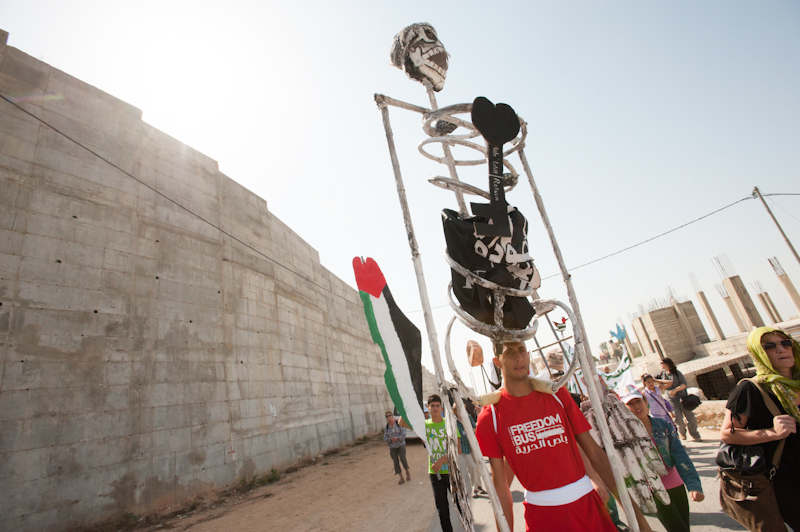
The Freedom Bus’s New Initiative “The Ride for Water Justice”

Details Published on Monday, 05 November 2012 08:46

PNN

Thirsting for Justice Campaign said in a press release that during November 2012, the Ride for Water Justice! is taking place in communities impacted by Israel’s illegal appropriations of Palestinian water resources.

The Ride includes guided walks, Playback Theatre performances, and community discussions about water apartheid and the broader struggle for freedom and justice in occupied Palestine. Audience members share autobiographical accounts and watch as a team of actors and musicians instantly transform these accounts into improvised theatre pieces. Playback Theatre provides opportunity for education, advocacy and community building.

The Ride started on Friday, November 2, in the village of Faquaa (in the Jenin district), one of many Palestinian communities impacted by Israel’s illegal appropriations of Palestinian water resources.

In the next Fridays, Palestinian and international activists, students, journalists, artists and the wider public are invited to join any or all of the Ride for Water Justice events:

November 9th: Attuwani, South Hebron Hills

November 16th: Al Hadidiya, Jordan Valley

November 23rd: Gaza via Video Conference

This four time event is organized by the Freedom Bus and EWASH’s West Bank local partner Juzoor.

The Freedom Bus is an initiative of The Freedom Theatre that uses interactive theatre and cultural activism to bear witness, raise awareness and build alliances throughout occupied Palestine and beyond.

Juzoor for Health and Social Development is a Palestinian non-governmental organization based in Jerusalem working at the national level, dedicated to improving the health and well-being of Palestinian families and promoting health as a basic human right.

The Emergency Water, Sanitation and Hygiene group (EWASH) is a coalition of almost 30 organisations working in the water and sanitation sector in the occupied Palestinian territory.

The Freedom Theatre: http://www.thefreedomtheatre.org/

Thirsting for Justice Campaign: http://www.thirstingforjustice.org/new

Juzoor: http://www.juzoor.org/portal

For further information about the event, visit

https://www.facebook.com/events/429492253776932/?ref=ts&fref=ts

Amazing! Daredevil Gaza Youths Run Free With Parkour

November 08, 2012

Agence France-Presse

Mohammed Jakhbir leans back, braces himself, and then leaps off the roof of a Khan Yunis hospital building, flipping backwards before landing on the next roof over.  He whoops with delight at performing the dangerous feat, his favorite of the moves he practices with his team — the first parkour group in the Gaza Strip.
Parkour, also known as free running, is an extreme sport that involves getting around or over urban obstacles as quickly as possible, using a combination of running, jumping, and gymnastic moves including rolls and vaults.


Practitioners leap from roof to roof, run up the side of buildings until they flip backwards, vault over park benches, or cartwheel along walls.

In Gaza, it’s still a novelty, and as Jakhbir and four members of his 12-man crew demonstrate their skills in the grounds of the southern city’s Nasser hospital, a crowd of patients and doctors look on, some filming with their cell phones.
“He’s like Spiderman!” says one onlooker as 23-year-old Jakhbir runs up a wall, seemingly defying gravity as he scales the facade.

As the crowd grows, the team decides to move to a quieter spot. Their practice sessions are occasionally interrupted when onlookers call the police to complain, and they prefer to avoid having to make a run for it.

“When we first started practicing, we could do it anywhere. But gradually we found people would complain and the police would come. It became a game, we’d practice until they arrived and then run awa

y,” Jakhbir said with a laugh.

He’s been practicing parkour for seven years, ever since his friend Abdullah showed him a documentary called “Jump London.” It instantly appealed to them.

“We would watch clips and try to imitate the moves that we saw. Gradually we started to make our own clips,” he says.

“Now sometimes people even request that we make clips to show them certain moves. It’s been a long journey for us, seven years, but now we have a real team.”
Jihad Abu Sultan, 24, joined the team four years ago after seeing some of Jakhbir’s clips on YouTube.

He had a background in both kickboxing and kung-fu, but saw something different in parkour.

“It uses physical strength more than any other sport … I was so impressed by it, especially the jumping involved,” he says.

One of Abu Sultan’s specialities is a move in which he flips his body in a full circle with one hand resting on a wall for him to pivot around.
He’s also an accomplished tumbler, throwing himself along the ground in a series of handsprings, rolls and twists.

“Parkour teaches us to overcome obstacles,” he says. “It makes me feel free, it makes me feel my body is strong, that I can overcome anything.”

But practicing parkour in Gaza hasn’t been easy.

At times they’ve had to shift practice locations because the areas have been targeted by Israeli air strikes. And both Abu Sultan and Jakhbir have battled disapproval from their families.

“At first, my parents forbade it,” admits Abu Sultan.
“They tried to stop me, especially after I was injured, but they couldn’t. It’s in my blood.”

Jakhbir’s parents told him to stop practicing parkour and find a job. He graduated with a degree in multimedia from Gaza’s Islamic University, but has been largely unemployed ever since.

“They told me there was no future to it,” he says with frustration.

“They need to understand that sport is something very important. Athletes can raise Palestine’s name throughout the world.”

Jakhbir and other Gaza Parkour members did just that earlier this year, when an Italian group called Unione Italiana Sport Per Tutti invited them to Italy.

“They were able to make our biggest dream come true, which was to get past the biggest obstacle of all — the Israeli checkpoint — and travel abroad,” Jakhbir says.
The trip took them to Rome and four other Italian cities, where they met with other enthusiasts, showing off their skills and learning a few new ones.
“We talked to people about our lives in Gaza, that we’re living under a siege, and in a continually tense situation. We face financial, social and political obstacles,” Jakhbir recalls.

They’ve spray painted “Gaza Parkour forever” on some of the walls, but they acknowledge an uncertain future.

Jakhbir and Abu Sultan say they’d like to continue parkour professionally, and are hoping to eventually win either local or international support that would allow them to commit to the sport full-time.

“Parkour teaches us we can overcome our problems even if we fail once or twice,” says Jakhbir. “We have to try and we can achieve our goals in life.”

This article appeared in Jakarta Globe

DAM featuring AMAL MURKUS – If I Could Go Back In Time لو أرجع بالزمن

http://www.DAMRAP.com
Translation and Credits
Arabic script: If I Could Go Back In Time
‏Suhel Nafar:
‏Before she was murdered, she wasn’t alive
‏We’ll tell her story backwards from her murder to her birth
‏Her body rises from the grave to the ground
‏The bullet flies out of her forehead and swallowed into the gun
‏The sound of her echo screams, she screams back
‏Tears rise up from her cheeks to her eyes
‏Behind the clouds of smoke, faces of her family appear
‏Without shame, her brother puts the gun in his pocket
‏Her father throws down the shovel and wipes the sweat off his forehead
‏He shakes his head, satisfied from the size of the grave
‏They pull her back to the car, her legs kicking
‏Like a sand storm, she’s erasing her own tracks
‏They throw her in the trunk, she doesn’t know where she is
‏But she knows that three left the house and only two will return
‏They reach the house; throw her to the bed in violence
‏”So you want run away huh?” they wake her with violence

‏Amal Murkus (Chorus)
‏If I could go back in time
‏I would smile
‏Fall in love
‏Sing
‏If I could go back in time
‏I would draw
‏Write
‏Sing

‏Mahmood Jrere:
‏She dreams before falling asleep
‏We’ll tell her story backwards, maybe understand
‏The clock hands move right to left
‏She reconstructs her steps as if she were lost
‏She sleeps prepared, money for the taxi
‏Plane ticket and passport under her pillow
‏Answer: leave the clothes in the closet; she plans to wear a new life
‏Question: what if they ask what the suitcase is for?
‏She went to bed, leaves table
‏Eats well, she must act today
‏Her nose stops bleeding, that’s what they see
‏But it’s a fresh wound; before they will beat her she will beat them
‏Her mom says “your life is like heaven”
‏She’s right, if you taste the forbidden you better know someone is watching
‏Two hours before dinner, the phone hangs up
‏Her mom is shocked “the flight is delayed”
‏Phone rings

‏ Amal Murkus (Chorus)

‏Tamer Nafar:
‏Before she answers, she isn’t even asked
‏The story is like the logic in her life, all backwards
‏Her hands up in the sky, begging for help
‏Their hands up in the sky reciting the Fatiha (ceremony before marriage)
‏The calendar page moves one day back, the time is
‏Afternoon, the argument is over, her brother commands her
‏Blood flows from her lips to her nose
‏A sound of a fist, his hand jumps from her face
‏It’s the first time in her life that she says “NO!”
‏Her mom announces happily “tomorrow you will marry your cousin”
‏If I look through the album of her life
‏I won’t see a photo of her standing up for her rights
‏It’s hard, the pages are stuck to my hand
‏Her past full of blood and tears
‏But we promise you, from her murder to her birth
‏Their expressions filled with anger as if someone announced a crime
‏”Congratulations, it’s a girl”
‏The beginning.

Arabic script:Freedom For My Sisters

Lyrics written by DAM
Music produced & arranged by NABIL NAFAR
Mixed by SAQIB and NABIL NAFAR
Mastered by SAQIB

Directed by JACQUELINE REEM SALLOUM and SUHEL NAFAR
Produced by LAURA HAWA
Assistant Director ELI REZIK
Director of Photography ARI ISSLER
Editor ABDUL JABBAR MAKI
Composting and Visual Effects CONRAD OSTWALD
Colorist SETH RICART
Costume Designer and Stylist NADA NAFAR
Art Director BASHAR HASSUNEH
Production Manager JAMAL KHLAYLEH
Makeup Artist VERED NIVO
Lighting Director ARI ISSLER
Steadicam Operator HAIM ASIAS
Focus Puller GEORGE DABAS
Key Grip MORDI BOAZ
Key Gaffer YANA MITNICK
Production Assistant MANAR YACOUB
Best Boy Gaffer REA’OT GING
Best Boy Grip FADI MATAR
Art Assistant PAULINE CARBONIER
V
Visual Effects Supervisor HASHEM ODEH
Sound Playback JAMIL NAFAR
Catering NADIA NAFAR and MONIRA GOHAR

Cast
Main Girl SAMAA WAKEEM
Brother DORAID LIDAWI
Mom KHAWLA DIBSI
Dad BAHJAT YOUNIS

Chorus scene
YARA ZRIEK
ISIS AZAM
NERIAN KEYWAN

Fateha Readers
BAHA KADURA
ABEDALLAH NAHFAWI
RAMI YOUNIS
SAMI AWADI
WAEL ABU SHAREKH
ABED SHAHADA
MUHAMAD HADDAD

Young girls
ASIL KADURA
CILIN AWADI

Special Thanks
UN WOMEN
JULIEN VAISSIER
FAIEZ NAFAR
MARKO MATKOVIC
MARTIN BJERREGAARD
AdTomic
WALEED ZAITER
SALIM SHEHADEH
SALMA SAMARA
AHMAD KANAAN
AYED FADEL
NINA ZIDANI
ABED HATHOT
BAHAA RASHED
ADI KHALEFA
ADI KRAYEM
ELYAN BASEL
MANAL BASEL
RASSLAN BASEL
ABEER AWADI
RASHA KADURA
CINDY THAI THIEN NGHIA

Palestinian artists launch art festival to protest Israel’s barrier

By REUTERS
WEST BANK

Sunday, 04 November 2012

Palestinian artists showcased their art work at West Bank’s Qalandia International Festival on Thursday framed as part of a creative reaction to the Israeli barrier that separates Palestinian villages from each other.

Israel has said the barrier, a mix of electronic fences and walls that encroaches on West Bank territory, is meant to keep suicide bombers out of its cities.

Palestinians call the barrier — whose course encompasses Israeli settlements in the West Bank — a disguised move to annex or fragment territory Palestinians seek for a viable state.

The International court of Justice declared the planned 600-km (370-mile) barrier, more than half of which is completed, illegal but Israel has ignored the non-binding ruling.

Qalandia International Festival Art Director, Jack Persekian, said it was an important way for Palestinians to channel their emotional reactions to the barrier.

“The wall and the road that was constructed recently connect the Israeli settlements together and separate the Palestinian villages from each other. The reaction to this separation was a cultural festival. It is an important and a good reaction — it shows a positive, artistic and cultural spirit in a painful situation that should be stopped,” he said.

The festival, which showcases Palestinian contemporary art projects, performances, films, and other cultural activities, kicked off on Thursday at Qalandia village northern of Jerusalem and ends on November 15.

According to the festival’s organizers, over 50 local and International artists came together for the launch of Qalandia International, ‘a milestone contemporary art event’.

Palestinian artist Khaled Jarar screened his 2 minutes film at the festival. His film, too, addresses barrier issues and Palestinians’ reactions to it.

“I went to the wall and I cut out some pieces of it. I smashed them then I mixed them with cement and water and I made a ball which children play with. My message is that the wall is an ugly thing, so we should seek out ways in which to use it and the occupation for our benefit,” he told Reuters television.

The festival was organized by seven Palestinian institutions- Riwaq, Al Ma’mal Foundation for Contemporary Art, A. M. Qattan Foundation, Palestinian Art Court – Al Hoash, International Art Academy – Palestine, Sakakini Cultural Centre and the House of Culture Arts – Nazareth.

Palestinian band ‘Dar Qandeel’ performed traditional and modern music at the festival’s opening ceremony and people from various Palestinian villages and cities as well as Internationals came to attend.

Yara Bayoumi, a visitor at the festival, said the cooperation involved in hosting such a festival was wonderful.

“The festival is very nice. It is the first of its kind in Palestine. It is the first time seven organizations have worked together to organize such a festival. I hope it will have a good effect, and put Palestine in the world’s contemporary art,” she said.
The festival is expected to tour Jerusalem and other West Bank cities.

This article appeared in http://english.alarabiya.net/articles/2012/11/04/247588.html

SoA Women take Shakespeare project to Palestine


By Zoë Miller

Columbia Daily Spectator

Published October 1, 2012

The Manhattan Shakespeare Project’s current venture is centered on the creation of original theatrical pieces that will incorporate Shakespeare’s sonnets and Palestinian youth songs.

For the all-female Shakespeare company Manhattan Shakespeare Project, all the world really is a stage­ for cross-cultural communication.  MSP’s newest project, “Shakespeare For A New World: The Palestinian Voice,” is centered on the creation of original theatrical pieces that will incorporate Shakespeare’s sonnets and Palestinian youth songs. Teaching artists Sarah Eismann, SoA ’12, and Jensen Olaya, SoA ’12, will travel to Palestine in late November, accompanied by documentary film director Lena Rudnick, SoA directing candidate, to work with students at the Drama Academy Ramallah and the Jenin refugee camp’s Freedom Theatre.

Eismann said that although “Shakespeare For A New World” and MSP are not political entities, projects “have the potential for having political undertones” by nature of the fact that MSP is an all-female company traveling to a region often associated with more rigid patriarchy. But the purpose of “Shakespeare For A New World,” above all else, is for Eismann and Olaya to work with the students at the Drama Academy Ramallah to create theater and art. Due to their geographical location, the Palestinian theater students are extremely isolated. The project will “help get their voice outside of the borders of Palestine,” Eismann said.

The concept of “Shakespeare For A New World” emerged after Eismann performed in an international production of “A Midsummer Night’s Dream” that took place in 2011 at the Folkwang University of the Arts in Germany. The “Midsummer” cast was comprised of acting students from Folkwang, in addition to students from Columbia, the Drama Academy Ramallah, the Shanghai Theatre Academy, and the Lucian Blaga University of Sibiu. Eismann said that she was inspired by the beauty of “a Palestinian Helena working with a Romanian Demetrius.” Shakespeare’s words, she realized, could effectively cut across cultural and linguistic barriers. “We found our common world. We found our common language,” she said.

The Folkwang production, Eismann said, led to an epiphany. “If only the world could work this way, we would have no problems,” she said. “It wouldn’t be me against you—it would be what was on that stage.”

Eismann was thrilled when the Drama Academy Ramallah’s director invited her to teach the “Shakespeare For A New World” workshops and make this vision of “a completely united, holistic, humanistic world” more of a reality—at least in theater.

As time went on, the project gained momentum and “exploded into this very idealistic, very grandiose plan.” The intense, six-hours-a-day workshops will include not only actors from the Academy but also teenagers at the Jenin refugee camp, which is one of the oldest, most devastated refugee camps in Palestine. With the help of a team including Rudnick, these workshops and the performances that result from them will be filmed.

In the next five years, Eismann hopes to take the methodology that the MSP team learns from the Ramallah and Jenin workshops and bring it to high school students in New York.

The end goal, she said, is to get diverse communities across the globe to learn about each other, “to use Shakespeare to talk, to create theater, to create peace.”

arts@columbiaspectator.com

This article appeared in Colubmia Spectator


A Message from Young Palestinians in Gaza to the World!

Singing Palestine: Rim Banna

Al Jazeera

Rim Banna has given melodic interpretations to the suffering of Palestinians and their defiant hopes and aspirations.

Between October 3 and 7, I was part of a wide-ranging celebration of Palestinian arts and culture in Milano, Italy.

The Philastiniat festival of Palestinian film, literature, theatre, folklore, music, dance and poetry opened in various locations in Milan to the enthusiastic reception of the city officials, the Palestinian community and their European friends and families.

Distinguished guests ranged from writers Suad Amiry and Salman Natur, film directors Michel Khleifi, photographer Rula Halawani, singer-activist Rim Banna, poet Zuhair Abu Shayeb, writer-journalist Akram Musallam and poets Nasr Jamil and Asmaa Azaizeh, and many others.

At the heart of the festival, which included performances, poetry readings and film series, was also a tribute to the late Palestinian scholar and public intellectual Edward W Said (1935-203).

A conference on Said was held on October 5 at Palazzo Marino – Sala Alessi – Piazza Della Scala – right across from the historic Scala opera house. Younger and more senior scholars from various universities in Italy exchanged ideas on the significance of Edward Said’s legacy.

The panelists included: Wasim Dahmash (Università degli Studi di Cagliari), Paolo Branca (Università Cattolica, Milano), Marco Gatto (Università della Calabria), Mauro Pala (Università di Cagliari) and Mariantonietta Saracino (Università Sapienza, Roma).

Rim Banna 

Particularly memorable in this event was the featuring of Palestinian singer Rim Banna in the very last night of Philastiniat. Born (1966) and raised in Nazareth, and educated in the Higher Music Conservatory in Moscow, Rim Banna is a Palestinian singer and composer who was initially celebrated for her endearing renditions of old Palestinian folk songs.

She has now emerged as a major voice in Palestinian music of resistance, giving melodic interpretations to the suffering of her people and their defiant hopes and aspirations. In pain and suffering, defiance and struggle, confidence and pride, Palestine sings in Rim Banna.

Listening to Rim Banna (here is a sample from her album “Maraya’ al-Ruh” – The Mirrors of My Soul) is an experience in living through the trials and tribulations of Palestinians, as their newborns are sung to by the lullabies of their resistance, their youngsters are point blank shot dead by Israeli soldiers and settlers alike, and as their heroes are loved and admired for their resistance.

Rim Banna sings love songs for towering Palestinian men and women, bearing witness to their people’s struggles, raising and protecting their children against a vicious killing machine that has occupied their homeland – and the result is the creation of a repertoire of folkloric and contemporary songs that have now blended into each other to become the common staple of Palestinian lives and resistances.

From her renditions of Palestinian lullabies to her lovingly flirtatious “Mash’al”, to her “Tayr Hawa” – Fly Love, Rim Banna’s ballads of Palestine have become integral to her people’s stories of struggles and resistance.

In beautiful and yet heart-wrenching songs like “Sarah“, Rim Banna transforms the brutal murder of young Palestinian children by Israeli army or their obscene settlers into unforgettable ballad, contemporary folksongs of her people.

As in the cases with jazz, blues, or ragtime, Rim Banna’s ballads derive their power from their deep-rooted connections to her people’s struggles.

Listening to and watching Rim Banna perform, you can hear Umm Kulthum in Egypt, Edith Piaf in France, Joan Baez in the US, or Mercedes Sosa in Argentina. In her voice and in her songs, she has wed the stories of her people to defiant joys of people around the globe. It is as if it has been the fate of Palestinians in their heart and soul to travel around the world and in the best and the most beautiful everywhere, find a way to tell and share their stories.

They say that the United States is the most powerful country on planet earth and when the Israeli Prime Minister goes to the US congress to deliver yet another vulgar and inane speech, there are so many standing ovations for him by the even more vulgar and inane members of the US congress that they probably spent more time on their feet applauding their Israeli benefactor than seating on their chairs thinking of their duties to the people who had elected them.

But what has AIPAC really bought for Israel with such obscene display of power – turning the democratic institution of a nation into the Joker-Jack-in-the-Box of a bankrupt ideology – when with one single, beautiful and powerful song, Rim Banna can make the whole world rise up and sing with Palestine?

Hamid Dabashi is Hagop Kevorkian Professor of Iranian Studies and Comparative Literature at Columbia University in New York. Among his books is his edited volume, Dreams of a Nation: On Palestinian Cinema(2006).

The views expressed in this article are the author’s own and do not necessarily reflect Al Jazeera’s editorial policy.

Source:
Al Jazeera

A circus comes to Gaza _ minus lions and ladies

By DIAA HADID, Associated Press – 7 hours ago

GAZA CITY, Gaza Strip (AP) — The circus came to Gaza on Friday, accompanied by blaring music, juggling clowns and fire blowers — but getting it there required its own high-wire act.

No women performers were included for fear of offending conservative Palestinians and the Gaza Strip’s militant Hamas rulers, and the circus’ lone lion and tiger were left behind because of the high cost of transporting them legally into Gaza.

The Egyptian National Circus put on its first show of a month-long visit to the impoverished coastal territory on Friday, a sign of warmer relations between Hamas and post-revolution Egypt, which is governed by the Islamic group’s ideological parent, the Muslim Brotherhood.

Although it’s not state-sponsored, the Egyptian circus could only come because the country’s government loosened restrictions on the flow of passengers in and out of Gaza. More foreigners now enter Gaza, including the ruler of the resource-rich Gulf state Qatar earlier this week.

Once in Gaza, the Egyptians’ faced an unusual situation — most Palestinians here don’t know what a circus is.

“I think it’s going to be really surprising for most people,” said Riwa Awwad, 19, ahead of the opening night.

“Gazans are famous for not liking anything and I think they’ll do the impossible to entertain us,” said Awwad, who came with her extended family to the fairground on Friday.

In an ironic twist, the cheery circus with its flashing lights was held on the grounds of a notorious security prison that was destroyed during an Israeli offensive four years ago.

For the Gazans fortunate enough to see the opening show, it was a welcome relief from conflict and despair. The fairgrounds were packed with excited children in new cloths, women in glittery headscarves, others in black face veils, and men in suits and freshly pressed shirts. Families snacked on pumpkin seeds.

They hollered and cheered as a tight-rope walker wiggled his hips and belly-danced on a thread suspended above the ground. A performer hurled silver knives around volunteers. A red-clad fire blower shot whooshing, yellow licks of flame out of his mouth. Two clowns dressed in yellow-and-blue bumbled and fumbled as they tried to juggle, delighting children.

It took months to arrange the visit to the impoverished territory, where 1.6 million people live in a 25 mile-long sliver wedged between Israel and Egypt and face a punishing blockade imposed after Hamas seized control in 2007.

Aside from a circus’ brief visit in the 1990s, there’s never been anything like it since Israel captured the strip from Egypt in 1967. Israeli forces and settlers withdrew in 2005.

Businessman Mohammed Faris said he remembered seeing the circus under Egyptian rule in the 1950s, when Gaza was still a liberal place with casinos and bars. He said he recalled as a child seeing men walking on nails and female acrobats flying across stage.

“It was men and women – pretty women,” he said.

Not this time around.

Organizer Mohammed Silmi said female performers had to stay behind because the circus was worried that leaping ladies in tights would offend Gazans.

He said Hamas didn’t explicitly ban women but he was asked to abide by Gaza’s “traditions” when he petitioned to get the circus to come.

In practice, the circus wiggled a little around the no-women rule. At one point a man in drag, sporting a brown wig and red dress, sang and danced with Bunduk the clown.

After Hamas seized control of Gaza in 2007, Israel and Egypt imposed a blockade that aimed to weaken the militants who seek Israel’s destruction.

Under international pressure, it was loosened after Israel raided a blockade-defying boat and killing nine Turkish activists aboard in 2009. Key restrictions still remain on exports and importing raw materials.

All the circus equipment came through the Rafah border crossing, but expensive fees and cumbersome paperwork kept the circus from bringing lions, tigers and horses across the border.

Gaza’s makeshift zoos and other merchants often bypass that problem by hauling animals through smuggling tunnels linking the territory to Egypt. In one famous scene captured on film, Gazans used a crane to lift a camel over the border fence as the animal twitched in the air in agony.

Animal welfare aside, Gaza’s main zoo recently turned to improvised taxidermy to keep its deceased animals on exhibit.

The area also continues to be violent. As circus technicians were setting up their tent earlier this week, Palestinian militants were fighting Israeli forces in tit-for-tat rounds of rocket fire and retaliatory airstrikes.

Egyptian technician Khalil Gomaa, 55, jolted upon every crashing boom. He told his children he was in Jordan so they wouldn’t be worried. “But I’m worried,” he said.

But the circus’ biggest challenge may be packing the 1,000-seater tent for the month-long visit.

A series of Palestinians interviewed didn’t know what a circus was, and the tickets — ranging from $5-$10 seats — are too expensive for most of Gaza’s traditionally large families.

Some 40 percent of Gazans live on less than $2 a day, a third are unemployed and most need U.N. donated food.

They include the mother of eight, Sabrine Baoud, and her unemployed husband. After the circus was explained to her, Baoud, 35, said she was glad her children didn’t know anything about it.

They’d never be able to afford to go.

‘Unto the Breach’: Palestinian dance adaptation of Shakespeare’s play

UK-based Palestinian dabke theatre group Al Zaytouna will present its new production entitled Unto the Breach in London in November 2012.
Interview by Mamoon Alabbasi – LONDON
Article Published: 2012-10-22 Middle East Online

Henry V set in modern-day Palestine

The UK-based Palestinian dabke theatre group Al Zaytouna will present its new production entitled Unto the Breach, an adaptation of Shakespeare’s Henry V set in modern-day Palestine. The show, directed by Ahmed Masoud and co-directed by HadjerNacer, will be performed in London in November 2012. Al Zaytouna board member Souraya Ali gave the following interview ahead of the full production’s debut.

Q– Could you give a brief introduction to the show?

Al Zaytouna Dance Theatre’s new show Unto the Breach is a dance adaptation of Shakespeare’s history play Henry V, set in modern-day Palestine. Paralleling Shakespeare’s account of the young English monarch, King Henry V leading his people in battle against the mighty French army, Unto the Breach tells the story of the Chairman, a Palestinian leader who, moved by his people’s suffering, leads them in a revolution against a more powerful force to free them from oppression.

As in Shakespeare’s original play, a Chorus leads the audience through the show, but here she urges them to imagine “the vast olive groves of Palestine” and “the very gates of Jerusalem” rather than the 15th century battlefields of France, and the scenes she narrates are brought to life not through Shakespearian dialogue, but through traditional Palestinian dabke and contemporary dance against a backdrop of digital media.

Q– Some have interpreted Shakespeare’s Henry V as a play that celebrates patriotism while others have viewed it as exposing the Machiavellian characteristics of a king – shedding light on the horrors of war. How do you understand the original play? And how does your show relate to that?

We don’t see Shakespeare’s play as a straightforwardly patriotic account of King Henry V’s French battles. Whilst the play does depict an extraordinary victory against all odds, it also shows that the motives behind this victory were not all virtuous, and that the means of achieving it were not all noble. For example the two clergymen who put the case for war to the King at the beginning of the play are driven by financial motives, as are various unsavoury characters who join the king’s army because of prospects of plunder. King Henry himself also shows a darker side to his character with a controversial decision to execute defenceless French prisoners during the battle of Agincourt.

Unto the Breach captures something of this ambivalence towards war. On the one hand, it celebrates Palestinians’ efforts to change their circumstances and shape their future through revolution, but on the other it recognises that these efforts have not yet succeeded. Palestinians still live under occupation and are far from achieving the freedom and sovereignty that they have been fighting for. The show also highlights the internal power struggles that have undermined Palestinians’ campaign for freedom, and depicts some of the darker outcomes of such struggles, such as in a scene where the Chairman executes two of his own people to quash a rebellion.

In the original play, the Chorus repeatedly draws the audience’s attention to the inability of the theatre and actors to accurately convey all aspects of the historical tale. Instead, the Chorus resorts to hyperbole and appeals to the audience’s imagination, indicating just how much our understanding of past events is constructed – and embellished – by those who recount them. Shakespeare thus highlights the power of rhetoric and political myth in re-telling military history. Unto the Breach reflects this idea with a scene where the world’s press attend the signing of a peace agreement, and then the journalists file their reports, constructing people’s understanding of this historical event.

Q– You noted that the launch of the show would coincide with the anniversary of Yasser Arafat’s death. In light of recent reports suggesting that the late Palestinian leader may have been assassinated via the radioactive element polonium-210, is there a reference to that incident in your show, since the theme of assassination is present in the original play where Shakespeare’s Henry V survives an attempt on his life (albeit by friends not foes)?

This incident is not addressed in our show.

Q– Although King Henry V, at one point in the original play, comes to the humble realisation that he is but a man; he is nevertheless the person responsible for rallying his men to victory. How does that reconcile with your show, given that: a- Yasser Arafat, who in the director’s words is “the great figurehead of the Palestinian struggle”, has died before managing to lead his people to liberty; and b- The Arab Spring, which you cite as among the inspirations for the show, had been sparked without any outstanding movement leaders?

Whilst the launch of Unto the Breach coincides with the anniversary of Yasser Arafat’s death, and there are parallels between our depiction of the Chairman and that of the late Palestinian leader, the show is not a historical account of his life. It does, however reflect on the value of a figurehead such as Arafat, in uniting people behind a common cause, enabling them to stand up for their rights and to stake their claim for sovereignty on a world stage. The show recognises this value but also acknowledges that the Palestinians have not yet achieved their objectives, and so the Chairman in our production dies without securing the liberty that he craved for his people. The achievement of victory is thus far less clear-cut in Unto the Breach than it is in Shakespeare’s Henry V.

In the show, the Chairman’s death leaves the Palestinians without a leader, and so the onus is on them to once again rise up and claim their rights. The idea that this is possible – that people can bring about change if they unite and call for it with a common voice – flowed strongly from the Arab Spring, and inspired us to create the show. Although we recognise that any such struggle is fraught with difficulties, it is this idea of hope that continues to drive us forwards.

Q– In the original play, future unity between the British and French kingdoms is suggested following the marriage between Henry and the daughter of the French king, Catherine. Monarchies aside, do you see the One-State solution as some sort of a modern day parallel to that?

Whilst Shakespeare’s play ends with King Henry V’s marriage and the expected union of England and France, the historical reality is that Henry V never succeeded to the French throne. He died two years after his marriage and two months before the King of France, and his French conquests were lost over the ensuing years under the reign of his son King Henry VI. Unto the Breach reflects this more sombre reality. In the production the Chairman also dies, and much of what he has fought for is dissipated as conflict and the grip of occupation continue, and his successors are debilitated by internal power struggles. The show has a deliberately ambiguous ending, leaving open the question of how the Palestinian question is to be resolved, and what the nature of the solution might be.

Q-Following a very impressive performance of your show Between the Fleeting Words in 2010, do you expect to outshine such success with Unto the Breach this year? Also, has there been any change in the way you do things or in the group members?

Since Between the Fleeting Words debuted in London in 2010, Al Zaytouna has continued to develop as a troupe. Thanks to the phenomenal support that we received for the last show, we toured it in the UK, Slovenia, Switzerland, and Germany. This experience helped us to hone many performance and production skills, which we believe will make Unto the Breach even better and stronger.

Al Zaytouna has also continued to grow, with new dancers joining us, and many of our members pursuing new artistic endeavours. These have included our artistic director Ahmed Masoud writing a radio play for BBC Radio 4, entitled Escape from Gaza, in collaboration with Justin Butcher, and winning the Muslim Writers Award 2011 in the Unpublished Novel category for his book Gaza Days. Several of our dancers have developed their own dance theatre work, such as Lorraine Smith’s Pictures of Life and new work Disco Babies, whilst others have taken on new performance roles, such as UmutUysal who drummed in the opening ceremony of the London Olympics. All of these experiences have enriched the group bringing new expertise and fresh ideas.

We were also fortunate to secure a grant from the BBC Performing Arts Fund to support the development of Unto the Breach, which given us the support and profile to take this show to the next level. We have been able to invest more in the show’s development and to reach out to new partners and collaborators. We are, for example, very happy to have professional actress Clare Quinn performing with us in this show, and we have been able to secure a really wonderful performance space at the artsdepot. All of these factors make us confident that Unto the Breach will be even more successful than Between the Fleeting Words.

Q– Again with regards to Between the Fleeting Words, the 2010 show featured a beautiful blend of music genres, projecting a mix that crosses cultural and generational divides. It also included the notable presence of the talented Palestinian artist Nizar Al-Issa. What music variety should we anticipate with Unto the Breach?

Unto the Breach builds on Al Zaytouna’s tradition of working with leading musicians, and features a collaboration with David Randall. David is a guitarist, composer and producer who has contributed to multi-million selling albums by Grammy-winning artist Dido, toured extensively with UK dance act Faithless, and released his own critically acclaimed albums as Slovo. He also wrote and produced the One World single Freedom for Palestine, and has published articles on the role of music in political campaigns and on Palestinian Hip Hop. He is a highly talented musician who is passionately committed to the Palestinian cause and his contribution to this production has been invaluable. David has composed and recorded a number of tracks especially for Unto the Breach, which are woven together with traditional Palestinian songs to create a powerful and moving sound track.

For information on booking, visit: http://www.alzaytouna.org/productions/unto-the-breach

This article appeared in Middle East Online http://www.middle-east-online.com/english/?id=55048

THE 7ARAKAT CONFERENCE: THEATRE, CULTURAL DIVERSITY AND INCLUSION

Friday 2nd and Saturday  3rd of November 2012 – Melbourne australia

The conference will explore practice, research and advocacy in the performing arts with a particular focus on Palestinian Theatre, Arab/Australian Theatre, and Applied Theatre with refugee/migrant groups. The conference will bring together theatre-makers, scholars, creative producers and community development workers to examine various issues of exclusion within the sector of performing arts and the theatre’s role in providing networks of participation and social inclusion.

For information and to register 

Freedom Bus takes cultural resistance to the streets

Freedom Bus takes cultural resistance to the streets

The Freedom Bus, an initiative of Jenin’s Freedom Theatre, used interactive theatre and cultural activism to bear witness, raise awareness and build alliances throughout occupied Palestine and beyond. From September 23-October 1 2012, Palestinians and allies from around the world took part in a 9-day solidarity ride through 11 communities in the West Bank of occupied Palestine. Read more

The Guardian: Palestinian theatre director Zakaria Zubeidi is released on bail

Co-founder of Jenin’s Freedom Theatre, who faces charges over an attack on the home of Jenin governor Qaddura Musa, has been released on bail following a series of hunger strikes.

The imprisoned theatre director Zakaria Zubeidi has been released on bailby Palestinian security forces, following a series of hunger strikes.

The co-founder of Jenin’s Freedom Theatre, a drama group active in the northern West Bank, had been detained in Jericho since 13 May following a wave of arrests by the Palestinian Authority. Charges were not brought against him for more than four months.

Read more The Guardian: Palestinian theatre director Zakaria Zubeidi is released on bail