Adania Shibli: A Decade of Palestinian Artists in Paris

A piece by Hani Zorob titled: A Long Egyptian Series.


Mustafa Mustafa

Al-Akhbar English

Published Thursday, February 14, 2013

The award-winning Palestinian novelist Adania Shibli interviewed 15 up-and-coming Palestinian artists for her new book, Hirak, orMovement.

Jerusalem – Between 1999 and 2009, 15 Palestinian artists passed through the Cité Internationale des Arts in Paris (CIAP), which offers residencies to artists from around the world to work in the city for a period of two months to a year.

This is where Palestinian novelist Adania Shibli got the idea for her latest book, Hirak. Using video conferencing, she interviewed the group of Palestinian artists who were offered residencies at the CIAP.

The book, available in both Arabic and French, probes questions at the heart of the Palestinian experience such as occupation, exile, and the state of constant movement to which the artists are subjected.

The Palestinians featured in the book are sculptors, painters, and installation and video artists. One of them is painter Hani Zorob, born 1976, whose experience in many ways captures that of a new generation of Palestinian artists.

“My place of birth in the Rafah refugee camp in Gaza greatly influenced my life overall. Growing up during the first intifada, the resources available to a child interested in art were very limited,” he said. “My canvas was the walls of the city, especially on national occasions. My tools were either a pencil or the shabby wax crayons distributed by UNRWA.”He remembers being overwhelmed the first time he entered an art store in Paris. “I didn’t buy anything because there were so many things I hadn’t seen before and had no idea how to use them.”

As for Shadi Zaqzouq, born 1981, he raised the issue of how foreign audiences tend to interact with Palestinian art as “political production.”

He began to think about the issue after successfully selling every single one of his pieces displayed at his exhibit titled “Merely a Dream.” When he discovered that most of his works were bought by people who actively support the Palestinian cause, it made him wonder whether this meant that he was a good artist.

Artist Majd Abdul-Hamid, born 1988, had a similar experience while attending the International Academy of Art in Ramallah.

“I noticed there were a lot of foreign artists who come to work with students at the academy due to the fact that we are Palestinians,” he said. “None of these instructors critiqued my work based on its appearance – they took it easy on me because I was a Palestinian student.”

This article first appeared here

Disabled people in Gaza fight for their rights

A great report about the challenges the disabled face in the besieged Gaza Strip.

Imra’a: For my sisters in the Arab world and beyond

250581_474702535893908_625593223_n

I

am

woman

Imra’a

Whole

Not a fragment of your shadow

Not a rib torn out of your torso

Not a mail order

Not a house slave

Not a fairytale princess

Not a damsel in distress

Not a genie in a bottle

Not a saint

Not scattered

Not arranged

Not lacking in brain or piety

Not a fountain of propriety

I am eternity

Lived in an instant

I am constant

Randomness

I am chaos in stability

In songs you ache for me

I am your refuge and your refugee

Your barren desert and your fertile field

Your homeland

Your ‘watan’

My womb yields the fruit of life

I am your daughter

Mother

Sister

Wife

A prince of poetry wrote of me

 “Alommo madrasaton…”

A mother is a school

 When well prepared

You prepare a well-mannered nation

A thousand and one Arabian nights

I am inspiration

In the holy scriptures

I am temptation

I am your Eve in the Garden of Eden

My qualities revealed in the holy Quran

‘inna kaydahonna azeem’

I am your dream

Your ‘hoor alayn’

Your seduction

Your redemption

Your struggle

Your salvation

I am your strengths and weaknesses

All rolled into one

I am your lived reality

And all that you refuse to see

I am what you cannot define

Cannot confine

To a fantasy

I am human

Of flesh and blood

My virtue unquantifiable

My faults monumental

I am neither a reflection of you nor on you

Your ticket to paradise does not begin with my virtue

Your redemption does not begin with my submission

Your peace of mind does not begin with my conformity

Your honor is not defined by my chastity

Your vice is your own

Your honor is your own

Your fantasies are your own

For I can barely carry

My own burden

Alone

I am

woman

Imra’a

Whole

Written by Samah Sabawi February 18, 2013

Video “Three Wishes: Palestinian and Israeli Children Speak Out”

Three Wishes in the Media

Three Wishes:  Ottawa Gladstone Theatre December 2008 

War from the eyes of a child – Education – New play focuses on Israeli-Palestinian conflict

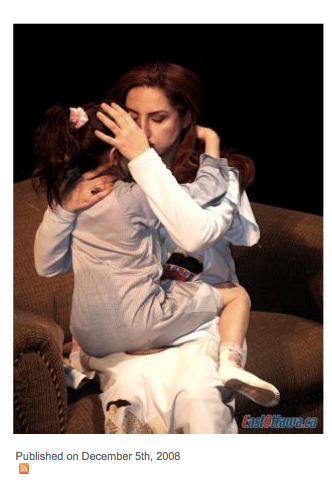
Orléans Star 12-07-31 11:56 PM Published on December 5th, 2008

Divided by conflict and witnesses to violence, Israeli and Palestinian children speak out about their fears, hopes and dreams in a new Ottawa play that features two east-end teens in leading roles.

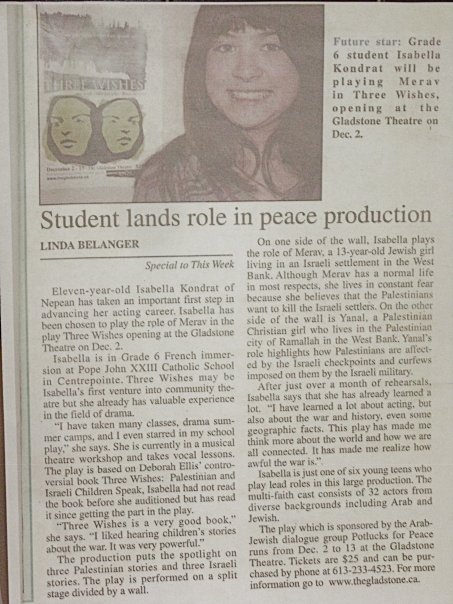
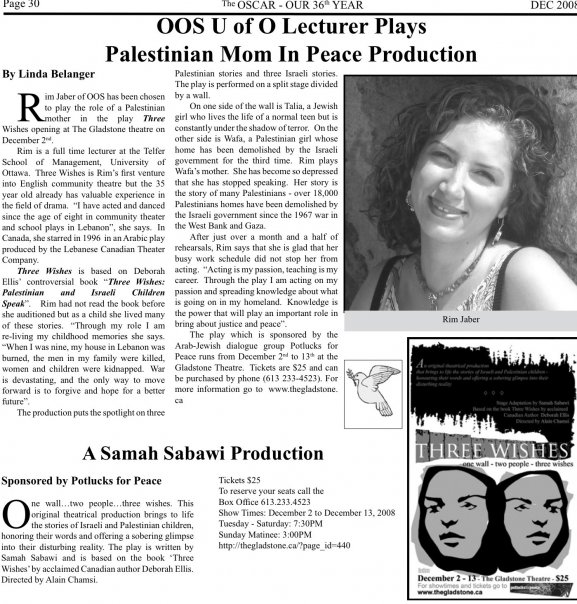
The stage adaptation of Deborah Ellis’ controversial book, Three Wishes: Palestinian and Israeli Children Speak, captures the honesty and straightforwardness only a child can share when the world around them is in turmoil. The production, written and produced by Ottawa’s Samah Sabawi and sponsored by the Arab-Jewish dialogue group Potlucks for Peace, puts the spotlight on three Palestinian stories and three Israeli stories. The play is performed on a split stage at the Gladstone Theatre, divided by a concrete wall topped with barbed-wire. It is on either side of this wall the lives of these children and their families unfold.

While every word in the play is lifted from the book, Sabawi has broken the dialogue up so a number of characters speak. For example, 18- year-old Hassan’s narrative has been cut so his family also shares in the storytelling. “It’s more like a conversation,” Sabawi explains.

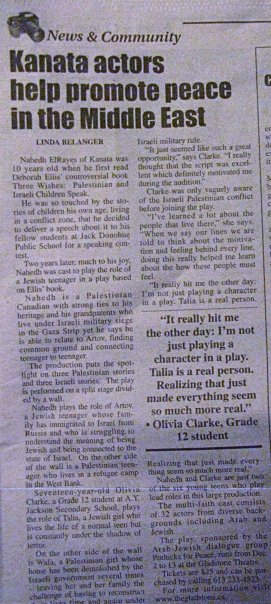
Colonel By’s Kiera Polak, 15, plays the role of Yanal, a 14-year-old Palestinian girl. “I’ve learned a lot through the play,” she says, noting children in the Middle East have gone through hard times and want things to be fixed.

Meanwhile Orléans resident Dergham Shahrouii plays Hassan, who lives in a refugee camp in the West Bank. Injured by Israeli shelling, Hassan is confined to a wheelchair. On the other side of the wall is Artov, a Jewish teen whose family immigrated to Israel from Russia and is struggling to understand the meaning of being Jewish and being connected to the state of Israel. “These kids talk about the simple, human need to live a normal life,” Sabawi says of the interviews from the book. “(They talk about) how conflict affects their life at a personal level.”

The book, she continues, is “very compelling. These are real stories and real experiences.”

Sabawi read the book about three years ago after her then-nine-year-old son read it and put together a speech for class. The kids in the book, she explains, are so honest – there’s no politics. “I just loved reading their words.”

The children’s book gained infamy in 2006 when the Canadian Jewish Congress questioned the inclusion of the book in the Silver Birch reading program. At least four school boards in Ontario, including the Toronto District School Board, pulled the book from their shelves. While some said the request to remove the book was about age-appropriateness, others indicated it was a political move.

Sabawi, who says parents are the best judge of what their children can take, doesn’t recommend the play for those under the age of eight. “The play is about kids in a conflict zone,” she explains. “This is serious stuff.”

Hoping to raise awareness with her production, Sabawi notes that people tend to discuss the conflict in “grown-up” terms with maps, statistics and borders. The conversation is distant and sometimes the human cost is forgotten, she continues. “The Middle East is not about angry men or Paris or fights between extremists,” Sabawi says. “People live there and their stories need to be told.” “Three Wishes” runs until Dec. 13 at the Gladstone Theatre, 910 Gladstone Ave. Tickets are $25 and can be purchased by phone at 613-233-4523 or online at http://www.thegladstone.ca


The Real News on repression and cultural resistance in Gaza with footage of Tales of a City by the Sea’s public reading