SoA Women take Shakespeare project to Palestine


By Zoë Miller

Columbia Daily Spectator

Published October 1, 2012

The Manhattan Shakespeare Project’s current venture is centered on the creation of original theatrical pieces that will incorporate Shakespeare’s sonnets and Palestinian youth songs.

For the all-female Shakespeare company Manhattan Shakespeare Project, all the world really is a stage­ for cross-cultural communication.  MSP’s newest project, “Shakespeare For A New World: The Palestinian Voice,” is centered on the creation of original theatrical pieces that will incorporate Shakespeare’s sonnets and Palestinian youth songs. Teaching artists Sarah Eismann, SoA ’12, and Jensen Olaya, SoA ’12, will travel to Palestine in late November, accompanied by documentary film director Lena Rudnick, SoA directing candidate, to work with students at the Drama Academy Ramallah and the Jenin refugee camp’s Freedom Theatre.

Eismann said that although “Shakespeare For A New World” and MSP are not political entities, projects “have the potential for having political undertones” by nature of the fact that MSP is an all-female company traveling to a region often associated with more rigid patriarchy. But the purpose of “Shakespeare For A New World,” above all else, is for Eismann and Olaya to work with the students at the Drama Academy Ramallah to create theater and art. Due to their geographical location, the Palestinian theater students are extremely isolated. The project will “help get their voice outside of the borders of Palestine,” Eismann said.

The concept of “Shakespeare For A New World” emerged after Eismann performed in an international production of “A Midsummer Night’s Dream” that took place in 2011 at the Folkwang University of the Arts in Germany. The “Midsummer” cast was comprised of acting students from Folkwang, in addition to students from Columbia, the Drama Academy Ramallah, the Shanghai Theatre Academy, and the Lucian Blaga University of Sibiu. Eismann said that she was inspired by the beauty of “a Palestinian Helena working with a Romanian Demetrius.” Shakespeare’s words, she realized, could effectively cut across cultural and linguistic barriers. “We found our common world. We found our common language,” she said.

The Folkwang production, Eismann said, led to an epiphany. “If only the world could work this way, we would have no problems,” she said. “It wouldn’t be me against you—it would be what was on that stage.”

Eismann was thrilled when the Drama Academy Ramallah’s director invited her to teach the “Shakespeare For A New World” workshops and make this vision of “a completely united, holistic, humanistic world” more of a reality—at least in theater.

As time went on, the project gained momentum and “exploded into this very idealistic, very grandiose plan.” The intense, six-hours-a-day workshops will include not only actors from the Academy but also teenagers at the Jenin refugee camp, which is one of the oldest, most devastated refugee camps in Palestine. With the help of a team including Rudnick, these workshops and the performances that result from them will be filmed.

In the next five years, Eismann hopes to take the methodology that the MSP team learns from the Ramallah and Jenin workshops and bring it to high school students in New York.

The end goal, she said, is to get diverse communities across the globe to learn about each other, “to use Shakespeare to talk, to create theater, to create peace.”

arts@columbiaspectator.com

This article appeared in Colubmia Spectator


A Message from Young Palestinians in Gaza to the World!

Gazans produce fish and vegetables in tiny rooftop spaces

by Sara Hussein

GAZA CITY, Palestinian Territories, Oct 29, 2012 (AFP) – Abu Ahmed looks out over a sea of grey, empty Gaza rooftops, and smiles as he looks back at the lush greenery sprouting in tubs and pipes on top of his apartment building.

He is part of a United Nations agency project to introduce cutting-edge urban agriculture to Gaza City, teaching Palestinians to farm without soil in the space available to them in one of the world’s most densely populated places.

Most of his rooftop is given over to an aquaponic system, which produces food by linking fish tanks of tilapia with gravel-filled planters.

The integrated system feeds the water from the fish tanks into the plant beds, where Abu Ahmed’s crops — lettuce, peppers, broccoli, celery and herbs — are fertilised by waste produced by the tilapia.

As the water trickles through the gravel, the plants absorb nutrients from the fish waste, cleaning the water, which then replenishes the tanks.

“The idea really was to help the poorest people in Gaza be able to grow some of their own food, and healthy food, grown without pesticides,” explains Mohammed El Shatali, the project’s deputy manager.

For Abu Ahmed, the project has been a major success.

Not only is he using the integrated aquaponic system, he had also set up his own subsidiary hydroponic system, growing additional crops in plastic pipes that are fed by the same water that runs through the aquaponic system.

“I had a bit of experience with agriculture and farming before, but nothing like this,” he says, examining the leaves of a celery plant.

Thanks to the project, the 51-year-old has been able to feed his 13-member family fresh vegetables and fish throughout the summer.

“The fish taste great, although I’m trying not to eat too many of them because I’m breeding new ones so I won’t have to buy more.”

There have also been other benefits from the system, he says, explaining that it cools the apartments below by providing shade.

“It’s great for the children. Nowadays they don’t see farming, they barely see trees or plants. It’s great for them to see this because it gets them interested in growing and planting things.”

Gaza’s 1.6 million residents live on just 360 square kilometres (140 square miles) of land, and much of that is off limits because Israel maintains a 300-metre (yard) deep exclusion zone along the length of the border fence.

Power cuts threaten fish

In Gaza’s main towns and cities, empty land is being eaten up by the construction of multi-storey apartment buildings, leaving little space for agriculture.

The challenges prompted the UN’s Food and Agriculture Organisation (FAO) to look for new ways to maximise crop production in tiny spaces.

In Gaza City’s Zeitun neighbourhood, 34-year-old Eman Nofal tends crops in a small yard next to her apartment. Peppers have been her biggest success this year, and both sweet and spicy red peppers dot the greenery in her planters.

Nofal’s husband was killed in fighting between rival Palestinian groups Fatah and Hamas in 2006, leaving her the sole provider for their four children.

When she heard about the project, she thought it could ease the cost of feeding her family.

“It’s been great. It’s really easy, the children even help me maintain the plants,” she says, acknowledging that the concept was somewhat alien at first.

“All our lives, we learnt that farming meant growing things in the ground, in soil, so it was strange to hear it was possible to grow in water and gravel, but I love the idea.”

Nofal says the project also gives her pleasure.

“Just the way it looks is really nice. Sometimes I come out here just to enjoy the greenery and to watch the fish play with each other. It relaxes me.”

The project has faced setbacks, including the Gaza-specific challenge of power cuts of up to 12 hours a day, which shut down the pumps that transfer water between the fish tanks and plant beds.

“Electricity has been one of the most difficult challenges,” says Chris Somerville, an urban agriculture consultant with the FAO.

“At 30 degrees centigrade (86 Fahrenheit), the capacity of the water to hold oxygen reduces, and during the summer many of the beneficiaries had fish die.”

New participants will receive a battery-powered pump to tide them over during power cuts, and the FAO is experimenting with fibres that could be used in hydroponic systems to retain moisture when power cuts stop the water flow.

Initially, the project also had to overcome a certain level of scepticism, Somerville says.

“To tell agrarian societies that you’re going to grow plants without soil can sometimes be a bit of a jump,” he laughs.

But the project has been so successful that the next cycle will expand from 15 aquaponic participants to around 80, with another 80 homes operating hydroponic systems.

It will be the first time the FAO has implemented aquaponics on this scale, and the agency is now looking at implementing the project elsewhere in the world.

“To be able to take this Gaza model and bring it to other countries would really be a massive achievement,” Somerville says.

This article appeared in http://www.mysinchew.com/node/79207?tid=10

Palestinian Film Festival Australia

Cultural Media is proud to present the 4th Palestinian Film Festival. This year’s theme is simple yet heartfelt: Visit Palestine.

Many of us have a connection to Palestine. For some, it may be historical, ancestral or spiritual. For others, it may be political, humanitarian or educational.

Whatever your interest may be, join us on a cinematic journey of unforgettable imagery and creative, thought-provoking storytelling.

For information and tickets go to http://www.palestinianfilmfestival.com.au/tickets


Singing Palestine: Rim Banna

Al Jazeera

Rim Banna has given melodic interpretations to the suffering of Palestinians and their defiant hopes and aspirations.

Between October 3 and 7, I was part of a wide-ranging celebration of Palestinian arts and culture in Milano, Italy.

The Philastiniat festival of Palestinian film, literature, theatre, folklore, music, dance and poetry opened in various locations in Milan to the enthusiastic reception of the city officials, the Palestinian community and their European friends and families.

Distinguished guests ranged from writers Suad Amiry and Salman Natur, film directors Michel Khleifi, photographer Rula Halawani, singer-activist Rim Banna, poet Zuhair Abu Shayeb, writer-journalist Akram Musallam and poets Nasr Jamil and Asmaa Azaizeh, and many others.

At the heart of the festival, which included performances, poetry readings and film series, was also a tribute to the late Palestinian scholar and public intellectual Edward W Said (1935-203).

A conference on Said was held on October 5 at Palazzo Marino – Sala Alessi – Piazza Della Scala – right across from the historic Scala opera house. Younger and more senior scholars from various universities in Italy exchanged ideas on the significance of Edward Said’s legacy.

The panelists included: Wasim Dahmash (Università degli Studi di Cagliari), Paolo Branca (Università Cattolica, Milano), Marco Gatto (Università della Calabria), Mauro Pala (Università di Cagliari) and Mariantonietta Saracino (Università Sapienza, Roma).

Rim Banna 

Particularly memorable in this event was the featuring of Palestinian singer Rim Banna in the very last night of Philastiniat. Born (1966) and raised in Nazareth, and educated in the Higher Music Conservatory in Moscow, Rim Banna is a Palestinian singer and composer who was initially celebrated for her endearing renditions of old Palestinian folk songs.

She has now emerged as a major voice in Palestinian music of resistance, giving melodic interpretations to the suffering of her people and their defiant hopes and aspirations. In pain and suffering, defiance and struggle, confidence and pride, Palestine sings in Rim Banna.

Listening to Rim Banna (here is a sample from her album “Maraya’ al-Ruh” – The Mirrors of My Soul) is an experience in living through the trials and tribulations of Palestinians, as their newborns are sung to by the lullabies of their resistance, their youngsters are point blank shot dead by Israeli soldiers and settlers alike, and as their heroes are loved and admired for their resistance.

Rim Banna sings love songs for towering Palestinian men and women, bearing witness to their people’s struggles, raising and protecting their children against a vicious killing machine that has occupied their homeland – and the result is the creation of a repertoire of folkloric and contemporary songs that have now blended into each other to become the common staple of Palestinian lives and resistances.

From her renditions of Palestinian lullabies to her lovingly flirtatious “Mash’al”, to her “Tayr Hawa” – Fly Love, Rim Banna’s ballads of Palestine have become integral to her people’s stories of struggles and resistance.

In beautiful and yet heart-wrenching songs like “Sarah“, Rim Banna transforms the brutal murder of young Palestinian children by Israeli army or their obscene settlers into unforgettable ballad, contemporary folksongs of her people.

As in the cases with jazz, blues, or ragtime, Rim Banna’s ballads derive their power from their deep-rooted connections to her people’s struggles.

Listening to and watching Rim Banna perform, you can hear Umm Kulthum in Egypt, Edith Piaf in France, Joan Baez in the US, or Mercedes Sosa in Argentina. In her voice and in her songs, she has wed the stories of her people to defiant joys of people around the globe. It is as if it has been the fate of Palestinians in their heart and soul to travel around the world and in the best and the most beautiful everywhere, find a way to tell and share their stories.

They say that the United States is the most powerful country on planet earth and when the Israeli Prime Minister goes to the US congress to deliver yet another vulgar and inane speech, there are so many standing ovations for him by the even more vulgar and inane members of the US congress that they probably spent more time on their feet applauding their Israeli benefactor than seating on their chairs thinking of their duties to the people who had elected them.

But what has AIPAC really bought for Israel with such obscene display of power – turning the democratic institution of a nation into the Joker-Jack-in-the-Box of a bankrupt ideology – when with one single, beautiful and powerful song, Rim Banna can make the whole world rise up and sing with Palestine?

Hamid Dabashi is Hagop Kevorkian Professor of Iranian Studies and Comparative Literature at Columbia University in New York. Among his books is his edited volume, Dreams of a Nation: On Palestinian Cinema(2006).

The views expressed in this article are the author’s own and do not necessarily reflect Al Jazeera’s editorial policy.

Source:
Al Jazeera

A circus comes to Gaza _ minus lions and ladies

By DIAA HADID, Associated Press – 7 hours ago

GAZA CITY, Gaza Strip (AP) — The circus came to Gaza on Friday, accompanied by blaring music, juggling clowns and fire blowers — but getting it there required its own high-wire act.

No women performers were included for fear of offending conservative Palestinians and the Gaza Strip’s militant Hamas rulers, and the circus’ lone lion and tiger were left behind because of the high cost of transporting them legally into Gaza.

The Egyptian National Circus put on its first show of a month-long visit to the impoverished coastal territory on Friday, a sign of warmer relations between Hamas and post-revolution Egypt, which is governed by the Islamic group’s ideological parent, the Muslim Brotherhood.

Although it’s not state-sponsored, the Egyptian circus could only come because the country’s government loosened restrictions on the flow of passengers in and out of Gaza. More foreigners now enter Gaza, including the ruler of the resource-rich Gulf state Qatar earlier this week.

Once in Gaza, the Egyptians’ faced an unusual situation — most Palestinians here don’t know what a circus is.

“I think it’s going to be really surprising for most people,” said Riwa Awwad, 19, ahead of the opening night.

“Gazans are famous for not liking anything and I think they’ll do the impossible to entertain us,” said Awwad, who came with her extended family to the fairground on Friday.

In an ironic twist, the cheery circus with its flashing lights was held on the grounds of a notorious security prison that was destroyed during an Israeli offensive four years ago.

For the Gazans fortunate enough to see the opening show, it was a welcome relief from conflict and despair. The fairgrounds were packed with excited children in new cloths, women in glittery headscarves, others in black face veils, and men in suits and freshly pressed shirts. Families snacked on pumpkin seeds.

They hollered and cheered as a tight-rope walker wiggled his hips and belly-danced on a thread suspended above the ground. A performer hurled silver knives around volunteers. A red-clad fire blower shot whooshing, yellow licks of flame out of his mouth. Two clowns dressed in yellow-and-blue bumbled and fumbled as they tried to juggle, delighting children.

It took months to arrange the visit to the impoverished territory, where 1.6 million people live in a 25 mile-long sliver wedged between Israel and Egypt and face a punishing blockade imposed after Hamas seized control in 2007.

Aside from a circus’ brief visit in the 1990s, there’s never been anything like it since Israel captured the strip from Egypt in 1967. Israeli forces and settlers withdrew in 2005.

Businessman Mohammed Faris said he remembered seeing the circus under Egyptian rule in the 1950s, when Gaza was still a liberal place with casinos and bars. He said he recalled as a child seeing men walking on nails and female acrobats flying across stage.

“It was men and women – pretty women,” he said.

Not this time around.

Organizer Mohammed Silmi said female performers had to stay behind because the circus was worried that leaping ladies in tights would offend Gazans.

He said Hamas didn’t explicitly ban women but he was asked to abide by Gaza’s “traditions” when he petitioned to get the circus to come.

In practice, the circus wiggled a little around the no-women rule. At one point a man in drag, sporting a brown wig and red dress, sang and danced with Bunduk the clown.

After Hamas seized control of Gaza in 2007, Israel and Egypt imposed a blockade that aimed to weaken the militants who seek Israel’s destruction.

Under international pressure, it was loosened after Israel raided a blockade-defying boat and killing nine Turkish activists aboard in 2009. Key restrictions still remain on exports and importing raw materials.

All the circus equipment came through the Rafah border crossing, but expensive fees and cumbersome paperwork kept the circus from bringing lions, tigers and horses across the border.

Gaza’s makeshift zoos and other merchants often bypass that problem by hauling animals through smuggling tunnels linking the territory to Egypt. In one famous scene captured on film, Gazans used a crane to lift a camel over the border fence as the animal twitched in the air in agony.

Animal welfare aside, Gaza’s main zoo recently turned to improvised taxidermy to keep its deceased animals on exhibit.

The area also continues to be violent. As circus technicians were setting up their tent earlier this week, Palestinian militants were fighting Israeli forces in tit-for-tat rounds of rocket fire and retaliatory airstrikes.

Egyptian technician Khalil Gomaa, 55, jolted upon every crashing boom. He told his children he was in Jordan so they wouldn’t be worried. “But I’m worried,” he said.

But the circus’ biggest challenge may be packing the 1,000-seater tent for the month-long visit.

A series of Palestinians interviewed didn’t know what a circus was, and the tickets — ranging from $5-$10 seats — are too expensive for most of Gaza’s traditionally large families.

Some 40 percent of Gazans live on less than $2 a day, a third are unemployed and most need U.N. donated food.

They include the mother of eight, Sabrine Baoud, and her unemployed husband. After the circus was explained to her, Baoud, 35, said she was glad her children didn’t know anything about it.

They’d never be able to afford to go.

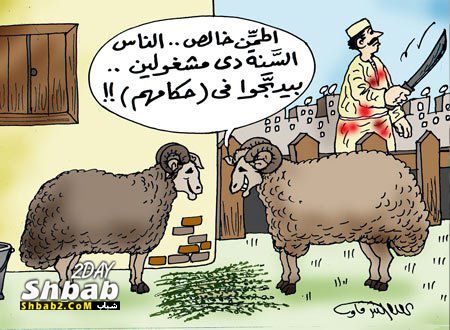
Arab revolutions inspire sheep mutiny!


This year even the sheep have started to exhibit signs of rebellion!  A collection of funny Arabic toons with English translations.  Eid Said everyone.

On the left the sign says imported for Eid sacrifices, on the right a representative from “Sheep without borders” says ‘you are accused of war against barns and collective genocide against foreigners.

A sheep protest calling for an end to the ‘butcher regime’

One sheep says to the other ‘no need to worry, this year humans are busy slaughtering their leaderships’

Sheep disguised as a chicken carrying a banner “Watch out for bird flu”

Sign reads “A happy and blessed Eid, this year ask about friends and family before you ask about what you should eat.”


Getting ready for Eid: Palestinians smuggle sheep to Gaza through tunnel

Palestinians smuggled sheep to Gaza in a tunnel under Egypt’s border for the Muslim celebration of Eid Al-Adha, where goats, sheep and camels are slaughtered commemorating Abraham’s willingness to sacrifice his son Ismail on God’s command.  For more incredible pics go to http://www.demotix.com/news/1544458/palestinians-smuggle-sheep-gaza-through-tunnel-under-egypt-border/all-media


‘Unto the Breach’: Palestinian dance adaptation of Shakespeare’s play

UK-based Palestinian dabke theatre group Al Zaytouna will present its new production entitled Unto the Breach in London in November 2012.
Interview by Mamoon Alabbasi – LONDON
Article Published: 2012-10-22 Middle East Online

Henry V set in modern-day Palestine

The UK-based Palestinian dabke theatre group Al Zaytouna will present its new production entitled Unto the Breach, an adaptation of Shakespeare’s Henry V set in modern-day Palestine. The show, directed by Ahmed Masoud and co-directed by HadjerNacer, will be performed in London in November 2012. Al Zaytouna board member Souraya Ali gave the following interview ahead of the full production’s debut.

Q– Could you give a brief introduction to the show?

Al Zaytouna Dance Theatre’s new show Unto the Breach is a dance adaptation of Shakespeare’s history play Henry V, set in modern-day Palestine. Paralleling Shakespeare’s account of the young English monarch, King Henry V leading his people in battle against the mighty French army, Unto the Breach tells the story of the Chairman, a Palestinian leader who, moved by his people’s suffering, leads them in a revolution against a more powerful force to free them from oppression.

As in Shakespeare’s original play, a Chorus leads the audience through the show, but here she urges them to imagine “the vast olive groves of Palestine” and “the very gates of Jerusalem” rather than the 15th century battlefields of France, and the scenes she narrates are brought to life not through Shakespearian dialogue, but through traditional Palestinian dabke and contemporary dance against a backdrop of digital media.

Q– Some have interpreted Shakespeare’s Henry V as a play that celebrates patriotism while others have viewed it as exposing the Machiavellian characteristics of a king – shedding light on the horrors of war. How do you understand the original play? And how does your show relate to that?

We don’t see Shakespeare’s play as a straightforwardly patriotic account of King Henry V’s French battles. Whilst the play does depict an extraordinary victory against all odds, it also shows that the motives behind this victory were not all virtuous, and that the means of achieving it were not all noble. For example the two clergymen who put the case for war to the King at the beginning of the play are driven by financial motives, as are various unsavoury characters who join the king’s army because of prospects of plunder. King Henry himself also shows a darker side to his character with a controversial decision to execute defenceless French prisoners during the battle of Agincourt.

Unto the Breach captures something of this ambivalence towards war. On the one hand, it celebrates Palestinians’ efforts to change their circumstances and shape their future through revolution, but on the other it recognises that these efforts have not yet succeeded. Palestinians still live under occupation and are far from achieving the freedom and sovereignty that they have been fighting for. The show also highlights the internal power struggles that have undermined Palestinians’ campaign for freedom, and depicts some of the darker outcomes of such struggles, such as in a scene where the Chairman executes two of his own people to quash a rebellion.

In the original play, the Chorus repeatedly draws the audience’s attention to the inability of the theatre and actors to accurately convey all aspects of the historical tale. Instead, the Chorus resorts to hyperbole and appeals to the audience’s imagination, indicating just how much our understanding of past events is constructed – and embellished – by those who recount them. Shakespeare thus highlights the power of rhetoric and political myth in re-telling military history. Unto the Breach reflects this idea with a scene where the world’s press attend the signing of a peace agreement, and then the journalists file their reports, constructing people’s understanding of this historical event.

Q– You noted that the launch of the show would coincide with the anniversary of Yasser Arafat’s death. In light of recent reports suggesting that the late Palestinian leader may have been assassinated via the radioactive element polonium-210, is there a reference to that incident in your show, since the theme of assassination is present in the original play where Shakespeare’s Henry V survives an attempt on his life (albeit by friends not foes)?

This incident is not addressed in our show.

Q– Although King Henry V, at one point in the original play, comes to the humble realisation that he is but a man; he is nevertheless the person responsible for rallying his men to victory. How does that reconcile with your show, given that: a- Yasser Arafat, who in the director’s words is “the great figurehead of the Palestinian struggle”, has died before managing to lead his people to liberty; and b- The Arab Spring, which you cite as among the inspirations for the show, had been sparked without any outstanding movement leaders?

Whilst the launch of Unto the Breach coincides with the anniversary of Yasser Arafat’s death, and there are parallels between our depiction of the Chairman and that of the late Palestinian leader, the show is not a historical account of his life. It does, however reflect on the value of a figurehead such as Arafat, in uniting people behind a common cause, enabling them to stand up for their rights and to stake their claim for sovereignty on a world stage. The show recognises this value but also acknowledges that the Palestinians have not yet achieved their objectives, and so the Chairman in our production dies without securing the liberty that he craved for his people. The achievement of victory is thus far less clear-cut in Unto the Breach than it is in Shakespeare’s Henry V.

In the show, the Chairman’s death leaves the Palestinians without a leader, and so the onus is on them to once again rise up and claim their rights. The idea that this is possible – that people can bring about change if they unite and call for it with a common voice – flowed strongly from the Arab Spring, and inspired us to create the show. Although we recognise that any such struggle is fraught with difficulties, it is this idea of hope that continues to drive us forwards.

Q– In the original play, future unity between the British and French kingdoms is suggested following the marriage between Henry and the daughter of the French king, Catherine. Monarchies aside, do you see the One-State solution as some sort of a modern day parallel to that?

Whilst Shakespeare’s play ends with King Henry V’s marriage and the expected union of England and France, the historical reality is that Henry V never succeeded to the French throne. He died two years after his marriage and two months before the King of France, and his French conquests were lost over the ensuing years under the reign of his son King Henry VI. Unto the Breach reflects this more sombre reality. In the production the Chairman also dies, and much of what he has fought for is dissipated as conflict and the grip of occupation continue, and his successors are debilitated by internal power struggles. The show has a deliberately ambiguous ending, leaving open the question of how the Palestinian question is to be resolved, and what the nature of the solution might be.

Q-Following a very impressive performance of your show Between the Fleeting Words in 2010, do you expect to outshine such success with Unto the Breach this year? Also, has there been any change in the way you do things or in the group members?

Since Between the Fleeting Words debuted in London in 2010, Al Zaytouna has continued to develop as a troupe. Thanks to the phenomenal support that we received for the last show, we toured it in the UK, Slovenia, Switzerland, and Germany. This experience helped us to hone many performance and production skills, which we believe will make Unto the Breach even better and stronger.

Al Zaytouna has also continued to grow, with new dancers joining us, and many of our members pursuing new artistic endeavours. These have included our artistic director Ahmed Masoud writing a radio play for BBC Radio 4, entitled Escape from Gaza, in collaboration with Justin Butcher, and winning the Muslim Writers Award 2011 in the Unpublished Novel category for his book Gaza Days. Several of our dancers have developed their own dance theatre work, such as Lorraine Smith’s Pictures of Life and new work Disco Babies, whilst others have taken on new performance roles, such as UmutUysal who drummed in the opening ceremony of the London Olympics. All of these experiences have enriched the group bringing new expertise and fresh ideas.

We were also fortunate to secure a grant from the BBC Performing Arts Fund to support the development of Unto the Breach, which given us the support and profile to take this show to the next level. We have been able to invest more in the show’s development and to reach out to new partners and collaborators. We are, for example, very happy to have professional actress Clare Quinn performing with us in this show, and we have been able to secure a really wonderful performance space at the artsdepot. All of these factors make us confident that Unto the Breach will be even more successful than Between the Fleeting Words.

Q– Again with regards to Between the Fleeting Words, the 2010 show featured a beautiful blend of music genres, projecting a mix that crosses cultural and generational divides. It also included the notable presence of the talented Palestinian artist Nizar Al-Issa. What music variety should we anticipate with Unto the Breach?

Unto the Breach builds on Al Zaytouna’s tradition of working with leading musicians, and features a collaboration with David Randall. David is a guitarist, composer and producer who has contributed to multi-million selling albums by Grammy-winning artist Dido, toured extensively with UK dance act Faithless, and released his own critically acclaimed albums as Slovo. He also wrote and produced the One World single Freedom for Palestine, and has published articles on the role of music in political campaigns and on Palestinian Hip Hop. He is a highly talented musician who is passionately committed to the Palestinian cause and his contribution to this production has been invaluable. David has composed and recorded a number of tracks especially for Unto the Breach, which are woven together with traditional Palestinian songs to create a powerful and moving sound track.

For information on booking, visit: http://www.alzaytouna.org/productions/unto-the-breach

This article appeared in Middle East Online http://www.middle-east-online.com/english/?id=55048

A compelling article: From manifesto to reality ‘Gaza Youth Breaks Out’

“My story is marked by violence, persecution, arrests, abuse and resistance,” writes Matte

It has been almost two years now since we wrote our manifesto. We called it a manifesto, but in reality, I’m not sure what it was.

Was it a manifesto, or was it a cry for help? Perhaps, an accusation, or even perhaps a demand to the world and to ourselves; a demand for change from the outside and from within.

It was before the uprisings began around us, and they have been roaring the last two years in Tunisia, Egypt, Libya, Syria and Bahrain. But we had felt like shouting in the dark, and while this raging had brought light into the darkness of the dictatorships around us, the night around us has not thinned even a bit. No, if anything, it has only become darker.

We had come out from under the rubble in 2009, when Israel had embarked on what they liked to call a “war” – which in actuality had been a massacre – leaving 1,385 people dead, among them 318 children. They left Gaza in ruins.

We had built up Gaza again with our bare hands, even though cement was blockaded; we had buried our loved ones and tried to cover the holes in our hearts which they left. A year later, we regained the strength to shout out our unbearable situation to the world, and to unite for a fight against the hell we were – and are – living in.

We too organised large demonstrations, even though they were overshadowed by the revolutions taking place in the surrounding countries. Our demonstrations in the West Bank and Gaza Strip began on March 15, 2011, bringing out a large part of the population onto the streets. We wanted to achieve the unity of our parties and leaders – Hamas and Fatah – who in the quest to have seize power and wealth have betrayed our land of Palestine and the dreams and demands of our youth.

For this we demonstrated, for this we put in weeks of work to bring the people of Gaza to the streets, for this we were knocked down by thugs on the streets, for this we have been arrested and abused.

And for this goal, we achieved what first had seemed promising: Discussions, negotiations and unity efforts by our leaders. And still, all of that ended up in empty promises.

Manifesto? That sounds too fierce, like a struggle that might produce victory. But we are tired, two years later. Tired of the empty promises surrounding us. There is a peace process, but one that is an insult to the word “peace”, and that makes one wonder for whom such a farce is still seriously maintained.

Under siege

Since 2006, the ongoing siege punishes us daily – we could mention all the UN conventions it violates, as if that wasn’t mentioned enough already. Collective punishment for all of us, for having elected the wrong party, for having held one Israeli soldier who is now free, while thousands of our prisoners languish in Israeli jails. Collective punishments for being Palestinians, for being born in Gaza.

And that siege means that our hospitals regularly declare a state of emergency because they don’t have enough medicine or medical equipment. This siege means that we are literally sitting in the dark most of the time – without connection to the internet and thus without any connection to the outside world – because there is no electricity.

It also means that the discourse in the media is about whether there is enough food coming in, whether the siege has lifted a bit and if now there are enough sorts of Israeli chips packets in our supermarkets. Like we are animals in a zoo and the question is whether we are fed enough. We are, I can tell you. We don’t need your aid packages, we don’t need your chips, nor your bread.

We had well-functioning factories, which were bombed away. We had rich land that could produce not only enough food for us, but enough to export it to the whole world. If that land wasn’t raped daily by Israeli bulldozers, and if we weren’t forbidden to enter by military declarations. There is still an ongoing siege, keeping us needy like beggars – and we get bread instead of rights.

There are talks about unity and re-elections, consisting of words which are so empty that it is not even worth listening to them.

And then there are the new Arab governments. The new Egypt, which wants to open the Rafah border crossing in order to no longer be complicit in imprisoning us in our 5 by 20 km hell. But even with so many visits by Hamas to Cairo, it’s still just words. When will this happen? When will there be open borders instead of just assurances? When will our children no longer be born into a world where there is no freedom, no adequate medical care, no work, no future, nothing but violence and falling bombs?

We are still young enough to fight for our own future, not only for that of our children, and yet old enough to be tired. Tired of the daily struggle for survival, which distracts us from our dreams. Tired of our own government, which meets our hopes with violence.

Story of resistanceWe are still young enough to fight for our own future, not only for that of our children, and yet old enough to be tired. Tired of the daily struggle for survival, which distracts us from our dreams. Tired of our own government, which meets our hopes with violence.

I still regularly keep in touch with people in Gaza. The talk is usually about the lack of electricity, bombs in the night, graduates with no job opportunities, the tight grip of the Hamas government, and walls that are nearly impossible to scale. Yes, mainly they talk about leaving. Leaving Gaza, leaving this prison and dumpster of the world. Many of my friends left like I did, and many more want to.

We wrote this manifesto because we wanted to live. Not because we wanted to be tortured, arrested and sacrificed. No, we are young enough to demand a future for ourselves, and we don’t see a future for us in Gaza right now.

My friends and I were forced to leave by a Gaza that has been made unbearable by violence and arrests through Hamas. A future in Gaza has been robbed from us by a siege that leaves us no jobs or opportunities. Nevertheless, even though we might be leagues apart and spread throughout the world, we will never cease to see a future for Gaza. Palestine, Gaza, that is our land, that is where we belong.

There’s an olive tree in my garden, and I have always dreamed of seeing my children playing under it. Wherever I might be now, one day my children will be playing under this olive tree, in a free Palestine, without fear for their lives, and that is what I will keep fighting for.

Yes, we are weary. But still, my story – and the stories of all the other amazing youth of Gaza – is and always will be a story of resistance, of resilience. Of always coming back to the land we belong to. We carry the hope of a free Gaza, a free Palestine and a future there for us in our hearts, and in our hands, in our daily work.

We struggle every day against our obstacles and for our dreams, and you can see that in all the amazing creativity coming out of Gaza, in our art, poems, writing, videos and songs, you can hear it and meet us in the talks we give all over the world.

Yes, we wrote a manifesto, and maybe that was just the bright and loud outcry of the beginning of a journey, whose path is hard and tiring, thorny and also often very quiet and dark. But it is always there.

So two years later, we say: We will be free. We will live. We will have peace. And we are always out there, fighting our daily struggle, full of the resistance we inherited from a long struggle for Palestine. We live and write and say and sing silent or load manifestos every day. Just listen to us.

Mohammed Matter ‘Abu Yazan’, from Gaza, is a political activist, writer and a member of Gaza Youth Breaks Out movement. He is currently in Germany, about to resume his studies.

The views expressed in this article are the author’s own and do not necessarily reflect Al Jazeera’s editorial policy.  

Source:  Al Jazeera  http://www.aljazeera.com/indepth/opinion/2012/10/201210159115846939.html

Life behind barbed wire in Gaza

  • Date 19.10.2012
  • Author Tania Krämer / sms
  • Editor Ben Knight

Though local elections are slated for the West Bank, Palestinians in Gaza won’t be casting ballots. Hamas, which controls Gaza, has boycotted the elections, leaving the 1.6 million people there in a difficult position.

Between piles of used spare parts and a container of motor oil, Munzer Al Dayya is working on a generator. The mechanic is a popular man in Gaza City, where power can go out for as long as eight hours a day, and he said he’s earning a decent living thanks to the blackouts.

“Every day that we get through is good, but no one knows what’s coming,” he said. “The only thing that’s clear is that the next day will be worse than the previous day. Why, how, and for what? Who knows? No one can explain what’s going on here.”

Al Dayya said getting an explanation for what’s happening in Gaza City depends on who you ask. But one thing is clear – Hamas controls the Gaza Strip and has expanded its control since taking power five years ago. Neither an Israeli blockade nor the US and European isolation policy has been able to change this.

Hamas, labeled a terrorist group by the West, has developed its own bureaucratic structures, ranging from an administration to an all-round security service. Various observers have noted that the political separation between Gaza and the West Bank has been widened by the separate governing structures in the two regions.

No local elections in Gaza

Local elections scheduled to take place in the West Bank on Saturday are expected to widen the gap. Hamas is not taking part in the poll, leaving voters there to choose between the Fatah party and some independent candidates.

“The elections cannot be transparent and fair,” said Hamas spokesperson Fawzi Barhoum. “Many of our Hamas leaders and members are in prisons run by the Palestinian Authority. These are Fatah elections – not Palestinian elections.”

Read more http://www.dw.de/life-behind-barbed-wire-in-gaza/a-16318900

After Zionism at the World Matters Literary Festival 20 October

Saturday 20 October

Session 4

3 .15 pm – 4.15 pm: After Zionism Making Peace with Palestine

The Israel/Palestine ‘peace process’ has failed and the occupation has never been more pervasive. The prospect of a two-state solution, a position advocated by all Western countries, is increasingly criticised as being at odds with the realities of the conflict. Antony Loewenstein and Ahmed Moor have  co-edited a new collection of essays which present the world’s leading writers on ways to achieve the only democratic outcome in the Middle East, a one-state solution. Samah Sabawi, co author of Journey to Peace in Palestine, playwright and advisor to Palestinian policy network, Al Shabaka, will contribute to the conversation. According to Samah , “peace is not just the absence of violence but the presence of justice.”

Chair: Hilary McPhee

For more information visit http://worldmatters.weebly.com/after-zionism-making-peace.html


Gaza deaf restaurant a chance to change perceptions

Sydney Morning Herald

October 19, 2012 – 10:16AM

The stylish Atfaluna restaurant near Gaza port stands out in a city with few facilities for the disabled. Waiters and cooks use sign language, guests point to selections from the menu and what ensues is a spontaneous form of communication that organizers hope will break down bias and barriers.

“Deaf people have determination and there are no worries except when it comes to communication, the language problem. At first we may get translators to help us with the speaking clients,” supervisor Ayat Imtair said in sign language.

After six months of training with her staff, she was confident the service would go smoothly.

“This is a call on the community, and a working chance for the deaf to help them engage with the community,” she signed.

Twenty years ago Palestinian attitudes to deaf people were negative, said Naeem Kabaja, director of Atfaluna Society for Deaf Children in Gaza, which runs the restaurant.

“It was perceived by many as a mental disability. But we’ve been able to change that and it has since improved, through our work, the spread of sign language, activities by the deaf and raising public awareness about this disability,” he said.

Still, Kabaja said, many of the deaf themselves tend to shy away from engagement with broader society, afraid of communications obstacles and expecting little understanding.

The staff of 12 were enthusiastic on opening day.

“We’re excited. There might be some difficulty at the start but we will overcome it. We’re all trained in lip-reading and that will help us take orders,” said cook Niveen, preparing a dish of spicy chicken balls.

The restaurant was established with help from the Drosos Foundation of Switzerland to promote income generation by the deaf in Gaza, where the unemployment rate is over 25 per cent.

About 1 percent of Gaza’s 1.6 million people suffer from total or near-total deafness. They can attend school up to ninth grade but have no opportunity to go on to a university education in the territory, said Sharhabeel Al-Zaeem of Atfaluna.

“Unfortunately they have to leave Gaza for that,” Al-Zaeem said. “We are doing out utmost to make special classes for the deaf in universities. We are liaising with different universities to see if there is a chance for the deaf to get places.

Reuters   http://www.smh.com.au/small-business/startup/gaza-deaf-restaurant-a-chance-to-change-perceptions-20121019-27v4e.html#ixzz29hx0sGS5

THE 7ARAKAT CONFERENCE: THEATRE, CULTURAL DIVERSITY AND INCLUSION

Friday 2nd and Saturday  3rd of November 2012 – Melbourne australia

The conference will explore practice, research and advocacy in the performing arts with a particular focus on Palestinian Theatre, Arab/Australian Theatre, and Applied Theatre with refugee/migrant groups. The conference will bring together theatre-makers, scholars, creative producers and community development workers to examine various issues of exclusion within the sector of performing arts and the theatre’s role in providing networks of participation and social inclusion.

For information and to register 

ChicoER.com: Art exhibit examines Israel-Palestinian conflict through children’s eyes

CHICO — “‘Keeping Hope Alive — Life and Culture in Occupied Palestine'” is a series of events including film, dance, poetry, folk art, traditional Palestinian food and more,” explained Emily Alma, a representative from Chico State University’s Cross-Cultural Leadership Center, in an interview last week.The presentational series, which begins Monday and runs through Thursday, Oct. 18, 2012, is a multi-media exploration of Palestinian culture. The series is free of charge and will primarily be held at the CCLC in Ayers Hall.”The presentations integrate information about Palestinian culture with life in the West Bank and Gaza under Israeli occupation,” said Alma.  Read more Art exhibit examines Israel-Palestinian conflict through children’s eyes

Photo Gallery: Rehearsing for Public Reading at La Mama in Melbourne

This slideshow requires JavaScript.

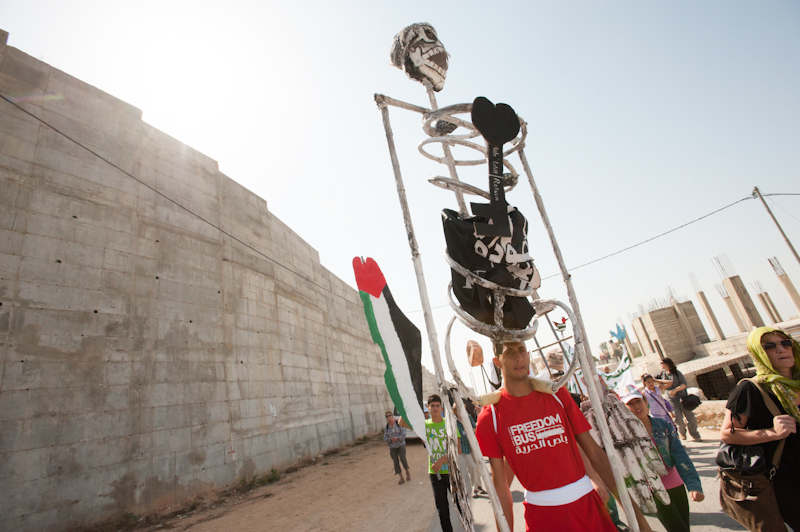
Freedom Bus takes cultural resistance to the streets

Freedom Bus takes cultural resistance to the streets

The Freedom Bus, an initiative of Jenin’s Freedom Theatre, used interactive theatre and cultural activism to bear witness, raise awareness and build alliances throughout occupied Palestine and beyond. From September 23-October 1 2012, Palestinians and allies from around the world took part in a 9-day solidarity ride through 11 communities in the West Bank of occupied Palestine. Read more

Ship to Gaza Sweden

We are sailing!

Publiceringsdatum:
2012-10-01

The port authorities in La Spezia in northern Italy finally decided to not give in to Israeli  pressure. Just minutes ago Ship to Gaza and its vessel Estelle got final clearance to depart from port. Credit to the responsible officials who showed integrity and a sense of justice!

We were beginning to recognise the pattern from last years Flotilla all too well, when a Greek government under pressure took the decision to detain all Flotilla boats in Greek ports.

The Israeli Foreign Ministry has already confirmed that it is pressuring those countries whose citizens are on board to prevent them from “approaching” Gaza. If “approaching” Gaza includes sailing from La Spezia to Napoli, that would have been a serious violation of one of the EU’s basic principles: freedom of movement.

It would be unacceptable for the EU to cave in to such pressure, turning against its own citizens and vessels. It is especially serious when such actions are taken against a peaceful, humanitarian action which enjoys wide public and political support. That support is currently being demonstrated in our petition to end the illegal and inhumane blockade of Gaza, which has been signed by thousands of people from all over the world in the last few days .

Ship to Gaza and our partners in the Freedom Flotilla Coalition urge each one of our supporters to follow S/V Estelles journey, and if necessary act in their respective roles and areas: sympathizers, local activists, support organizations, union organizations, EU parliamentarians and national parliamentarians.

Use any resources available to you to protest the Israeli government’s attempt to expand its blockade to ports in northern Italy. Ask your respective foreign ministers questions, and do the same to the EU through the EU Parliament. Conduct support actions to demand that Estelle stays free to sail.

End the blockade of Gaza!

Contacts onboard Estelle:

Victoria Strand + 46 727356564

Mikael Löfgren: +46 707983643

Ship to Gaza-Sweden

www.shiptogaza.se

Spokespersons:

Dror Feiler: +46 702855777

Mattias Gardell: +46 703036666

Ann Ighe: +46 709740739

Victoria Strand + 46 727356564

Media coordinator:

Mikael Löfgren: +46 707983643

Staffan Granér: +46703549687

media@shiptogaza.se

Website:  http://shiptogaza.se/en/Pressrum/Pressmeddelanden/we-are-sailing

The Guardian: Palestinian theatre director Zakaria Zubeidi is released on bail

Co-founder of Jenin’s Freedom Theatre, who faces charges over an attack on the home of Jenin governor Qaddura Musa, has been released on bail following a series of hunger strikes.

The imprisoned theatre director Zakaria Zubeidi has been released on bailby Palestinian security forces, following a series of hunger strikes.

The co-founder of Jenin’s Freedom Theatre, a drama group active in the northern West Bank, had been detained in Jericho since 13 May following a wave of arrests by the Palestinian Authority. Charges were not brought against him for more than four months.

Read more The Guardian: Palestinian theatre director Zakaria Zubeidi is released on bail

The Guardian: Detained Palestinian theatre director resumes hunger strike

 in Jenin

Zakaria Zubeidi is being held without charge by Palestinian security forces, and supporters say he could die within days

The Palestinian militant turned theatre director Zakaria Zubeidi has resumed a total hunger strike in protest at his continued detention without charge by Palestinian security forces, and his supporters say he could die within days.

Zubeidi, who publicly renounced armed struggle in 2006 in favour of cultural resistance, has been held in prison in Jericho since 13 May after being detained in a wave of arrests in his home city of Jenin. He has not been charged with any offence.

He received assurances that he would be released, but at a court hearing on Monday his detention was extended by a further 19 days. He declared that he would refuse all food, fluids and medical attention.