Al-Akhbar: Visualizing Palestine Design Against Injustice

Written by: Yazan al-Saadi

Published Sunday, April 14, 2013 by Al-Akbar English 


A quote at the bottom right corner of the graphic reads: “We are not in search of death, we are looking for real life.” The words are from the 1989 declaration of the Tiananmen Square hunger strike.

This was Visualizing Palestine’s first infographic and it was quite a compelling start.

More than a year later, other stunning infographics were produced. These elegant images range from a simple demonstration
of childhood births at Israeli checkpoints to a more complex image detailing the inequality of water distribution in the West Bank.

“Visuals are important because of their speed, its adaptiveness to social media, and the fact that the mind captures more from visuals than from texts,” Joumana al-Jabri, one of the co-founders, remarked to Al-Akhbar during a lunch on a Sunday afternoon that gathered most of the VP team at her apartment on Bliss Street.

The use of images and graphs to emphasize the daily injustices experienced by Palestinians by the Israeli colonial occupation is not entirely unique, but what makes the works produced by VP groundbreaking is the group’s ability to streamline and bond documented facts with eye-popping visuals.

The bread and butter of the project’s work are rooted in its embrace of a multi-disciplinary approach. In this way, diverse strands are tied together, further strengthening the emotional and intellectual impact of each graphic.

The staff of VP are very much aware of the power they hold.

In the Beginning…

The idea of VP was conceived by Ramzi Jaber in the early months of 2011. Like most good tales, it began with a journey and personal questions.“The story I tend to tell is this: I was part of TEDxRamallah, and for a year and a half I was going from village to village, asking myself why as Palestinians are we in this mess and who is doing something about it,” he said.

On his trips, he’d hear shocking statistics, like the fact that each year, 700 Palestinian children are incarcerated in Israeli jails. To Jaber, the injustices committed in Palestine are “the most documented injustices on earth.”

“I was shocked on two levels – shocked by the whole colonial aspect and the sheer injustice, and shocked by my own ignorance,” he said.

At the same time, Jaber was in awe of the growing popularity of TED, prompting him to think about how to take Palestine’s statistics and “present it through the power of storytelling.”

In April of that year, Jaber attempted to establish such a project using volunteers. According to him, he spent months organizing two workshops that brought in researchers and designers, but zero graphics were produced. According to him, the problem they faced was two-fold: the amount of expertise required was difficult to find since this was a new endeavor and it required a stable, committed team rather than volunteers.

Soon after, Joumana al-Jabri, a designer and architect mainly based in Dubai, and Ahmad Barclay, an architect by training, were brought into the fold. Immediately, they began looking for others.

Naji El Mir, a designer based in Paris, and Hani Asfour, founder of PolyPod, a multi-disciplinary designing company located in Lebanon, became key partners at VP, as well as the main designers behind many of the graphics.

“Infographic is like an iceberg, you see one-tenths of it and there is so much below that of work being done. We needed researchers, people who sit down and do huge amounts of research and we still need more,” Jaber said.

Today, VP is a small core team of eight individuals, most in their twenties and thirties, and each providing their own unique skill set. Recently, Saeed Abu-Jaber, a young designer from Jordan was hired. In terms of research, text, and copy-editing, Zaid Amr, in Palestine, and Chris Fiorello, in Beirut, were added.

“Most of the people are from a mixed background so this adds a nice flavor to the design. We aren’t brought together by nationality or driven by jingoistic tendencies, and we are not an activist project that simply wants to save ‘the poor helpless victims,’” Barclay stressed.

Infographic 101

How does VP create an infographic?Mainly, if an urgent news story breaks out, the team decides to develop an infographic in order to give context to what is happening. “Often, or almost always, the news is misrepresented or isn’t given context by the media. The rule of thumb tends to be that if the news is more prominent, it is more likely to lose its context,” Jaber said.

The final element, which is not the main focus of VP presently, is to highlight the absurdities of daily injustices. As an example, Jaber spoke of how Israel prohibits Palestinians holding different color-coded IDs from marriage, a restriction he had personally experienced and was keen on highlighting sometime in the future.

Once a topic is selected and fleshed out through various brainstorming sessions, the researchers gather the data and verify sources. From there, it is passed on to Barclay who molds it into a story.

The hardest part, according to Barclay, is the ability for one close to the data to take a step back and try to look at the bigger picture. He pointed out that there may be topics that simply can’t be visualized easily, topics and data that are segregated by borders, complicated stories that are hard to simplify on a static, two-dimensional image.

“It’s a good and bad exercise, in the sense that how do you get to the core message that strikes people and is rooted in analysis and facts? How do you tell the story to engage and motivate people, without becoming jingoist? How do you get people to understand an idea better or that the continuation [of injustice] isn’t inevitable?” he emphasized.

Abu-Jaber, the newest hire, said, “The beautiful thing is choosing. Finding that point of the story that grabs you. I like the process. It is quite fantastic because you’re learning something new while you’re designing. Essentially, you need to educate yourself.” For Abu-Jaber the work with VP offered a much more meaningful experience than his previous experiences working in fashion and magazine design.

“The work I used to do before made me feel dead inside. But this has a point and I feel like I’m doing something meaningful. This is like design activism,” he chuckled.

After this stage, a brief is made and shared with the designers, who proceed to translate the words into an alluring visual. The visual product is reviewed in order to ensure that the story is still intact.

“The facts are always the red-line. We actually go beyond, and try to maneuver the story to put the context in because you can take the facts out of context. So we maneuver it to include context, and puts the fact right where it needs to be,” Jaber said.

Once all parties are satisfied, it is published online.The final step is to track the graphic’s impact, seeing who shares it and what type of debates it generates. This entire process can take anywhere between three days and three months.

The structure behind the process came out of a lot of trial and error, or as Jaber joked, “more error than trial.” But a structure was shaped, and in the spirit of the project, it was presented as an infographic available online for others to see and use.

Yet even now, the production isn’t entirely without kinks. “We need more effort, more people,” Jaber stated, “People who are dedicated, committed, and have the required skills. It’s harder than getting money.”

Funding, the bane for every organization on the planet, is particularly an issue, especially for a team that is independent from political backing. The VP team are planning to tap into crowd-funding campaigns through sites like Kickstarter, rather than the traditional grant route. This way, they hope, will continue to ensure the project’s ideological independence.

Visualizing International

Since its first graphic, VP has steadily been building a strong following, particularly within the NGO, civil society, and international solidarity sectors. For Jaber, it’s a sign that VP is on the right track.

“Success to me is that our visuals are being used effectively. I’ve heard that people have used them in conferences and in schools. They use our visuals to deliver a message, and the more that effectively happens, the better,” he said.

As another sign of success, the graphics by VP have been translated into more than seven languages, such as Arabic, French, Spanish, Korean, and Finnish. They have penetrated parts of the mainstream media, popping up in Al Jazeera English, the Huffington Post, and elsewhere. And there is still more to come.

“Our next plan is to move into other media. We are very keen to go into animation, dynamic infographics, or even crowd-designed graphics,” Jabri stated.

But it is the ambitious concept of Linked word Visualizing Justice that has the most potential. The idea builds from the successes of VP and first conceived during an American tour by Jaber.

“We were being contacted by lots of people around the world who wanted to use the same form of visual styles for their causes and communities. They saw that communications is what rallies and mobilizes people together. So we wanted to provide tools and platforms for people to do the same thing in other cause. That’s our plan, but right now we are barely surviving as it is,” Jaber explained.

“Visualizing Justice became our platform that allowed us to transfer knowledge and become an umbrella for other groups to visualize topics other than Palestine – such as Visualizing Syria, Visualizing Burma, and Visualizing Water,” Jabri said.

Jaber reflected on the end-game for VP. He pointed to how the end of Apartheid was brought about by the achievement of a “world-wife understanding.”

“When people understand, it translates into action. Positive change is happening, whatever it is,” Jaber said with a wide smile.

The Japanese technological-fashion designer Issey Miyake once wrote, “Design is not for philosophy, it’s for life.” Can design really change realities and lives? In the case of Visualizing Palestine’s designs, it seems to ring true.

This article first appeared here

Zionist intellectuals offer a Pizza to Samer Issawi

Some of those who claim to be “Israeli intellectuals” have proven today that their arrogance and insensitivity far exceed those of Mrs. Netanyahu.

“Writers and poets, including Eli Amir, Amos Oz and AB. Yehoshua, turned in a personal letter to Samer Al Issawi, on hunger strike for more than 230 days, and called on him to stop the strike.” So we read in today’s (13/04/2013) press.

No, they did not wake up when Samer was arrest without any cause, as they didn’t protest at the imprisonment without trial of thousands of other Palestinians, including political activists, journalists and intellectuals. They didn’t even raise their voices while Samer was on a hunger strike for 200 days, as the continuing disregard to his cry for freedom puts his life under imminent danger.

freehaifa's avatarFree Haifa

Zionist intellectuals offer a Pizza to Samer Issawi

Israel’s Prime Minister’s wife, Mrs. Netanyahu, became a symbol of insensitivity, a local Marie Antoinette, when she famously offered pizzas to students activists on hunger strike against rising tuition fees. She didn’t express support for their just demands, nor did she show any admiration for their sacrifice or sympathy with their suffering. All she displayed was the light minded selfishness and hedonism of someone who is complete stranger to the notions of a just cause, struggle or sacrifice.

Some of those who claim to be “Israeli intellectuals” have proven today that their arrogance and insensitivity far exceed those of Mrs. Netanyahu.

“Writers and poets, including Eli Amir, Amos Oz and AB. Yehoshua, turned in a personal letter to Samer Al Issawi, on hunger strike for more than 230 days, and called on him to stop the strike.” So we read in today’s (13/04/2013) press.

No, they did not wake…

View original post 691 more words

The Economist: A theatre of protest “The Island” opened to packed audiences in Palestine’s Jenin refugee camp

ADAPTED from South Africa’s Robben Island, where Nelson Mandela was jailed under apartheid, to an Israeli prison cell, Athol Fugard’s play “The Island” has opened to packed audiences in the Jenin refugee camp on the Israeli-occupied West Bank. Confined to a concrete floor set in a sea of sand, two cellmates keep up their morale by rehearsing a production of Sophocles’s Antigone, in which a woman chooses to die rather than obey the king’s decree not to bury her brother, a political dissident. “You won’t sleep peacefully,” Antigone tells the king when he condemns her to death.

Despite its transposed setting, the play retains its poignancy. Almost every Palestinian on the West Bank has a brother, father or husband whom the Israeli authorities have, at one time or another, locked away. At present, 4,500 are behind bars. Jenin may have the highest rate of any town. Imprisonment has become a male rite of passage, as well as a place of higher education: many opt for distance learning at Israeli universities.

Ahmad Rokh, one of the actors in “The Island”, who has served four prison terms, was first put inside at the age of 14. The refugee camp in Jenin was a prime source of suicide-bombers during the second intifada (uprising) that lasted from 2000 to around 2005. Nearly a decade on, it has recovered a sense of humour. The audience laughs at the prisoners dressed in drag.

The theatre has had to overcome a troubled phase. Two years ago its founder, Juliano Khemis, a half-Palestinian, half-Jewish actor, was killed in circumstances that neither the Israeli nor the Palestinian authorities have explained. The Freedom Theatre has reopened its drama school after a hiatus of more than a year.

Though the number of Palestinian political prisoners has halved since the height of the second (and most recent) intifada, it is still twice as high as it was a dozen years ago. Those behind bars include hundreds of stone-throwers, 15 members of the Palestinian parliament and 170 people held without trial under “administrative detention”. The Palestinian Authority also runs its own prisons, where scores of leading members of Hamas, the Islamist group that rejects Israel’s existence, have been locked up.

When an Israeli production of the same play was performed at the Hasimta Theatre in Jaffa three years ago, the director, Alon Tiran, observed members of the audience leaving “in a different mindset from when they arrived”. He could not ask for more than that, he said. In Jenin, reactions have been more pronounced. “We are all Antigone,” says Ahmad Jbarah, better known by his nom-de-guerre, Abu Sukar, who attended the play’s opening. “The more the oppressor condemns us as criminals, the more heroic we are,” he says. Mr Sukar was in prison for 27 years for his part in a bombing in Jerusalem in 1975 that caused 15 civilian deaths.

This article appeared here

Art As Resistance: Centre for Palestine Studies to host representatives from Jenin Freedom Theatre at Columbia University’s Middle East Institute April 14

Centre for Palestine Studies

Please join us for a panel discussion with videos and presentations by representatives from the Jenin Freedom Theatre in Palestine. The panelists will discuss the following:

  • What is it like to make theater in Occupied Palestine and why is this work important?
  • What is the relationship between theatre and politics in Palestine as practiced at The Freedom Theatre?
  • How does the theatre continue its work under severe repression, murder and arrests?
  • What are the similarities/differences in acting education between the U.S. and Palestine?

Panelists

Faisal Abu Alheja is 23-yr-old Palestinian actor trained at The Freedom Theatre in Jenin. He has performed in Animal Farm, Fragments of Palestine, Men in the Sun, Sho Kaman and is currently in rehearsal for The Island. Faisal was a member of the Playback Theatre troupe in 2012 and has toured in Germany, Austria, and Switzerland.

Ahmad Al-Rokh is a 24-yr-old Palestinian actor trained at The Freedom Theatre in Jenin. He has performed in Animal Farm, Men in the Sun, Journey, Sho Kaman and is also currently in rehearsal for The Island. Ahmad was a member of the Playback Theatre troupe in 2012 and has toured in Luxembourg, France, and Belgium.

Gary English is a Board of Trustees Distinguished Professor, Professor of Theatre, of the University of Connecticut. He is also the Founding Artistic Director of Connecticut Repertory Theatre, as well as the current Artistic Director of The Freedom Theatre in Jenin.

This event is co-presented by the Friends of the Jenin Freedom Theatre (www.thefreedomtheatre.org) and the Center for Palestine Studies at Columbia University and co-sponsored by the Network of Arab American Professionals – NY (NAAP-NY), ArteEast, and Alwan for the Arts.

This event is free and open to the public and on a first-come, first-seated basis. RSVP recommended to palestine@columbia.edu.

APRIL 14, 2013, 5PM
Room 501 Schermerhorn
Columbia University
Enter Gates on 116th Street & Amsterdam or Broadway
Facebook: https://www.facebook.com/events/441878539223779/

For more information go to the Centre for Palestine Studies

Palestinian Singer Oday Khatib Awaits Israeli Military Trial

This article appeared April 4 on the World Music Network

Palestinian Singer Oday Khatib Awaits Israeli Military Trial

Oday Khatib, the young Palestinian singer of Arabic classical music and protégé of Riverboat Records artist Ramzi Aburedwan, has been charged with stone-throwing, facing up to ten years in prison if he is convicted. Testimonials from around the world have been written in protest at the charge, from teachers and associates who know him, with many expressing a profound skepticism at the credibility of the charge.

Oday’s father, Jihad Khatib, claims that his son was arrested while waiting for a friend he was meeting for dinner, a victim of the indiscriminate nature of occupying forces in the West Bank. Talking to Musa Abuhashhash, a field worker for the Israeli human rights organization B’tselem, Jihad noted that nearby some youths were throwing stones, ‘and when the soldiers chased the kids, it did not come to his mind that the soldiers would go for him. Otherwise he would have run away.’

Born and raised in the Al Fawwar refugee camp near Hebron, Oday had never been arrested before and had always been known for his singular dedication to music, gaining a reputation for his interpretations of Palestinian protest songs from an early age. ‘Oday is not interested in throwing stones or getting involved in this. Since he was nine years old he was interested only in music’, his father said.

As a teenager Oday became celebrated as the star singer of Aburedwan’s Ramallah-based Association Al Kamandjâti, an orchestra set up to provide access to music for Palestinian children under occupation in the West Bank. He has since toured internationally with a number of ensembles, including Al Kamandjâti, as well as participating in music education and outreach projects in Europe.

OdayKhatib

Julia Katarina, the British Mezzo-Soprano who put her opera career on hold to teach voice lessons at Al Kamandjâti for three years, was among many musicians from around to voice her support for Oday: ‘He is very generous with his art, and just loves singing beyond all else! He is a true singer, and I imagine the only way he is surviving prison is by singing. I hope he sings in the military court,’ Julia writes, because if Oday’s accusers can find ‘an ounce of humanity in their hearts, they will release him.’

Such a prospect appears unlikely, however; according to the author and blogger Sandy Tolan, in 2010 the conviction rate in military trials for such alleged offenses was about 399 out of 400, a figure accompanied by a growing clamour among settler communities in the West Bank to have stone-throwing treated as akin to live fire by the IDF.

Support Association Al Kamandjâti: http://www.alkamandjati.com/en/home/

Follow Sandy Tolan’s blog: http://ramallahcafe.com/

This article appeared on  World Music Network

Press Release: Palestinian Museum’s Groundbreaking Ceremony Set for 11 April 2013

[issued by the Palestinian Museum on 3 April 2013.]

The Welfare Association, celebrates on Thursday, 11 April, the groundbreaking ceremony for the Palestinian Museum in the town of Birzeit. The museum, which will open its doors in Fall 2014, will be dedicated to the exploration and understanding of the culture, history, and society of Palestine and its people and will be a space that brings together an innovative mix of exhibitions, research, and education programs, acting as an agent of empowerment and integration and a place for inspiration, dialogue, and reflection.

The concept behind the museum is a transnational institution bringing together Palestinians from all over the world. It will not be confined by borders, barriers, and geopolitics. It will be a physical and virtual space for those living in Palestine and those living abroad, enabling them to explore their shared past, present , and future. The museum will be an innovative, world-class research and cultural institution that mobilizes Palestinians and encourages them and others to ask questions about important issues while simultaneously engaging a global audience of scholars, researchers, and anyone interested in learning more about Palestinian culture and heritage.

Omar Al-Qattan, Chairman of the Museum Task Force stated: “The Palestinian Museum is created to encourage new thinking about Palestine and its people. It is a place for a continual conversation about the most important issues facing us today, which will be conducted through a variety of forms of expression. The project is about Palestinians, but it is not simply for them: we want to create a space that is inclusive, welcoming, and informative, but is also international in its reach and audience. The Birzeit Building will be a hub in a network of partnerships with local and international organizations that focuses on the present, history, and future of Palestine.”

The building will house a collection of objects and historical documents that date from the modern period to the present that will be held by the Palestinian Museum in public trust for the benefit of current and future generations. A digital archive will hold information about the museum’s collection in addition to the existing collections of other Palestinian cultural institutions. The museum is also building a cutting edge digital platform that will form a major part of its ongoing program.

The idea for a museum was first discussed in 1997, when members of the Welfare Association’s Board of Trustees recognized the need to establish a modern historical museum in Palestine dedicated to preserving and commemorating the recent Palestinian past; in particular the Nakba (Catastrophe) of 1948 —the watershed event of 20th century Palestinian history which led to the displacement and dispossession of 750,000 Palestinians.

“A series of conceptual changes over the years have reconfigured the museum’s purpose. “When the Museum opens its doors in 2014, it will do so as an institution dedicated to celebrating, preserving, interpreting, exhibiting, and making accessible Palestinian culture, history, and art to the museum’s visitors and audiences. Our vision for the Palestinian Museum is founded upon the belief that a museum presents information, asks questions, and provides opportunities for visitors to explore and engage with different aspects of culture and history in order to reach their own informed conclusions,” said Jack Persekian, Director and Head Curator.

Designed by the Dublin-based architectural firm, Heneghan Peng, the building is a modern structure that will cover forty dunums (40,000 m2) of land adjacent to Birzeit University. Construction of the building will be done in two phases. Phase 1 will consist of a built area of 3000 m2, and will include a climate-controlled gallery space, an amphitheater, cafeteria with outdoor seating, classrooms, storage, gift shop and staff offices. During Phase 2, which will be completed within ten years, the museum will expand to 9000m2 and will include more gallery space for temporary and permanent exhibitions, an auditorium, additional classrooms, and a library.

###

About The Palestinian Museum
The Palestinian Museum is a flagship project of the Welfare Association, an independent not-for-profit organization providing development and humanitarian assistance to Palestinians since 1983.

For more information log on to:

www.palmuseum.org or www.facebook.com/ThePalestinianMuseum

Twitter: @palmuseum

Media contacts

The Palestinian Museum
Rana Anani
Communications & Media manager
ranani@palmuseum.org
Tel: 02.2974797/8
Cell: 0599782995


History told through art: Palestinian scholarship student Bisan Abu Eisheh makes his mark in London through his unique exhibits.

By Denise Marray

 Gulf Times

When ordinary household objects are taken out of context and displayed under glass as exhibits in an art gallery, they look alien and misplaced. But each of these simple utensils has a history and when the history is told they acquire a quite unexpected poignancy.

Bisan Abu Eisheh is the young Palestinian artist who made it his business to collect the objects from the rubble of houses bulldozed by the Israeli authorities as illegal structures built without planning permission. So the objects taken from demolished houses are symbolic of shattered family homes and who knows what heartbreak, anger and despair they represent.

“The house demolitions are part of an Israeli government plan to minimise the percentage of Arabs who live in the city of Jerusalem and accommodate the settlements which are expanding,” he explains.

Bisan is a Palestinian conceptual artist who is the first recipient of a scholarship awarded by the Caspian Arts Foundation. The foundation is a not-for-profit organisation set up to provide scholarships for students from the Mena (Middle East and North Africa) region who wish to pursue their post-graduate studies in Fine Arts, Film Photography or Fashion at one of the leading colleges that comprise the University of the Arts London.

Bisan is now undertaking a two year MA in Fine Art at Central Saint Martins College of Art and Design in London. He recalled the moment when he was told he had been awarded the scholarship. “It was a real pleasure and honour for me,” he says.

On arriving at St Martins he became even more appreciative of the excellent grounding in the arts he had received at the International Academy of Art in Palestine. “It was a very good four years preparation for me and I was very proud of my background because it was very diverse and we were introduced to lots of concepts and ideas and received many tutorials from visiting artists,” he explains.

At St Martins he appreciates the vast resources and opportunities for attending workshops in many subjects including video, sound recording, woodwork and metalwork. He also finds London inspiring. “London is an MA in itself with all its rich cultural and historical resources and archives,” he says.

However, studying at St Martins as one of a 4,500 strong student body representing top talent from around the world makes him aware that to succeed as an artist requires many skills including how to manage your time and career. “It’s a great challenge; you need to fight for your tutorials. You are not that spoiled. It prepares you well for the art world because it’s a tough environment – it’s an ocean – you can’t take a break,” he says.

Bisan admits that his experience of growing up in Palestine has strongly influenced his work. “I like art that has a message. Maybe I am very much affected by my background and feel responsible to say something,” he reflects. His father, a theatre playwright, TV presenter and director was imprisoned from 1980 to 1983 for his role in fighting against the occupation.

Bisan’s wearying experience of crossing checkpoints as part of his daily routine in Jerusalem has left its mark. But he has taken this exasperation and tried to shape it into something transforming through his art. So it was that visitors to the Victoria and Albert Museum in London recently had the experience of going through ‘border controls’ to enter the Middle Eastern section which was cordoned off by volunteers for the purpose.

They found themselves  participating  in one of Bisan’s performance art concepts which afforded a completely new interpretation of the usual process of applying for and being granted access through the issuing of permits. Instead of being asked to fill in a form under the usual categories, visitors were asked to describe themselves as they wished. They were given access on the basis of how they represented themselves as individuals.

“I guaranteed them access according to what they wanted and their understanding of their selves; not according to how I wanted to see them,” Bisan explains.

He is also working on a project undertaken jointly by Art School Palestine, the Delphina Foundation and the British Council, which will be exhibited at the Institute of Contemporary Arts in London in June. The basis for the project is a Travel Guide on Jerusalem, published by Eyewitness, which Bisan in conjunction with others is ‘editing’ in order to give a more accurate impression of the city.

“I bought the Travel Guide here in England and it almost totally ignores any Palestinian existence or narrative. I used ‘post-it’ notes and transparencies overlaid over maps to fill in the missing information,” Bisan says.

He then sent the book to Ramallah and asked people to interact with it and add their own contributions.  When it is returned to him he will transform it into another art medium, possibly using video.

Clearly there is a political dimension to his work; his frustration with the guidebook is evident.

“This book is 90% guiding you to Israel – it’s a totally Israeli narrative. Even when describing the souk in the old city of Jerusalem it says that if you are interested in buying things the modern malls in the West side of the city have more to offer. It’s like they are saying: ‘You can go and look but we don’t really advise you to buy anything or spend money over there’,” he comments.

Nina Mahdavi, Founder and Chair Trustee of the Caspian Arts Foundation, is motivated to assist talented artists from the Mena region to reach their full potential.

She was born in Iran but her family left during the revolution and she was educated in Europe and the US. Her career background is in property investments and she describes art as “my personal passion”.

She is impressed with the talent and creativity in the Mena region, and through fund raising and corporate sponsorship intends to expand the scholarship programme, which is open to all regardless of nationality or religious background. She aims to offer practical support for students after they graduate and have to find their feet in the intensely competitive art world.

“We’re trying to partner with different institutions to give a platform to students after they graduate through residencies or internships or participation in exhibitions,” she says. She also emphasises the importance for students to understand the commercial aspect of their careers which can be very challenging.

Partners include Christie’s, the Delphina Foundation, Sotheby’s, the Lahd Gallery and the University of the Arts London which includes Central Saint Martins, the London College of Fashion, Camberwell College of Arts, Wimbledon College of Art, London College of Communication and Chelsea College of Art and Design.

This article appeared here 

AlMonitor: Palestinian Children’s Museum Goes Green

By: Dalia Hatuqa for Al-Monitor Palestine Pulse. Posted on April 3

In a land where space is limited, and public parks and gardens are few and far between, a Bethlehem-based mother of two is working on opening a museum for children — who comprise more than 40% of the Palestinian population — with a special focus on green living and sustainability.

Drawing inspiration from visits to children’s museums across the globe, Layla Kaiksow has a one-of-a-kind museum in mind for Palestinian children — one that can help them not only learn about sustainability and conservation, but also get them immersed in their culture away from the confines of theclassroom.

“In Palestine, people are conscious of the environment in many ways, but in a lot of other ways they are not,” Kaiksow said. “Traditionally, Palestinians have not been a wasteful people, but as things ‘developed,’ trash became rampant and conservation isn’t exercised as it once was. We need to plant green ideas in children’s heads from the outset.”

Plans for the new museum — expected to open in the summer of 2014 — are still at an early stage. The museum, which targets children between the ages of one to 12, as well as their families and educators, is slated to not only be environmentally friendly, but also culturally rooted.

The exhibits will be designed to teach children about local culture and traditions, shedding light on the environment and sustainability, and garnering more interest for math and sciences away from the traditional methods being used in schools.

A water exhibit is also in the making so children can learn about why this precious resource is particularly coveted in the region, along with instructions on how to use it sparingly. “We are not shying away from politics in the museum,” Kaiksow said. “But it’s also not our focus, so we may teach the kids some political facts on a basic level.”

The museum is being created using the “only local” toolkit outlined by the Madison Children’s Museum, known for its commitment to sustainability and community collaboration. This means that during its foundation, local architects, curators and exhibition designers will be hired, and local and recyclable materials will be used whenever possible.

For the math and science exhibitions, the museum is teaming up with Al-Nayzak, a local organization that focuses on encouraging scientific innovation among young Palestinians. Shams/Ard, Palestine’s first green design firm, will be building the museum’s furniture (and some of the exhibitions) out of discarded, recycled or locally produced materials. “The aim of this museum is to teach children through play about green concepts and sustainability, among other things,” said Danna Masad, one of the Shams/Ard architects.

As part of the museum’s vision to promote the use of sustainable energy and support the prevalence of green ideas in the Palestinian territories, unconventional methods will be used during the renovation and building phase. This includes setting up a geothermal heating and cooling system in the building, as well as installing a solar energy and grey wastewater treatment system. There are plans to also operate a mobile museum in the form of a bus running on bio-diesel in the months following the museum’s opening.

The exhibits will be designed with Palestinian culture in mind, using objects made in cities like Hebron, known for its glass and traditional ceramics, and Bethlehem, where hand-stitched embroidery is made. With that in mind, one of the workshops envisioned will include a station where kids can make their own embroidery using felt and glue. Another is an arithmetic exhibit where children can learn about the traditional process of making ceramics, and stack plates as they solve math problems.

An old historic villa that’s just a few streets away from Manger Square and the Church of the Nativity was chosen to house the museum. An architecture firm that restores historic buildings throughout Bethlehem will renovate the house. The structure itself was chosen for its proximity to the city’s religious sites and its vaulted ceilings, large windows, arched doors and spacious backyard where an old pine tree provides shade over what is to become a large play area.

While the renovation of the building is being funded by the Russian government, the museum itself has so far only received funds from individual donors. A Kickstarter campaign is in the works for the summer and the long-term goal is to form an endowment for the museum. In the meantime, the museum is aiming for individual donations and grant monies.

Kaiksow is hoping that the museum will attract Palestinian children from all over the territories and from inside Israel. She envisions that, with the right exhibitions, the museum will be a destination for educators interested in teaching children through interaction and creativity.

This article appeared at AlMonitor

Dalia Hatuqa is a contributing writer for Al-Monitor‘s Palestine Pulse. A print and broadcast journalist specializing in the Middle East, she is based in the West Bank city of Ramallah and writes for several publications about politics, the economy, culture, art and design. On Twitter: @DaliaHatuqa.


PNN: Istanbouli Theatre Will Represent Palestinian Suffering at the Arab Festival of Arts at Douz, Tunisia

Palestine News Network

Theatre director Kassem Istanbouli is preparing his participation at the 4th Arab Festival of Arts at Douz, invited by the Tunisia Ministry of Culture and the municipality of Douz. This year the Festival of Douz will show the work of theatre companies coming from Morocco, Tunisia, Algeria, Libya and Lebanon at the Es-Salaam Theatre space from 5 to 10 of April.

Istanbouli has expressed his great satisfaction not only by the fact that he has been invited to the Festival of Arts of Douz but also because cultural exchanges of this nature are taking place within Arab countries and this makes a strong contribution to enrich cultural ties between the countries.

Istanbouli Theatre will bring to Douz “Koum Yaba” theatre play, a black comedy speaking of the suffering of the Palestinian people since year 1948 and up-to-date, and inspired by the writings of Palestinian author Salman Natour. Istanbouli started to perform this theatre play after the attack to Gaza, bringing it to the streets and squares of Beirut, in front of the USA embassy in Lebanon, at the Palestinian refugees camps, at the universities of both Lebanon and Syria. Also “Koum Yaba” has been performed at 2008 Gaza Festival, at 2010 Earth day Festival, at the first anniversary of Nakba, at Madrid, at the Theatre Festival of Beiaia (Algeria) and at Chile last January 2013.

This article appeared here

(Video) Global Street Art: MOCAtv Series Focuses On Palestinian Graffiti

Global Street Art, the newest MOCAtv series to hit YouTube, turns to the world of Palestinian graffiti in its latest episode. Featuring the work of artists Hafez Omar, Areej Mawasi, Majd Abdel Hamid and Hamza Abu Ayash, the five-minute clip explores the use of street art as a means of communication in Ramallah, the de facto capital of the Palestinian Authority, and beyond.

The street artists take turns explaining their own struggles with freedom of expression and how the expanding medium has helped them to establish their political beliefs and showcase their artistic talents in the public realm.

“In the first Intifada it was more about conveying political messages than being aesthetically pleasing,” says artist Hafez Omar. “Today, however, there is more aesthetic quality to the murals.”

Watch the video above and let us know what you think of the shift in the Palestinian street art movement in the comments. Want more? Check out last week’s episode on Libya’s graffiti scene here.

This article appeared at the Huff Post Arts & Culture  


The PLO’s dangerous land swaps rhetoric

The “land swaps” rhetoric is designed to protect the large Israeli settlement blocks and their buffer zones.

By Samah Sabawi

Published on AlJazeera 

Hailed as one of the best spokespersons for Palestine, veteran diplomat Afif Safieh impressed many during his four-city tour in Canada, earlier this year.

Safieh – the author of The Peace Process: From Breakthrough to Breakdown – is also the Palestinian Authority’s roving ambassador for special missions.

But while the messenger was admirable, the message was disturbing.

Safieh’s high degree of eloquence and refined diplomatic skills were not enough to conceal the current pathetic state of political stagnation and bankrupt strategic thinking that inflict the Palestine Liberation Organization (PLO) and Palestinian Authority (PA).

Safieh stressed his personal view that international intervention is needed for any peace agreement to be reached with Israel and repeatedly referenced international law as the basis for the demands the Palestinians are making. But his message was greatly compromised by the limitations of his official status as representative of the PLO.

In response to threats made by Canada’s Foreign Affairs Minister John Baird that the PA would face great “consequences” if it decided to make a case against Israel at the International Criminal Court, Safieh assured the Canadian government and the public that the Palestinian leadership has no “immediate plans” to pursue Israel at the ICC.

Ending ‘settlement’ 

This is disappointing to say the least, given that high level PLO/PA officials also assured the Palestinian people that once they secured member state status at the United Nations – which they did in November 2012 as an observer state – they would be able tohold Israel to account for war crimes that have so far gone completely unpunished.

So what is the plan for moving forward?

If Safieh’s interviews with Canadian media are anything to go by, the plan is apparently to save the peace process, even though it has led nowhere for 20 years.

He insisted that the fate of the peace process depends “on ending Israel’s settlement building”. This phrase has been repeated in PLO/PA official statements during the past several years with emphasis on “ending” settlement building or “freezing” the settlements, and no mention of dismantling the settlements and returning Palestinian land to its rightful owners.

To understand the implications of this language we only need to listen carefully to a key sentence Safieh repeated in various interviews while in Canada:

“There would be some territorial land swaps containing Jewish settlement blocs with Israel in exchange for an equal amount of land from the Israeli side.”

But this idea of land swaps began during a different era, before Israel colonised large amounts of land in the West Bank. In fact, it was first brought up in 1990 in Italy at a meeting jointly arranged by the Hebrew University of Jerusalem’s Harry S Truman Institute for the Advancement of Peace and an alliance of Arab academics and intellectuals.


Land swaps were brought up again at the Camp David Summit in 2000 and have continued to be part of the discourse. The problem is that while negotiations went on over the past two decades, settlements grew and today the settlements and their system of roads and infrastructure consume more than 40 percent of the West Bank. So how exactly do we envision land swaps today?

Safieh told the Canadian public and media that Palestinians would exchange their territorial land for equal amount of land from the Israeli side. But according to documents from the Palestinian Negotiation Support Unit leaked to Al Jazeera, the last land-swap proposal made by Israel in 2008 gave the Palestinians smaller, less significant patches of land that are of lesser agricultural quality. Moreover, this exchange excluded Jerusalem.

Safieh’s media catch phrase that the Palestinian leadership is being “unreasonably reasonable” is not accurate. The correct phrase should be that the Palestinian leadership is being unreasonably suicidal.

The “land swaps” rhetoric is designed to protect the large Israeli settlement blocks and of course their buffer zones, settler-only roads and infrastructure – all built on prime agricultural Palestinian land, from being included in any Palestinian state.

Land-swaps

As PLO representatives parrot the parlance of “land swaps”, they need to remember that these settlements they are protecting are responsible not only for destroying Palestinian livelihood, but also for theft of Palestinian resources most important of which is water.

Today, the PLO/PA has been boxed into an Israeli-American framework. Not only are they unable to realise that Israel has created the irreversible reality of a single state on the ground, they are not even capable of imagining a situation where they would change the mantra of direct negotiations with Israel to a call for international arbitration or a referral to the International Court of Justice.

Worse, as is evident from Safieh’s Canada tour, missing from the PLO/PA public discourse today is any serious advocacy for the rights of the millions of Palestinian refugees or the inequality suffered by Palestinian citizens of the state of Israel.

It is as if we are somehow meant to believe that an end to occupation that may lead to a deformed state on tiny patches of undesirable agricultural land, where less than a third of the total Palestinian population lives, is all that is needed to bring about peace.

Finally, this talk of “land swaps” evokes memories of decades of colonial oppression and total disregard for the indigenous people’s rights, the people whose lives are affected with every line drawn on some sterile map by well-suited men.

For the PLO/PA to lend legitimacy to Israel’s colonisation of Palestinian land by accepting the principle of land swaps and for them to adopt the same language as their occupiers is unforgiveable. Who then speaks in a language that represents Palestinian aspirations, advocates for their rights in the refugee camps, inside Israel and in the diaspora and challenges the injustices suffered?

Samah Sabawi is a Palestinian writer and Policy Adviser to Al-Shabaka, the Palestinian policy network.   

Follow her on Twitter: @gazaheart

The views expressed in this article are the author’s own and do not necessarily reflect Al Jazeera’s editorial policy.

Source Al Jazeera

The Independent: A plea from Palestine’s first female director Judge me by my films not my gender

TUESDAY 02 APRIL 2013

One recent trend in world cinema that has become hard to ignore is the rapid emergence of Arab women film-makers. Directors such as Saudi Arabian Haifaa Al-Mansour, Palestine-American Cherien Dabis and Lebanese Nadine Labaki have been feted at festivals all round the world. Acknowledging this new wave, the Birds Eye View Film Festival is this year celebrating female Arab film-makers.

Not that all the directors involved relish their work being judged in terms of their gender or Arabic background. Annemarie Jacir is often called Palestine’s “first woman feature film director” but the label is clearly beginning to grate a little. Jacir (whose new feature, When I Saw You, opens the festival next week) would prefer to be acknowledged as a film-maker in her own right rather than as a standard bearer for Arab womanhood.

“I don’t think women make different kinds of films to men,” Jacir states. “You just want to be a film-maker. Yes, I am Palestinian, yes, I am a woman – but I am so many other things too… it does box you in at times.”

Read more…

vicbethlehem's avatarVisitor Information Center - Bethlehem

“400 Years of Palestinian Creativity” is a selection of multiple art works from a private collection of George Michel Al Ama, currently exhibited in the newly opened building of Bank of Palestine in Bethlehem. The bank is situated on the Jerusalem – Hebron road, very close to the Intercontinental Hotel in Bethlehem.

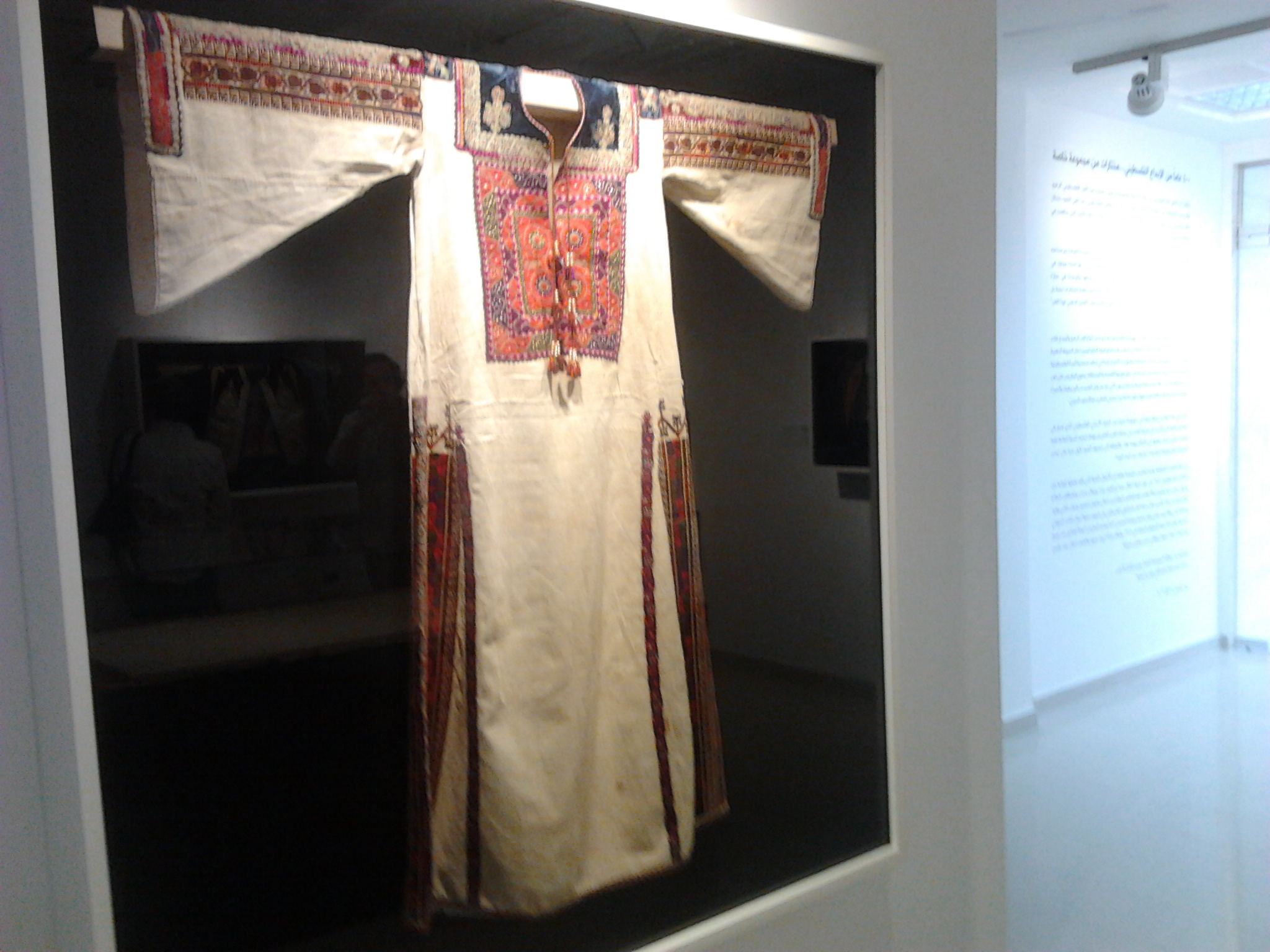
Traditional Palestinian Dress

“This exhibition is an attempt to present a new perspective on Palestinian fine art.” writes George Michel Al Ama

BOP - Exhibition

The exhibition presents:

  • Some of the items dating as far to 17th century
  • Beautiful carvings in the mother of pearl and wood made not only as souvenirs but also gifts for kings and presidents.
  • Glass and ceramic art, e.g. Palestinian Armenian Pottery
  • One of the extinct arts of Palestine: Dead Sea stone carving.
  • Art of embroidery of Palestinian traditional costumes – the essential component of Palestinian identity and culture.
  • Fine Art in painting and more of distinctive artists like…

View original post 82 more words

Travel to and explore Palestine’s cultural landscape: Summer academy in Ramallah

Posted on 25 March 2013

European Union National Institute of Culture

3 weeks in Ramallah, live, work and join our visual journey! Summeracademy Ramallah is inviting participants from all walks of life and all corners of the world to meet and mix with Palestinian participants! We will explore the cultural landscape of the region and facilitate the contact within all aspects of Palestinian life, society and close neighborhood. We want to discover unseen images and collect unheard stories that will give a fresh impression of contemporary life in Palestine. Date: 13 August – 3 September.

Our participants will be encouraged to follow their own vision as well as working in groups. By using the full range and capacity of audio-visual and time-based media we will elaborate each work piece to its full potential. The participants will have the opportunity to present their artistic results in the final exhibition.

Of course, we will have a rich social life too. Every season new cafés are popping up all over the place where you can have a shisha while taking snacks. Visit stylish restaurants and colorful  barbecues which are open until 4 in the morning. Ramallah´s nightlife offers an interesting cultural program of free concerts of Arab, Classical or Rock music in public spaces. You can listen to lectures in lush gardens under fig trees, watch Art House Films at Al Kasaba, dip into the world of the Hip and the Beautiful at Bar Beit Al Aneesa, listen to famous Khalas Rock band or Arab singer-songwriters and a lot more to explore and have fun.

We look forward to make excursions to Bir Zeit, and if possible, to Jerusalem and Nablus to visit galleries, artistic projects and theater projects, Slow Food initiatives etc.

If you have personal questions, please let us know: office@summeracademyramallah.org!

To apply for the workshop please go to Application in the menu bar or click here.

Excursions to several cultural organizations in the region, e.g.:
Al Qattan Foundation,  Al Sakakini Cultural Center,  Al Kasaba CinemaBir Zeit MuseumArt School RamallahMahatta Art GalleryAl Ma´amal Art GalleryAl Hoash, Al Riwaq Architectural CenterDanish House in PalestineThis Week In Palestine(Monthly Cultural Magazine)

Nabila Irshaid offers her expertise in art in public space, participative art, art as a process and audio – visual concepts. She can provide her knowledge about the cultural landscape of Ramallah and its surroundings and has some knowledge about local life.

Tobias Hammerle will be the second instructor during the workshop and will share his many technical skills and experience in teaching all over the world.

More information about the Instructors 2013 you’ll find here.

This article originally appeared here